
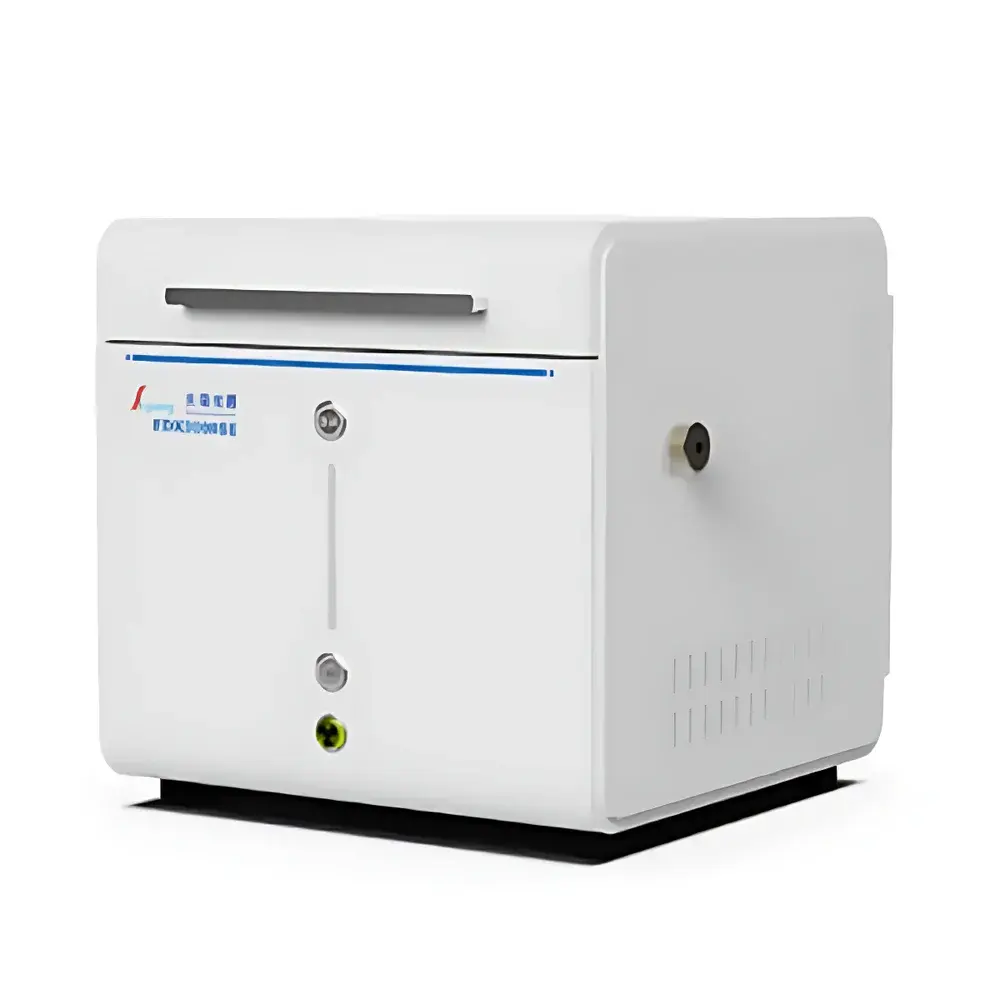
Skyray Instrument EDX3000SE Energy Dispersive X-Ray Fluorescence Spectrometer
| Brand | Skyray Instrument |
|---|---|
| Origin | Jiangsu, China |
| Manufacturer Type | Original Equipment Manufacturer (OEM) |
| Product Type | Benchtop/Free-standing |
| Model | EDX 3000SE |
| Detector | Si-PIN |
| Compliance | GB/T 18043–2013 |
| Optical Path | Vertical Beam Geometry with Micro-Collimated Excitation |
| Sample Chamber | Large-volume cavity |
| Software Algorithm | Fundamental Parameters (FP) Quantification |
| Imaging | Integrated High-Resolution CCD Camera |
Overview
The Skyray Instrument EDX3000SE is a benchtop-to-floor-standing energy dispersive X-ray fluorescence (EDXRF) spectrometer engineered for precise, non-destructive elemental analysis of precious metal alloys. Operating on the physical principle of X-ray fluorescence—where primary X-rays excite atoms in a sample, inducing emission of characteristic secondary X-rays—the EDX3000SE delivers quantitative compositional data based on energy discrimination of emitted photons. Its vertical-beam optical architecture, combined with micro-collimated excitation optics, minimizes geometric scattering and enhances spatial resolution at the measurement spot—critical for detecting trace-level adulterants such as rhenium (Re) and tungsten (W) in gold bullion or jewelry, where even sub-0.1 wt% contamination compromises material integrity and regulatory compliance. Designed to meet the technical specifications outlined in GB/T 18043–2013 (“Jewellery—Determination of gold content—X-ray fluorescence spectrometry”), the system supports routine quality control in refineries, assay offices, customs laboratories, and precious metal trading entities requiring ISO/IEC 17025-aligned analytical workflows.
Key Features
- Si-PIN semiconductor detector with Peltier cooling: Delivers high spectral resolution (FWHM ≤ 145 eV at Mn Kα), enabling reliable separation of adjacent emission lines (e.g., Pt Lα vs. Au Lα, Pd Kα vs. Ag Kα).
- Vertical beam geometry with adjustable micro-collimation (φ0.3 mm to φ2.0 mm): Optimizes signal-to-background ratio for heterogeneous or plated samples; reduces matrix effects in layered structures.
- Large-volume sample chamber (≥ 300 × 300 × 120 mm W×D×H): Accommodates irregularly shaped jewelry, ingots, coins, and scrap fragments without repositioning or cutting.
- Integrated high-resolution CCD camera (≥ 5 MP): Captures real-time optical images aligned with the analysis spot; auto-embeds annotated images into PDF test reports for traceability and audit readiness.
- Fundamental Parameters (FP)-based quantification engine: Eliminates need for matrix-matched calibration standards; supports automatic correction for absorption, enhancement, and inter-element effects across Au-Ag-Pt-Pd-Cu-Zn-Ni-Re-W systems.
- One-touch operation workflow: From sample placement to final report generation—including peak identification, background subtraction, and concentration calculation—completed within <90 seconds per measurement.
Sample Compatibility & Compliance
The EDX3000SE accepts solid, homogeneous, or multi-phase metallic samples up to 5 kg in mass and 150 mm in height. It is validated for use with karat gold (9K–24K), platinum group alloys (Pt–Ir, Pt–Rh), palladium-based white gold substitutes, and base-metal-plated articles. All measurement protocols adhere to GB/T 18043–2013 requirements for detection limit (≤0.05 wt% for Re/W in Au), repeatability (RSD ≤1.5% for Au at 99.99%), and linearity (r² ≥0.999 over 30–99.99 wt% range). The instrument’s firmware and reporting module support GLP-compliant data handling, including electronic signatures, audit trails, and report versioning—fully compatible with laboratory information management systems (LIMS) via standard XML export.
Software & Data Management
The proprietary SkyAnalysis™ software provides a validated, password-protected interface compliant with FDA 21 CFR Part 11 Annex 11 principles. It features role-based user access control, encrypted database storage, and time-stamped raw spectrum archiving. Quantitative results are traceable to NIST-traceable reference materials (e.g., NIST SRM 58c, 114a, 128a). Reports include full spectral overlays, uncertainty estimation per element (k=2), and conformance flags against preset specification limits (e.g., “Au ≥ 99.95% pass/fail”). Data export formats include CSV, PDF/A-2, and ASTM E1359-compliant XML.
Applications
- Refinery incoming/outgoing assay of doré bars and recycled scrap
- Regulatory verification of hallmarking compliance in retail jewelry
- Forensic detection of tungsten-filled gold bars or rhenium-doped counterfeit coins
- QC screening of electroplated watch cases, rings, and connectors
- Research-grade composition mapping of ternary and quaternary PGM alloys
- Customs border inspection for rapid classification under HS codes 7113.11–7113.19
FAQ
Does the EDX3000SE require vacuum or helium purge for light element analysis?
No. The system operates in air atmosphere and is optimized for elements from sodium (Na, Z=11) upward; light elements below Na are not within its specified analytical range.
Can it quantify plating thickness on base metals?
Yes—when used with FP-based thin-film mode and certified multilayer reference standards (e.g., Au/Ni/Cu/Brass), it achieves ±5% accuracy for Au layers ≥0.1 µm thick.
Is method validation documentation provided?
Yes. A complete IQ/OQ/PQ protocol package, including GB/T 18043–2013 verification reports and uncertainty budgets, is supplied with each unit.
What maintenance is required for the Si-PIN detector?
The Peltier-cooled detector requires no liquid nitrogen or periodic gas refills; annual performance verification using Mn Kα check sources is recommended.
Is remote diagnostics supported?
Yes—via secure TLS-encrypted VNC tunnel with prior customer authorization; all remote sessions are logged and auditable.




