
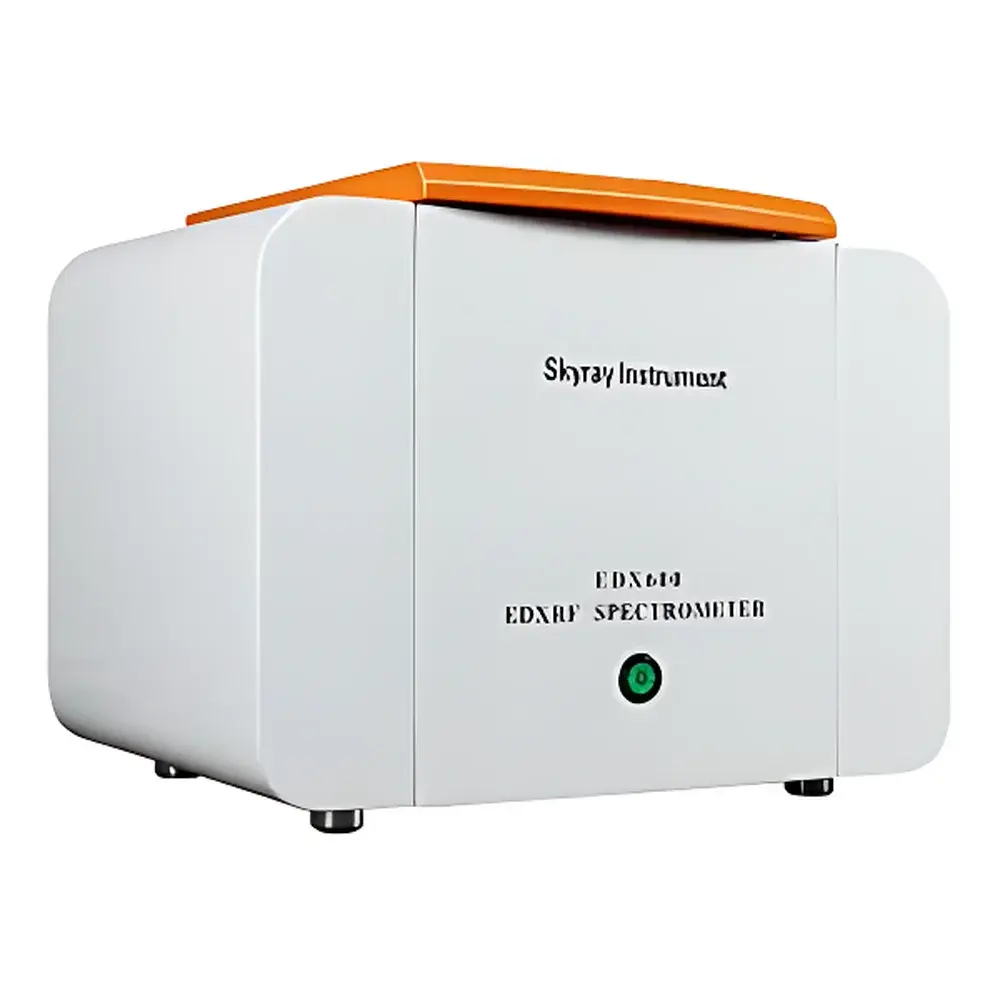
Skyray Instrument EDX600 Energy Dispersive X-Ray Fluorescence Spectrometer
| Brand | Skyray Instrument |
|---|---|
| Origin | Jiangsu, China |
| Manufacturer Type | Direct Manufacturer |
| Product Category | Domestic |
| Model | EDX600 |
| Configuration | Benchtop/Floor-standing |
| Application Scope | General-purpose |
| Energy Resolution | 125 eV |
| Detector | FAST-SDD |
| Excitation Source | X-ray Tube |
| Sample Chamber | Single-sample cavity |
| Electronics | Integrated signal detection circuitry |
| Power Supply | High-voltage and low-voltage dual-mode power supply |
| Software | Multi-model quantitative analysis suite with independent matrix correction algorithms and multivariate nonlinear recovery routines |
Overview
The Skyray Instrument EDX600 Energy Dispersive X-Ray Fluorescence (EDXRF) Spectrometer is a benchtop-to-floor-standing analytical platform engineered for precise, non-destructive elemental composition analysis across a broad range of solid and powdered samples. Based on the fundamental principle of X-ray fluorescence—where primary X-rays from a tube source excite inner-shell electrons in sample atoms, resulting in characteristic secondary (fluorescent) X-ray emission—the EDX600 quantifies elemental concentrations by measuring the energy and intensity distribution of emitted photons using an energy-dispersive detection system. Its core architecture integrates a high-stability X-ray tube, a single-sample cavity optimized for consistent beam geometry and minimal scatter, and a FAST-SDD (Silicon Drift Detector) offering 125 eV energy resolution at Mn Kα, enabling reliable separation of adjacent peaks in complex spectra (e.g., Cr–Fe–Mn or Pb–Sb–Sn). Designed specifically for routine quality control and regulatory screening in precious metal refining, jewelry manufacturing, electronics recycling, and geological surveying, the EDX600 delivers reproducible results without requiring vacuum or helium purge—making it operationally robust in standard laboratory environments.
Key Features
- FAST-SDD detector with 125 eV energy resolution at Mn Kα (5.89 keV), ensuring high spectral fidelity for overlapping elemental lines
- Optimized X-ray tube excitation system with selectable kV/mA settings to balance sensitivity and beam stability for light- to heavy-element analysis (Na to U)
- Single-sample cavity design minimizing geometric variability and enhancing measurement repeatability across batch testing
- Dual-mode power supply supporting both high-voltage tube operation and low-noise signal conditioning electronics
- Integrated signal detection circuitry featuring pulse processing with digital pile-up rejection and real-time dead-time correction
- Modular software architecture supporting user-defined calibration curves, multi-layer film analysis, and thickness quantification for coated substrates
Sample Compatibility & Compliance
The EDX600 accommodates flat, homogeneous solids (e.g., bullion bars, alloy coupons, PCB fragments), pressed pellets, and fused beads—within dimensional limits defined by its fixed sample chamber. It complies with IEC 61000-4 electromagnetic compatibility standards and meets Class I laser product safety requirements per IEC 60825-1 for enclosed X-ray sources. While not certified to ISO/IEC 17025 as a standalone testing facility, its hardware and firmware support GLP-compliant workflows: audit trails for method changes, user access levels, electronic signatures, and raw spectrum archiving are embedded in the analysis software. The instrument supports traceable calibration via NIST-traceable reference materials (e.g., SRM 2782, 2783, 2784), and its quantitative engine implements matrix-matched standardization and fundamental parameter (FP)-based corrections aligned with ASTM E1621 and ISO 21043 guidelines.
Software & Data Management
The EDX600 operates with Skyray’s proprietary EDX Analysis Suite—a Windows-based application built for scientific integrity and workflow efficiency. It provides independent, user-selectable analytical models: empirical calibration for routine alloys, FP modeling for unknown matrices, and iterative non-linear recovery algorithms for heterogeneous or layered samples. Each model maintains its own matrix-effect correction framework, allowing simultaneous optimization for different sample types without cross-contamination of parameters. All spectra are stored in vendor-neutral .spc format with embedded metadata (acquisition time, tube settings, detector live time, environmental temperature). The software supports CSV export of quantitative reports—including uncertainty estimates derived from counting statistics—and integrates with LIMS via ODBC-compliant database drivers. Full 21 CFR Part 11 compliance is achievable through optional configuration: role-based login, electronic signature enforcement, and immutable audit logs for all data modifications.
Applications
- Precious metal assay in jewelry and refinery QA/QC labs—rapid Au, Ag, Pt, Pd, Rh quantification in alloys up to 99.99% purity
- RoHS and ELV compliance screening—detection of restricted elements (Pb, Cd, Hg, Cr⁶⁺, Br, Cl) in polymers, coatings, and electronic components
- Geochemical exploration—semi-quantitative analysis of major and trace elements (Si to U) in soil, sediment, and rock powders
- Recycling stream characterization—sorting and grade verification of scrap metals, e-waste fractions, and catalytic converters
- Coating thickness and composition analysis—multi-layer evaluation of Ni/Cu/Sn plating on PCBs or Zn–Al alloys on steel substrates
FAQ
Does the EDX600 require liquid nitrogen cooling?
No. The FAST-SDD detector uses thermoelectric (Peltier) cooling, eliminating dependency on cryogens and enabling continuous unattended operation.
Can it analyze light elements below sodium (Na)?
The standard configuration is optimized for Na (Z=11) and heavier elements. Light element analysis (e.g., C, N, O, F) requires optional beryllium window modification and vacuum/purge capability—not supported on the base EDX600 model.
Is method transfer possible between different EDX600 units?
Yes. Calibration models, including matrix correction coefficients and FP parameters, are fully portable via encrypted .cal files and retain traceability when deployed across identical hardware configurations.
What maintenance is required for long-term stability?
Annual verification using certified reference materials is recommended. The X-ray tube has a typical service life exceeding 15,000 hours; detector performance is monitored automatically via daily energy calibration checks.
Does the software support custom report templates?
Yes. Users can define field-specific report layouts (PDF/Excel) with configurable pass/fail thresholds, logo insertion, and automated email dispatch via SMTP integration.





