
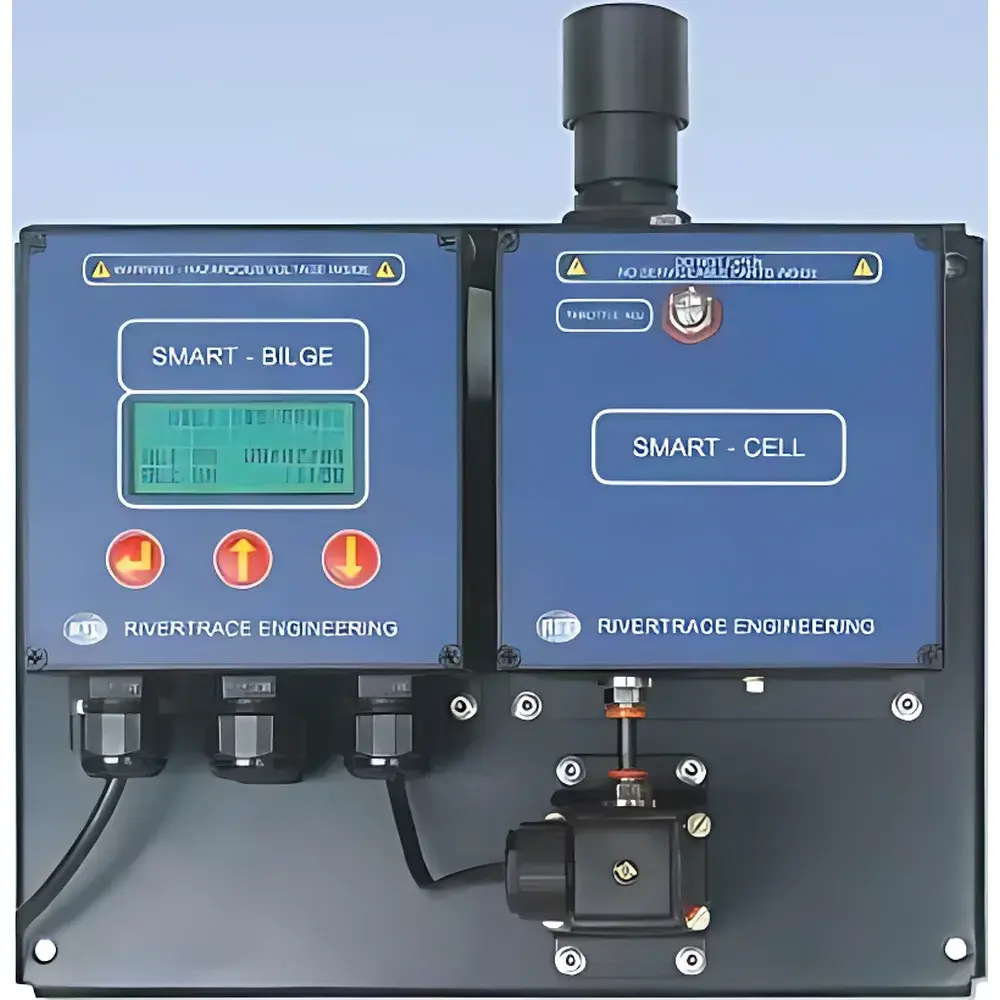
Smart Oil Tanker Oily Water Discharge Monitor
| Origin | UK |
|---|---|
| Manufacturer Type | Authorized Distributor |
| Origin Category | Imported |
| Model | Smart |
| Pricing | Available Upon Request |
Overview
The Smart Oil Tanker Oily Water Discharge Monitor is a marine-grade, type-approved online monitoring system engineered for continuous, real-time measurement and recording of oil-in-water concentration in ballast and bilge discharge streams from oil tankers. Designed in strict compliance with IMO MEPC.108(49) — the International Maritime Organization’s standard for oily water separation and monitoring systems — this instrument ensures regulatory adherence for vessels whose keels were laid or which reached an equivalent stage of construction on or after 1 January 2005. It operates on the principle of optical absorption spectroscopy optimized for hydrocarbon detection across a broad spectral response range, enabling reliable quantification of total petroleum hydrocarbons (TPH), including aromatic and aliphatic fractions, irrespective of oil type (e.g., crude, fuel oil, lubricants). The system integrates seamlessly into existing oily water separator (OWS) discharge lines and provides fail-safe verification of effluent quality prior to overboard release.
Key Features
- Full-spectrum oil detection capability covering all common marine oil types — crude oil, bunker fuel, diesel, and lubricating oils — without recalibration.
- Measurement range of 0–1000 ppm oil-in-water with a stated accuracy of ±1 ppm at low concentrations (≤15 ppm), meeting MEPC.108(49) repeatability and linearity requirements.
- Automated clean-water zero calibration routine executed at user-defined intervals or triggered by flow/pressure anomalies, minimizing manual intervention and drift-related errors.
- Robust industrial enclosure rated IP66 for marine deck or engine room installation, with operating ambient temperature tolerance from –10 °C to +50 °C.
- Dual power supply architecture: 230 V AC, 50 Hz for the analyzer unit; 380 V AC, 50 Hz, three-phase for integrated sample pump motor — ensuring compatibility with global vessel electrical systems.
- Sample handling optimized for turbulent-flow conditions: supports inlet flow rates of 0.5–4.0 L/min and pressure ranges of 0.1–10 bar, accommodating variable OWS backpressure scenarios.
Sample Compatibility & Compliance
The Smart Monitor is validated for use with seawater, brackish water, and freshwater matrices containing suspended solids, emulsified oil, and trace dispersants — typical of post-OWS discharge effluents. Its optical path design mitigates fouling via self-cleaning flow dynamics and optional ultrasonic transducer integration (available as field-upgrade). Regulatory conformance includes full alignment with MEPC.108(49) Annex 1 test protocols for precision, recovery, interference rejection, and alarm functionality. System documentation supports classification society audits (LR, DNV, ABS, BV) and satisfies flag-state implementation of MARPOL Annex I Regulation 14. No third-party certification is required beyond initial type approval — all internal diagnostics, calibration logs, and alarm events are timestamped and immutable per IMO guidelines.
Software & Data Management
Data acquisition and archival are handled via an embedded microcontroller with non-volatile memory for real-time parameter logging (oil concentration, flow rate, temperature, pressure, calibration status). Internal microSD card storage retains ≥12 months of high-resolution discharge records (1-minute sampling interval default), exportable via USB 2.0 or RS232 serial interface in CSV or XML format. Firmware supports remote firmware updates and configuration backup/restore. Audit-trail functionality meets GLP-aligned data integrity expectations: all operator actions (e.g., manual calibration, alarm acknowledge) are logged with user ID, timestamp, and action context. Optional PC-based software (SmartView Suite) enables graphical trend analysis, report generation compliant with Port State Control (PSC) inspection templates, and automated email alerts upon threshold exceedance.
Applications
- Continuous discharge monitoring on crude oil and product tankers during ballast water exchange operations.
- Real-time verification of oily water separator performance during port state inspections and flag administration surveys.
- Permanent installation in shipboard monitoring rooms or portable deployment for pre-departure compliance verification at terminals and repair yards.
- Integration with vessel integrated monitoring systems (IMS) and electronic logbook platforms via Modbus RTU or optional analog 4–20 mA output (add-on module).
- Support for environmental due diligence programs under ISO 14001 and corporate sustainability reporting frameworks requiring verifiable discharge data.
FAQ
Does the Smart Monitor require periodic re-certification by a classification society?
No — once installed and commissioned per MEPC.108(49) Annex 2, only annual functional testing and calibration verification by shipboard personnel or authorized service agents are required. Full re-certification is only necessary after major hardware modification or replacement.
Can it detect emulsified oil effectively?
Yes — its broadband optical detection method responds to both free and stable oil-in-water emulsions, provided droplet size distribution falls within the measurable range (typically >0.5 µm). Performance is verified per MEPC.108(49) Emulsion Test Protocol using ISO 8769 reference emulsions.
Is the internal memory battery-backed to prevent data loss during power interruption?
Yes — the microcontroller’s SRAM and flash memory retain all critical logs and configurations during mains failure. The system resumes operation and logging automatically upon power restoration without data gap.
What maintenance intervals are recommended?
Optical cell cleaning every 3 months (or per voyage cycle in high-fouling environments); full system calibration check every 6 months; annual verification of pressure/flow sensors against NIST-traceable references.







