
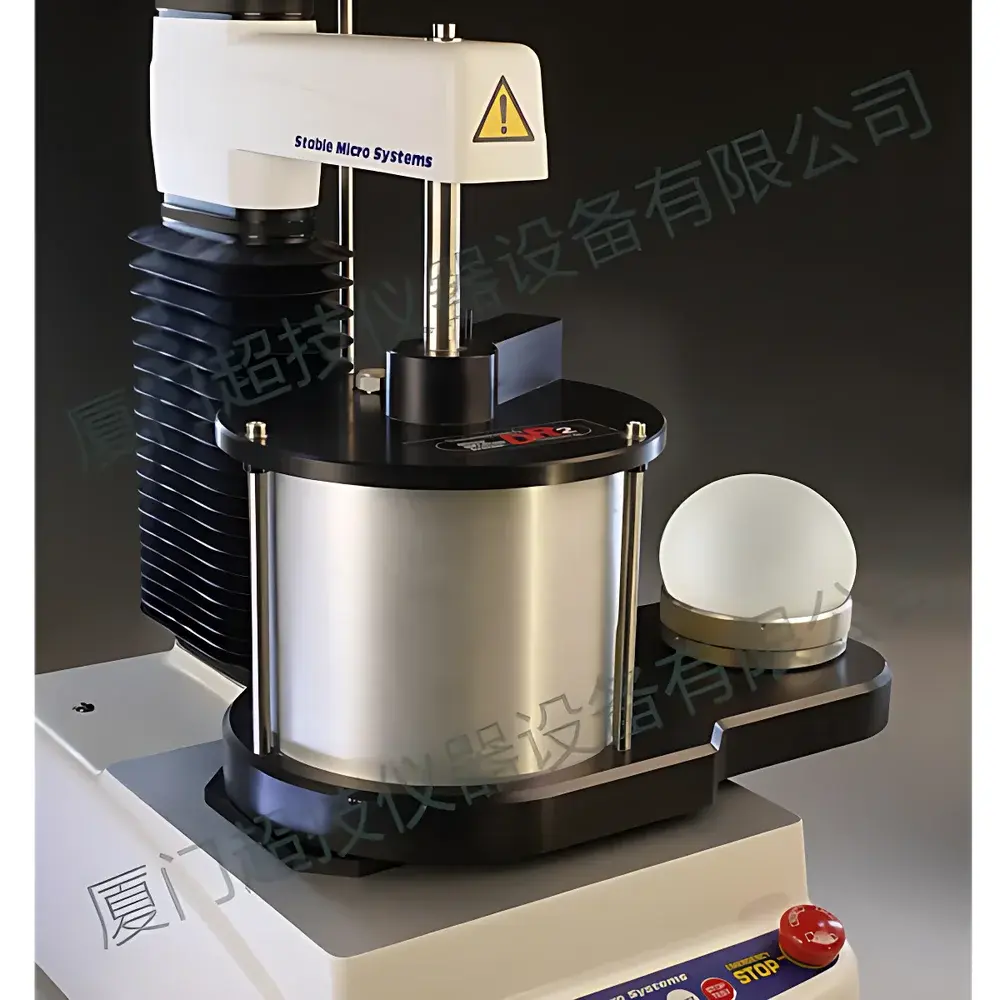
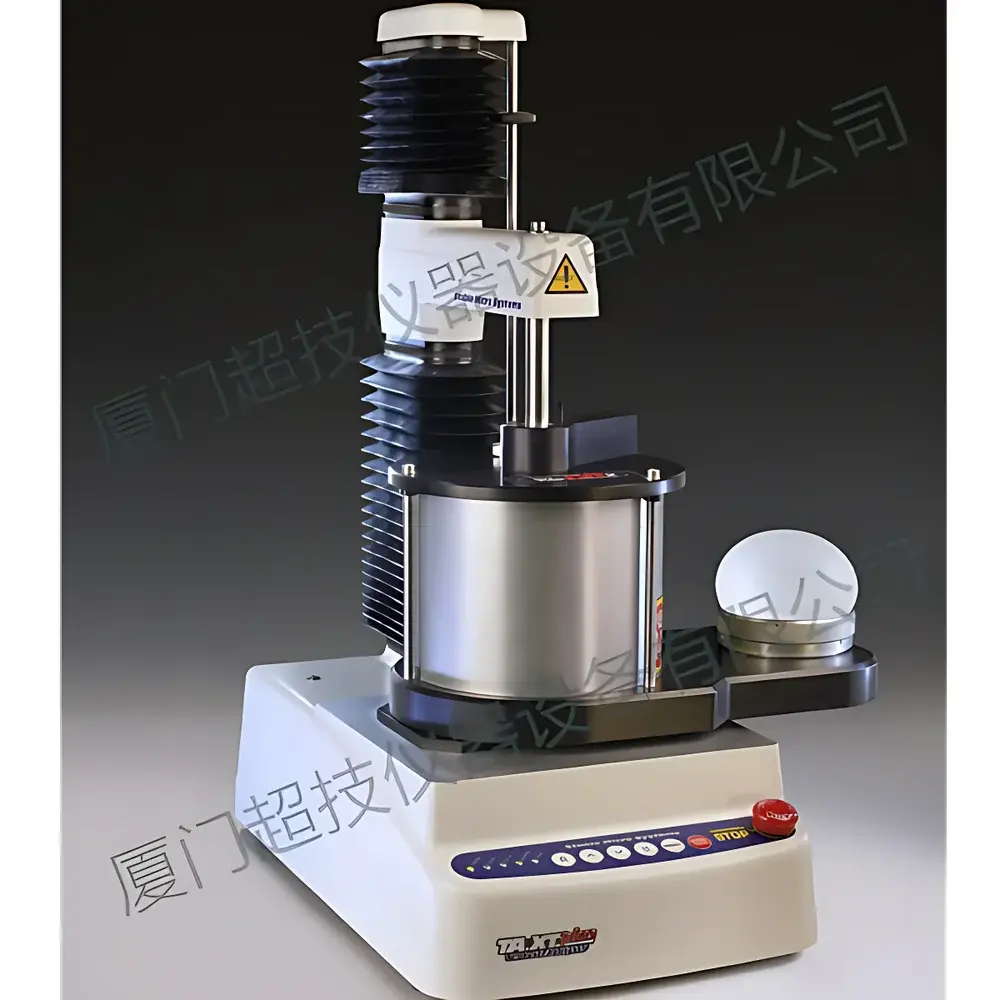
SMS DR/DIS Bubble Volume Tester for Dough Rheology
| Brand | SMS |
|---|---|
| Origin | United Kingdom |
| Model | DR/DIS |
| Application | Dough bubble expansion rheometry |
| Measurement Principle | Piston-driven volumetric inflation with real-time pressure–volume–time profiling |
| Compliance | Designed for ASTM AACC 54-30A, ISO 21502, and GLP-aligned bakery R&D workflows |
| Software | Windows-native data acquisition & analysis suite with macro scripting, spreadsheet-integrated calculations, and export-ready charting |
Overview
The SMS DR/DIS Bubble Volume Tester is a precision-engineered instrument for quantitative rheological characterization of wheat-based dough systems under controlled inflation conditions. It implements the fundamental principle of bubble expansion rheometry—where a standardized dough sample is pneumatically inflated by a motorized piston within a sealed chamber, simulating the gas expansion phase during proofing and oven spring. Unlike empirical tactile assessment, the DR/DIS captures objective, time-resolved mechanical responses: internal pressure (kPa), volumetric displacement (mL), and piston position (mm) are continuously logged at high temporal resolution. From these primary signals, critical dough parameters—including resistance to extension (P, in kPa), extensibility (L, in mm), and the energy required for deformation (W, in kPa·mm)—are derived using standardized algorithms aligned with AACC Method 54-30A and ISO 21502. The system’s mechanical architecture ensures minimal hysteresis and repeatable seal integrity across thousands of test cycles, making it suitable for both routine QC environments and high-throughput breeding trials.
Key Features
- Piston-driven inflation mechanism with closed-loop position control and calibrated force feedback, enabling precise replication of rising kinetics observed in commercial proofing ovens.
- Integrated pressure transducer (0–100 kPa range, ±0.5% FS accuracy) and linear displacement sensor (0–150 mm, 0.01 mm resolution) synchronized at 100 Hz sampling rate.
- Thermostatically stabilized test chamber (ambient to 40 °C, ±0.3 °C stability) to maintain consistent dough temperature during inflation—critical for reproducible gluten network behavior.
- Modular sample holder design accommodating standard 50 g dough pieces; rapid tool-free exchange supports high-throughput screening of flour variants or additive formulations.
- Robust aluminum alloy frame with IP54-rated electronics enclosure, engineered for continuous operation in industrial laboratory settings.
Sample Compatibility & Compliance
The DR/DIS is validated for use with leavened doughs prepared from wheat, spelt, rye, and composite flours meeting standard hydration protocols (e.g., 60–65% absorption per AACC 54-10). It accommodates doughs with varying gluten strength—from weak pastry flours (W 300)—without recalibration. All hardware and firmware comply with CE marking requirements and electromagnetic compatibility (EMC) Directive 2014/30/EU. Data handling workflows support audit trails, user access levels, and electronic signature functionality—enabling alignment with FDA 21 CFR Part 11 and EU Annex 11 expectations where required for regulated product development. Test reports include full metadata: operator ID, ambient humidity/temperature, dough batch ID, and calibration certificate traceability.
Software & Data Management
The DR/DIS operates exclusively with TexturePro CT v4.x software—a Windows 10/11 native application built on .NET Framework with embedded VBA macro engine and Excel-compatible spreadsheet interface. During testing, the software displays real-time overlay plots of pressure vs. volume, pressure vs. time, and L–P trajectory curves. Raw data (.csv) and processed parameters (P, L, W, P/L ratio, elasticity index) are automatically saved with timestamped filenames and optional network folder synchronization. Built-in macros automate repetitive tasks: batch normalization against reference flour, outlier detection via IQR filtering, and generation of comparative summary tables across multiple samples. Charts export natively to EMF, PNG, or PDF formats and retain vector fidelity for publication-grade documentation. All analytical functions—including derivative-based peak detection for rupture onset and integral computation of W—are transparently documented in the software’s validation report.
Applications
- Flour mill quality assurance: Routine monitoring of incoming wheat lots and finished flour batches for consistency in baking performance.
- Cereal breeding programs: High-volume phenotyping of advanced lines for dough strength, extensibility, and oven-spring potential under standardized hydration and fermentation protocols.
- Ingredient innovation: Evaluation of enzyme treatments (e.g., glucose oxidase, transglutaminase), vital wheat gluten supplementation, or clean-label improvers on dough gas retention capacity.
- Regulatory documentation: Generation of compliant test records supporting claims related to “high-protein”, “strong gluten”, or “improved loaf volume” in product labeling and technical dossiers.
- Academic research: Mechanistic studies linking gluten polymer architecture (via SEC-MALS or FTIR correlation) to macroscopic inflation behavior quantified by DR/DIS metrics.
FAQ
What standards does the DR/DIS comply with for dough testing?
It adheres to AACC International Method 54-30A (“Bubble Test for Wheat Flour”) and ISO 21502:2020 (“Cereals and cereal products — Determination of dough rheological properties using the bubble test”).
Can the DR/DIS be integrated into an existing LIMS or ERP system?
Yes—via configurable ODBC drivers and structured CSV/XML export templates, enabling automated ingestion into laboratory information management systems (LIMS) or enterprise resource planning (ERP) platforms.
Is operator training required before first use?
Basic operation requires ≤2 hours of supervised instruction; advanced macro programming and statistical reporting modules are covered in optional 1-day certified training workshops offered by SMS-authorized service partners.
How often must the pressure transducer be recalibrated?
Annual factory recalibration is recommended; field verification using NIST-traceable deadweight tester kits can be performed quarterly per internal QA protocols.
Does the system support unattended overnight testing?
Yes—the instrument includes automatic shutdown after final test completion and error-triggered pause/resume logic for multi-sample sequences scheduled via the software scheduler.




