
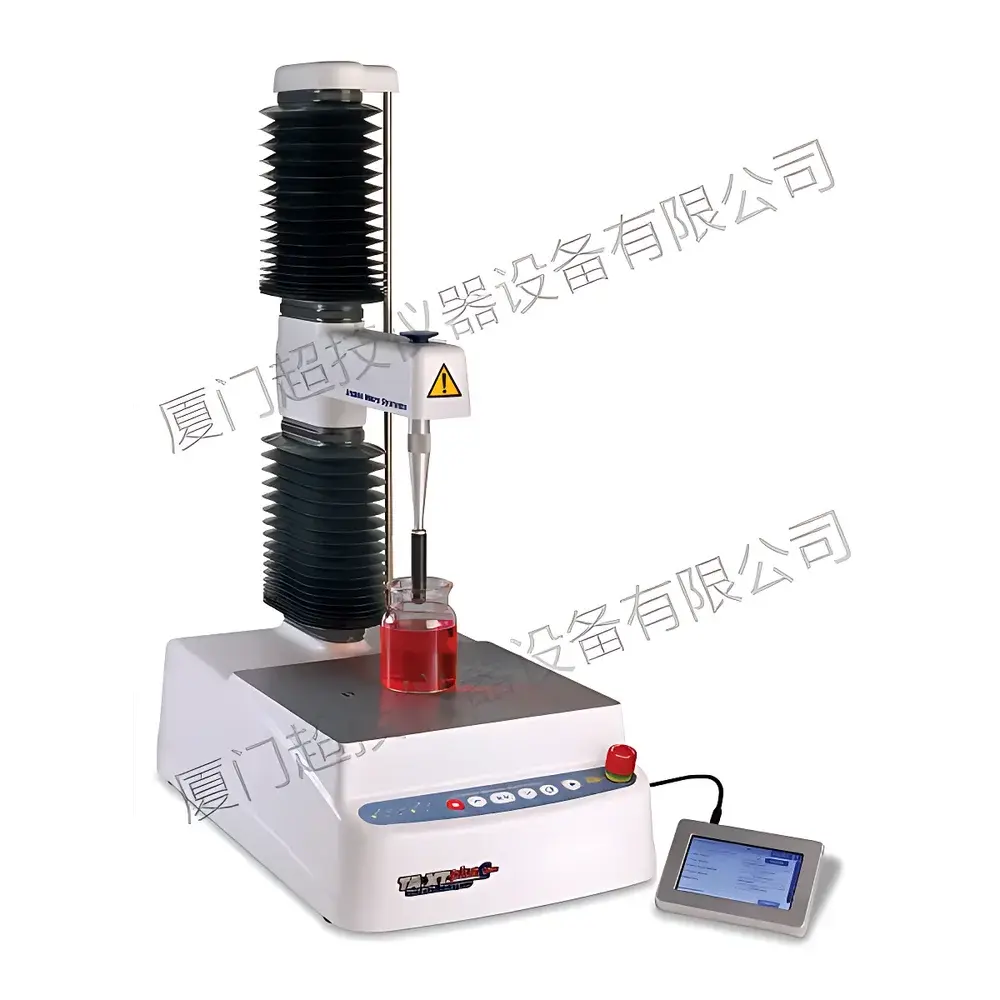
SMS TA.XT Plus Multi-Extrusion Texture Analyzer for Pasta, Meat, and Semi-Solid Food Systems
| Brand | SMS |
|---|---|
| Origin | United Kingdom |
| Model | Multi-Extrusion Cell Configuration |
| Force Range | 0.5–50 kgf |
| Force Resolution | 0.1 g |
| Test Speed | 0.01–40 mm/s |
| Travel Distance | 0.001–370 mm |
| Position Resolution | 0.001 mm |
| Data Acquisition Rate | >2000 samples/sec (4 channels simultaneously) |
Overview
The SMS TA.XT Plus Multi-Extrusion Texture Analyzer is a high-precision, motorized mechanical testing system engineered for objective quantification of structural breakdown in semi-solid and solid food matrices under controlled compression, extrusion, and cyclic deformation. It operates on the principle of controlled-force or controlled-distance uniaxial deformation, capturing real-time force–distance–time profiles during mechanical perturbation. Unlike conventional single-bite texture profiling, this configuration integrates the proprietary Multi-Extrusion Cell—a cylindrical chamber with adjustable piston geometry and integrated artificial saliva delivery—to simulate sequential masticatory cycles. The system replicates physiological shear-compression dynamics observed during oral processing, enabling measurement of breakdown kinetics including initial yield stress, fracture energy, rate of structural disintegration, and cumulative work to swallowable consistency. Designed specifically for R&D, QC, and sensory correlation studies in pasta, processed meats, cheeses, plant-based analogs, and other viscoelastic food systems, it delivers repeatable, instrument-based correlates to human mastication behavior—critical for product reformulation, shelf-life assessment, and regulatory documentation.
Key Features
- Multi-Extrusion Cell module with programmable piston stroke sequencing and synchronized artificial saliva infusion for physiologically relevant mastication simulation
- High-resolution load cell with 0.1 g force resolution and dual-range calibration (0.5–50 kgf), compliant with ISO 11357-3 and ASTM F3080 for food mechanical testing
- Variable-speed actuator delivering precise displacement control from 0.01 to 40 mm/s, with sub-micron positioning accuracy (0.001 mm)
- Real-time data acquisition at >2000 Hz across four synchronized analog input channels—supporting simultaneous force, distance, temperature, and optional pH or conductivity monitoring
- Barcode-triggered test execution: scan pre-assigned protocol barcodes via USB-connected imager to auto-load method parameters, eliminating manual selection errors and reducing operator training time
- Remote operation capability via secure web-based interface compatible with iOS and Android tablets—enabling live monitoring, parameter adjustment, and post-run email dispatch of raw data (.txt) and analysis reports (.pdf)
Sample Compatibility & Compliance
The system accommodates standardized sample geometries per ISO 11357-3 Annex B and USP , including cylindrical pasta segments (spaghetti, fusilli, macaroni), cuboidal meat loaves (10 × 10 × 10 mm), sliced cheese blocks, and molded plant-protein patties. All fixtures—including the Multi-Extrusion Cell—are constructed from FDA-compliant 316 stainless steel and undergo passivation per ASTM A967. Data integrity meets ALCOA+ principles; audit trails, electronic signatures, and 21 CFR Part 11–compliant user access controls are embedded within the Texture Exponent software platform. Instrument validation documentation (IQ/OQ/PQ templates) and GMP/GLP-ready SOPs are provided as standard deliverables.
Software & Data Management
Texture Exponent v4.2 provides full method scripting capability using drag-and-drop logic blocks—supporting multi-stage extrusion, hold-relax, and cyclic loading protocols without coding. Built-in algorithms compute Breakdown Index (BI), Masticatory Work (MW), Fracture Onset Strain (FOS), and Rate of Structural Disintegration (RSD) directly from force–distance curves. Over 400 peer-reviewed methodology references—including Journal of Texture Studies, Food Hydrocolloids, and Meat Science publications—are indexed and searchable within the software library. All datasets are stored in vendor-neutral HDF5 format with embedded metadata (operator ID, timestamp, environmental conditions, calibration certificate ID). Export options include CSV, Excel, and XML for LIMS integration.
Applications
- Quantifying textural evolution during repeated extrusion of fresh/frozen pasta to predict cooking stability and mouthfeel consistency
- Evaluating myofibrillar protein denaturation in cured meats under simulated chewing stress—correlating with Warner-Bratzler shear values and consumer chewiness scores
- Assessing melt-down behavior of semi-hard cheeses (e.g., Cheddar, Gouda) under thermal–mechanical coupling (optional heated cell accessory)
- Validating texture retention in plant-based meat analogs after freeze-thaw cycling and extended refrigerated storage
- Supporting FDA GRAS dossiers and EFSA health claim submissions where mechanical breakdown is linked to nutrient release kinetics (e.g., iron bioaccessibility in fortified cereals)
FAQ
What standards does the Multi-Extrusion Cell protocol align with?
It conforms to ISO 11357-3:2019 (Plastics – Differential scanning calorimetry – Part 3: Determination of crystallinity), ASTM F3080-18 (Standard Guide for Sensory Evaluation of Food Texture), and internal SMS Method Reference MR-TA-EX01.
Can the system be validated for regulated environments?
Yes—full IQ/OQ/PQ documentation packages, 21 CFR Part 11 compliance modules, and traceable NIST-traceable calibration certificates are included.
Is artificial saliva composition customizable?
Yes—the fluid delivery subsystem supports user-defined rheological profiles and enzymatic formulations (e.g., α-amylase concentration gradients) via programmable syringe pump integration.
How is data security managed during remote operation?
All remote sessions use TLS 1.3 encryption; no data is stored on mobile devices—raw files reside exclusively on the instrument’s local SSD or designated network share.
Does the software support automated report generation for QA release?
Yes—customizable PDF reports with embedded statistical process control charts (X̄/R, Cpk), pass/fail thresholds, and digital signature fields can be scheduled for automatic generation upon test completion.






