
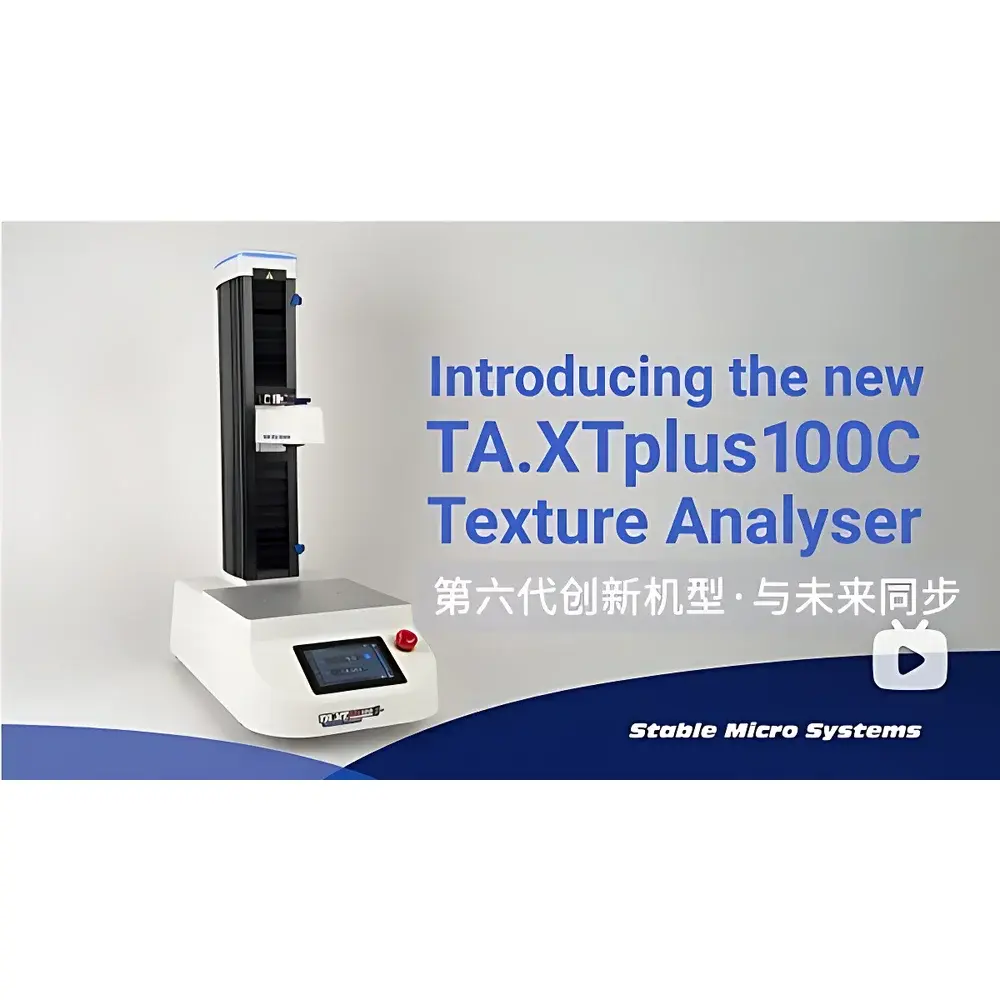
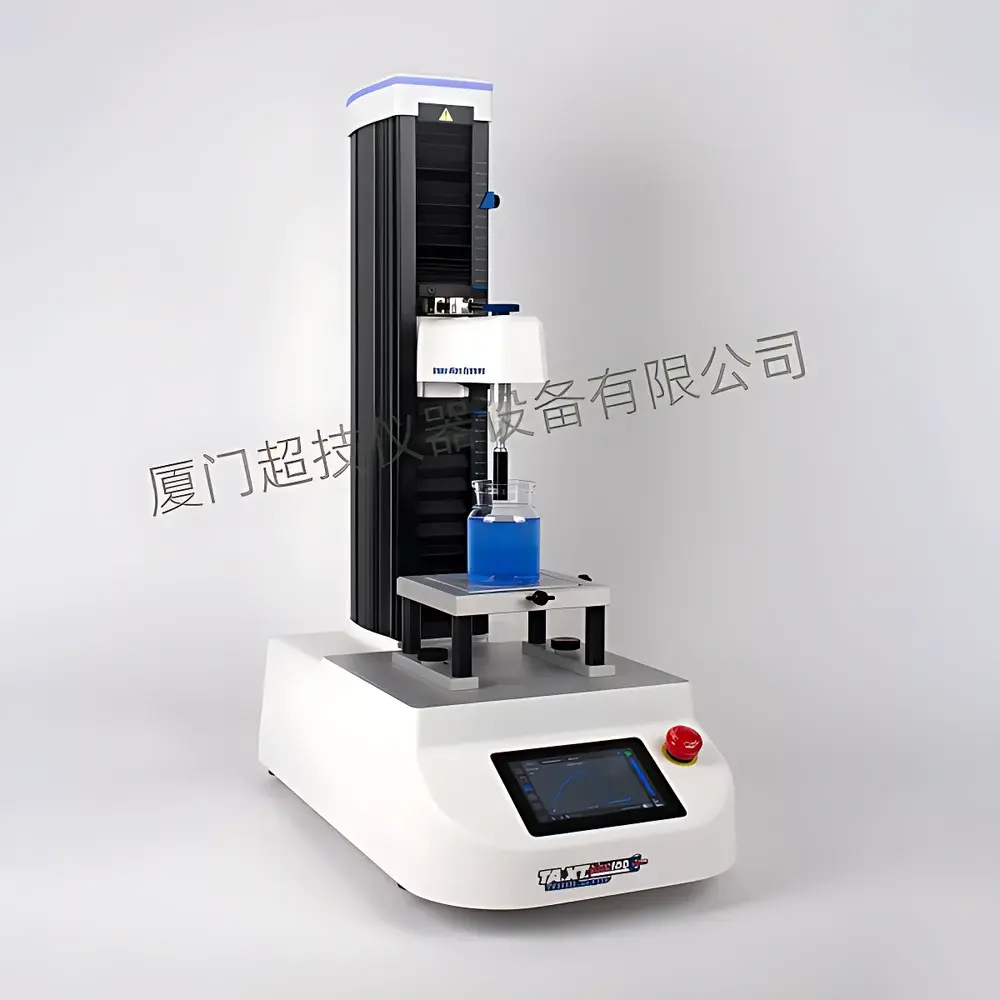
SMS TA.XT Plus100C Advanced Texture Analyzer
| Brand | SMS |
|---|---|
| Origin | United Kingdom |
| Model | TA.XT Plus100C |
| Force Range | 0.5–100 kg |
| Force Resolution | 0.1 g |
| Test Speed Range | 0.01–20 mm/s |
| Maximum Travel Distance | 361 mm (standard), 588 mm (extended height option) |
| Position Resolution | 0.0005 mm (0.0001 mm in smoothed mode) |
| Data Acquisition Rate | >2000 points/sec (4 channels simultaneously) |
| Dimensions (Std) | 671 × 280 × 516 mm (H×W×D) |
| Weight | 20.9 kg |
| Dimensions (Extended) | 921 × 280 × 516 mm |
| Weight | 25 kg |
| Operating System | Windows 7 or later |
Overview
The SMS TA.XT Plus100C is an advanced, high-capacity texture analyzer engineered for precision mechanical property evaluation of solid and semi-solid materials across food science, pharmaceuticals, cosmetics, and biomaterials research. Based on the fundamental principles of uniaxial compression, tension, penetration, extrusion, and shear deformation, the instrument applies controlled force and displacement to samples while continuously recording load–distance–time profiles. Its dual-range transducer architecture supports seamless switching between low-force (0.5 kg) and high-force (100 kg) configurations—enabling rigorous testing of both delicate gels and rigid confectionery bars, tablet hardness, capsule shell integrity, or baked goods crumb structure. The system’s rigid cast-aluminum frame and reinforced crosshead design minimize deflection under load, ensuring high reproducibility in force transmission and positional fidelity—critical for GLP-compliant method validation and regulatory submissions.
Key Features
- High-force capability up to 100 kg with interchangeable load cells (0.5, 5, 10, 30, 50, and 100 kg ranges), each calibrated to ±0.1% full scale and traceable to UKAS-accredited standards.
- Ultra-fine position resolution of 0.0005 mm (0.0001 mm in smoothed acquisition mode), essential for micro-scale deformation analysis of small-diameter particles, coated pellets, or thin films in pharmaceutical development.
- Programmable test speed from 0.01 to 20 mm/s, with speed accuracy maintained within ±0.1% across the full range—validated per ASTM E2412 and ISO 11357-3 protocols.
- Modular hardware platform supporting optional environmental modules (temperature-controlled chambers, humidity enclosures) and peripheral instrumentation including dough extensibility rigs, acoustic emission sensors, and synchronized high-speed video capture (up to 1000 fps).
- Integrated status lighting system and intuitive touch-enabled mobile control interface compatible with iOS and Android devices—allowing real-time monitoring and emergency stop activation without physical access to the console.
- Multi-language software environment supporting 24 localized UIs—including technical terminology glossaries, animated procedural guides, and embedded reference datasets aligned with peer-reviewed literature and USP and guidelines.
Sample Compatibility & Compliance
The TA.XT Plus100C accommodates a broad spectrum of sample geometries—from micropellets (≥1 mm diameter) to large-format bakery loaves (up to 300 mm wide). Standard fixtures include spherical probes (1–12.7 mm), cylindrical plungers, Kramer shear cells, Warner–Bratzler blades, and custom-machined grips for tensile ribbon testing. All mechanical components comply with ISO 17025 requirements for measurement uncertainty estimation, and firmware supports audit-trail logging compliant with FDA 21 CFR Part 11 and EU Annex 11 for electronic records. Calibration certificates include uncertainty budgets per GUM (JCGM 100:2008) and are issued with UKAS accreditation where applicable.
Software & Data Management
Exponent Connect™ software (v7.0+) provides fully scriptable test method development, real-time curve overlay, statistical process control (SPC) charting, and automated pass/fail decision logic based on user-defined thresholds. Raw data streams are stored in vendor-neutral HDF5 format with embedded metadata (operator ID, timestamp, environmental conditions, calibration history). Export options include CSV, Excel, and XML for integration into LIMS platforms such as LabWare or Thermo Fisher SampleManager. The software includes built-in compliance tools: electronic signatures, version-controlled method libraries, and immutable audit trails with granular access permissions aligned with GMP Annex 11 requirements.
Applications
- Food Science: Quantification of hardness, cohesiveness, springiness, chewiness, and fracturability per AACC 74-09 and ISO 11357-3; texture mapping of layered snacks and dairy spreads.
- Pharmaceuticals: Tablet friability and breaking force per USP ; capsule dissolution resistance; gelatin film tensile strength; lyophilized cake structural integrity assessment.
- Cosmetics: Emulsion stability profiling via repeated compression cycles; lipstick break point and smear resistance; hydrogel adhesion kinetics.
- Academic Research: Viscoelastic parameter extraction using time–temperature superposition; creep-recovery modeling; fracture energy calculation via area-under-curve integration.
FAQ
What load cell options are available, and how are they calibrated?
Six interchangeable load cells (0.5, 5, 10, 30, 50, and 100 kg) are supplied with individual UKAS-traceable calibration certificates. Each cell undergoes multi-point linearity verification and temperature-compensated zero drift correction.
Can the TA.XT Plus100C operate under regulated GxP environments?
Yes—the system supports 21 CFR Part 11 compliance via Exponent Connect™’s role-based authentication, electronic signatures, and tamper-evident audit logs with configurable retention policies.
Is third-party environmental control integration supported?
Yes—standard RS-232 and Ethernet interfaces enable bidirectional communication with commercial temperature/humidity chambers (e.g., Memmert, Binder) and allow synchronized parameter logging.
What is the maximum recommended sample height for extended-height configuration?
The extended-height model supports vertical travel up to 588 mm, accommodating tall cylindrical samples such as stacked cheese wheels or vertically oriented extruded pasta strands.
How is data integrity ensured during high-speed acquisition?
All analog-to-digital conversion occurs onboard the controller at 24-bit resolution, with hardware-triggered synchronization across all four input channels to eliminate timing skew—even at 2000 pps sustained sampling rates.




