Sofraser MIVI9510 Online Vibrational Viscometer for Extrusion Processes
| Brand | Sofraser |
|---|---|
| Origin | France |
| Model | MIVI9510 |
| Viscosity Range | 0–1,000,000 mPa·s |
| Temperature Range | Up to 300 °C (standard 200 °C, extended option) |
| Pressure Rating | 60 bar (extended to 500 bar) |
| Repeatability | ±0.2% |
| Reproducibility | ±0.5% |
| Housing Material | 316L stainless steel (optional Hastelloy®, PTFE, or enamel coating) |
| Intrinsically Safe Certification | ATEX EEx ia IIC T3–T6 |
| Output Signals | 4–20 mA (±0.1%, 12-bit resolution, 750 Ω), RS485/RS422 (Modbus RTU, 300–19200 baud), Relay (1 A / 250 VAC or 30 VDC) |
| Power Supply | 80–265 VAC / 100–385 VDC |
| Integrated Sensor | PT100 temperature probe |
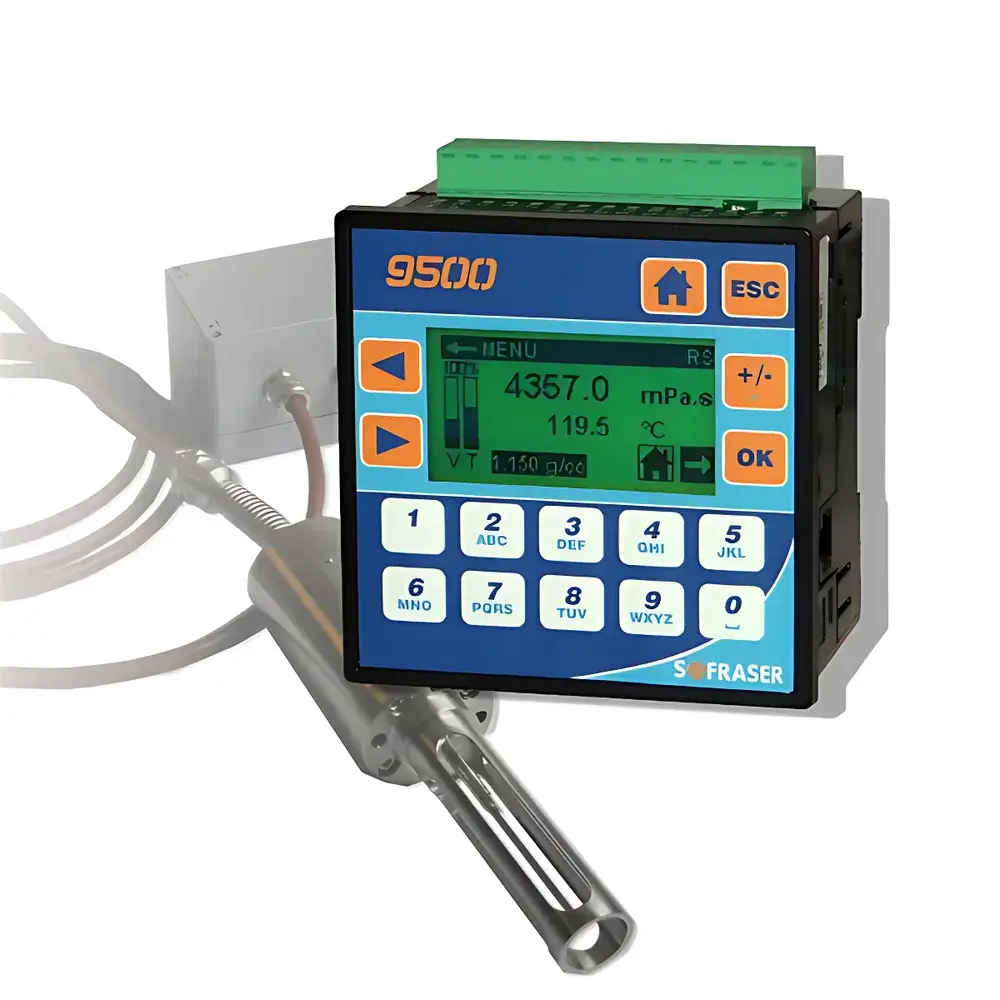
| Display | Dual LED — red 4-digit (viscosity/temperature), green 6-digit (unit), 5 status LEDs (4 alarm + 1 connection) |
| Optional Software | WISC80 |
Overview
The Sofraser MIVI9510 is an intrinsically safe, vibration-based online viscometer engineered for real-time rheological monitoring directly within extrusion lines and continuous polymer processing systems. Unlike rotational or capillary viscometers, the MIVI9510 employs a resonant vibrating rod principle grounded in the physical relationship between fluid damping and shear viscosity. When excited at its natural frequency by a low-power electromagnetic driver, the amplitude and phase shift of the rod’s oscillation are modulated by the surrounding medium’s viscous resistance. This passive, wear-free transduction mechanism eliminates moving parts, seals, or bearings—making it inherently robust for harsh industrial environments where maintenance downtime and calibration drift must be minimized. Designed specifically for integration into high-temperature, high-pressure extrusion die heads, melt streams, and reactor effluents, the MIVI9510 delivers continuous, non-invasive viscosity data across an exceptionally wide dynamic range—from Newtonian solvents near 0 mPa·s up to highly filled thermoplastic melts exceeding 1,000,000 mPa·s—without requiring sample extraction or flow conditioning.
Key Features
- Vibration-based measurement principle ensures zero mechanical wear, no consumables, and immunity to particle loading or fiber suspension
- Intrinsically safe design certified to ATEX EEx ia IIC T3–T6, FM, JIS, and 3A standards—approved for Zone 0/1 hazardous areas
- High-pressure capability: standard 60 bar rating, optionally extended to 500 bar for high-output extruders and reactive extrusion applications
- Extended thermal resilience: operating range up to 300 °C with integrated PT100 Class A temperature sensor and real-time viscosity–temperature compensation
- Corrosion-resistant wetted parts: standard 316L stainless steel construction; optional Hastelloy C-276, PTFE-lined, or vitreous enamel coatings for aggressive chemistries
- Dual LED interface: red 4-digit display for live viscosity/temperature values, green 6-digit unit indicator, and five dedicated status LEDs for alarm and communication diagnostics
- Multi-protocol digital output: Modbus RTU over RS485/RS422 (configurable baud rate 300–19200), plus isolated 4–20 mA analog output with 12-bit resolution and user-adjustable scaling
Sample Compatibility & Compliance
The MIVI9510 is validated for direct in-line installation on extrusion dies, gear pump outlets, and static mixer taps via standard ANSI/DIN/ISO flange interfaces (e.g., DN25–DN80). It accommodates non-Newtonian, shear-thinning, and time-dependent melts—including polyolefins, engineering thermoplastics, elastomers, hot-melt adhesives, and reactive resins—without flow restriction or pulsation sensitivity. Its compliance portfolio includes ATEX Directive 2014/34/EU (Category 1G), IECEx, UL/cULus Class I Div 1, and FDA-compliant surface finish options (3A sanitary standard available upon request). All firmware and configuration tools adhere to IEC 61508 SIL2 functional safety requirements for process control instrumentation. Traceability and audit readiness are supported through optional WISC80 software with electronic signature, change history logging, and 21 CFR Part 11–compliant data archiving.
Software & Data Management
The optional WISC80 configuration and visualization software enables full instrument setup, calibration validation, trend analysis, and alarm threshold definition via USB or RS232 connection. It supports export of time-stamped viscosity–temperature–pressure datasets in CSV and Excel-compatible formats, with built-in statistical functions (mean, SD, min/max, Cp/Cpk) for SPC-based process capability assessment. Data synchronization with DCS/SCADA systems is achieved natively through Modbus TCP gateways or OPC UA wrappers. Firmware updates preserve all user-defined parameters and maintain GLP/GMP audit trails—including operator ID, timestamp, and action type—for regulatory submissions under ISO 9001, ISO 13485, or ICH Q7 frameworks.
Applications
- Polymer extrusion: real-time melt index correlation, batch-to-batch consistency verification, and feedstock variability detection in PE, PP, PET, PC, and TPU production
- Compounding & masterbatch manufacturing: dispersion quality control of fillers, pigments, and flame retardants in molten polymer matrices
- Hot-melt adhesive lines: viscosity stability monitoring during thermal aging or solvent evaporation stages
- Food-grade extrusion: starch gelatinization profiling and protein denaturation tracking in twin-screw systems
- Coating & ink formulation: inline rheology feedback for solvent-based and UV-curable resin streams prior to die coating
- Pharmaceutical hot-melt extrusion (HME): critical quality attribute (CQA) monitoring for amorphous solid dispersion development per FDA Guidance for Industry (2019)
FAQ
How does the MIVI9510 compensate for temperature and pressure effects on viscosity readings?
The device integrates a calibrated PT100 sensor adjacent to the vibrating rod and applies real-time polynomial correction algorithms based on material-specific viscosity–temperature coefficients. Pressure compensation is implemented using pre-characterized elastic deformation models of the rod assembly, validated per ISO 10418 for high-pressure fluid instrumentation.
Can the MIVI9510 be installed on existing extrusion lines without process interruption?
Yes—its compact flanged design allows retrofit installation during scheduled maintenance windows. No flow diversion, bypass loops, or external pumping are required. Thermal expansion joints and purge ports can be added as field accessories.
Is calibration traceable to national standards?
Factory calibration is performed against NIST-traceable silicone oil reference standards across the full 0–1,000,000 mPa·s range, with certificate of calibration (ISO/IEC 17025 accredited lab option available).
What cybersecurity measures are included for Modbus communications?
The RS485 interface operates in slave-only mode with no remote write access by default. Network-level security (firewall rules, VLAN segmentation) is enforced at the SCADA layer; device-level authentication is managed via WISC80 session tokens.
Does the MIVI9510 support predictive maintenance analytics?
When integrated with edge computing platforms (e.g., Siemens MindSphere or PTC ThingWorx), raw amplitude/phase data streams enable anomaly detection models trained on historical failure modes—such as die buildup, screw wear progression, or thermal degradation onset.
Related Products