
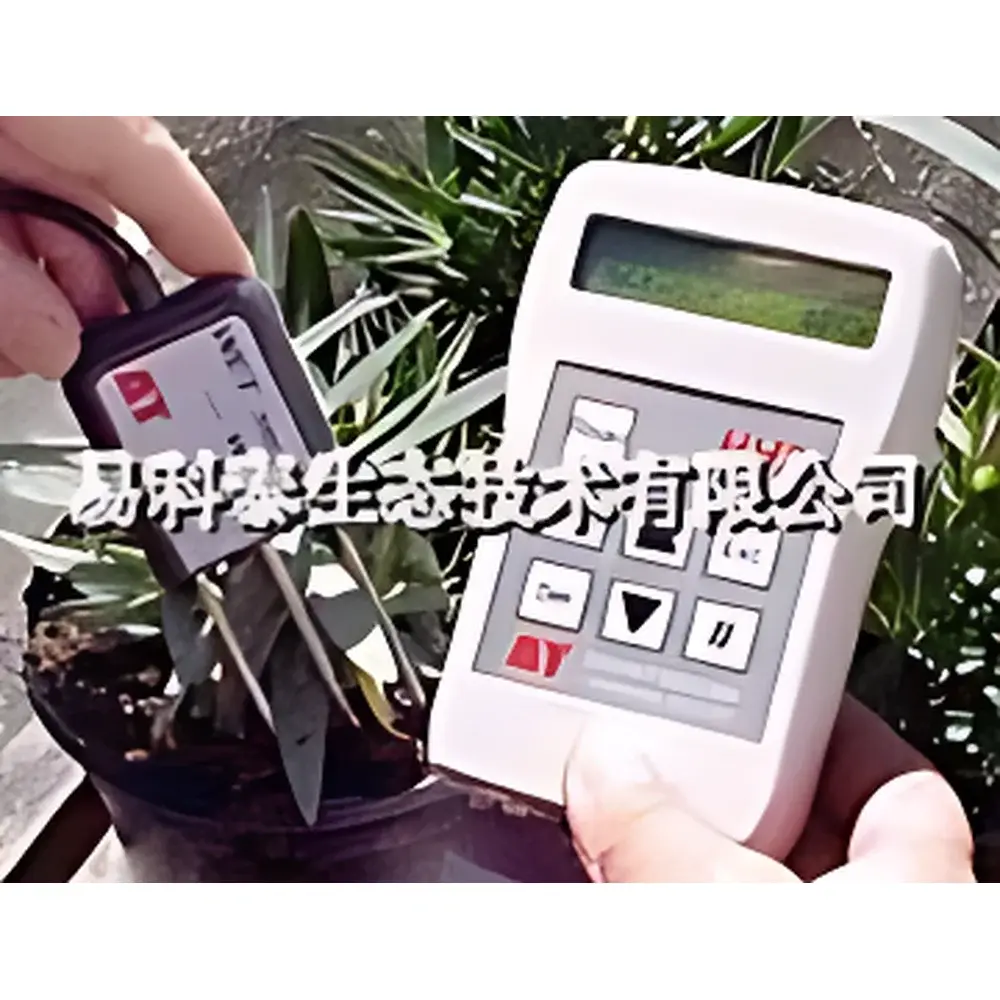
W.E.T. Soil Moisture, Temperature, and Electrical Conductivity Meter
| Origin | UK |
|---|---|
| Manufacturer Type | Authorized Distributor |
| Origin Category | Imported |
| Model | W.E.T. |
| Pricing | Available Upon Request |
Overview
The W.E.T. Soil Moisture, Temperature, and Electrical Conductivity Meter is a field-deployable, multi-parameter sensor system engineered for rapid, in-situ characterization of soil physical and electrochemical properties. Based on Frequency Domain Reflectometry (FDR), the instrument simultaneously quantifies volumetric water content (θv), bulk electrical conductivity (ECb), and soil temperature—three interdependent parameters critical for irrigation scheduling, salinity assessment, nutrient leaching studies, and environmental monitoring under field conditions. Unlike time-domain reflectometry (TDR) systems requiring complex waveform analysis, FDR operates at fixed high-frequency excitation (typically 100 MHz range), enabling compact electronics, low power consumption, and robust performance across variable soil textures and moisture regimes. The integrated probe design ensures minimal soil disturbance during insertion, while the calibrated dielectric response (εr = 1–80) supports reliable θv estimation across mineral, organic, and mixed soils when paired with appropriate empirical or pedotransfer functions.
Key Features
- Triple-parameter measurement in a single insertion: volumetric water content (0–100 %vol), bulk EC (0–200 mS/m), and temperature (−5 to +50 °C)
- FDR-based sensing architecture with 5-second response time and factory-calibrated dielectric permittivity (εr) output (resolution: 0.1; accuracy: ±2.5)
- IP67-rated stainless-steel sensor rod and IP65-rated connector ensure operational reliability in wet, dusty, or humid field environments
- Onboard data logger capable of storing up to 2,100 timestamped readings—including θv, ECb, temperature, and derived pore-water EC (ECp)—with automatic unit conversion and real-time display
- Field-configurable calibration support: users may apply custom calibration curves for specific soil types (e.g., sandy loam, clay, peat) or non-soil media (e.g., compost, fly ash, fibrous substrates)
- Low-power operation compatible with standard alkaline or rechargeable AA batteries (typical field life >12 months at 15-min logging interval)
Sample Compatibility & Compliance
The W.E.T. sensor demonstrates broad compatibility across heterogeneous soil matrices, including coarse sands, silty clays, volcanic tephra, and anthropogenic fill materials. Its FDR methodology mitigates signal attenuation issues common in high-clay or high-salinity soils where TDR systems often exhibit reduced sensitivity. For regulatory and research-grade applications, the instrument conforms to ISO 11274 (soil physical property measurement standards) and supports GLP-compliant data collection when used with its ASCII-export-capable desktop software. While not intrinsically certified for hazardous locations, its ingress protection rating (IP67 sensor / IP65 interface) meets IEC 60529 requirements for outdoor environmental instrumentation. Calibration traceability is maintained via NIST-traceable reference solutions for EC and certified thermal baths for temperature verification.
Software & Data Management
Data retrieval is performed via USB connection to the handheld readout unit, exporting fully timestamped records in plain ASCII format (.txt)—a universally ingestible structure compatible with Excel, R, Python (pandas), MATLAB, and LIMS platforms. The included Windows-compatible software provides batch download, metadata tagging (site ID, operator, depth), basic statistical summary (min/max/mean/std dev), and export to CSV or PDF report templates. Audit trail functionality includes operator login timestamps and firmware version logging—supporting documentation requirements under ISO/IEC 17025 and FDA 21 CFR Part 11 when deployed in regulated agricultural or remediation projects. No cloud dependency or proprietary database is required; all raw data remain under user control at point of download.
Applications
- Real-time irrigation management in precision agriculture and horticulture
- Salinity mapping and long-term monitoring of secondary salinization in arid-zone croplands
- Soil hydrological modeling input (e.g., HYDRUS-1D, SWAP) requiring co-located θv and ECb
- Landfill cover performance assessment and leachate plume tracking
- Ecological restoration site monitoring (e.g., wetland rehydration, mine tailings stabilization)
- Calibration validation for remote-sensing soil moisture products (e.g., Sentinel-1 SAR, SMAP)
FAQ
How does FDR differ from TDR in soil moisture measurement?
FDR measures the dielectric constant by evaluating the impedance response of a coaxial sensor at a fixed high frequency, offering faster acquisition, lower power demand, and simpler electronics than TDR’s pulse propagation timing method.
Can the W.E.T. be used in frozen or snow-covered soils?
No—measurements are invalid below −5 °C due to phase change effects on dielectric response and potential sensor damage from ice expansion.
Is sensor recalibration required after long-term burial?
Yes; annual verification against known standards is recommended, especially in high-salinity or chemically aggressive soils where electrode polarization or coating may affect ECb fidelity.
Does the device calculate pore-water conductivity (ECp) internally?
Yes—the onboard algorithm estimates ECp using the Rhoades model (or user-defined relationship) based on measured ECb and θv, with resolution of 1.0 mS/m and theoretical upper limit of 1500 mS/m.
What is the maximum recommended insertion depth for accurate profiling?
The standard 120-mm probe is validated for 0–10 cm depth; for deeper stratification, multiple probes at staggered depths or use with a calibrated access tube system is advised.







