
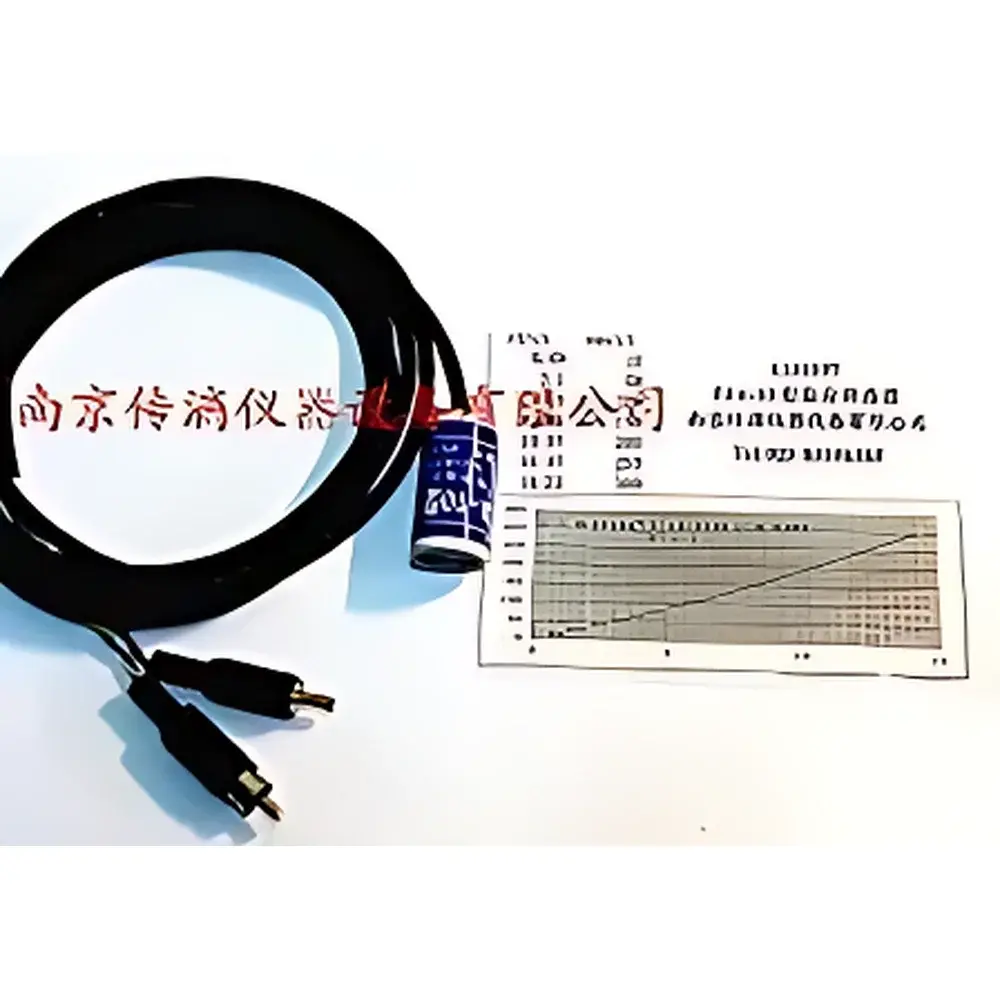
Soil Salinity Sensor FJA-10 | Electrochemical Conductivity Probe for In-Situ Soil Solution Monitoring
| Origin | Jiangsu, China |
|---|---|
| Manufacturer Type | Authorized Distributor |
| Origin Category | Domestic (China) |
| Model | FJA-10 |
| Portability | Handheld / Field-Deployable |
| Calibration Compatibility | KCl/NaCl standard solutions (0.01–0.2 mol/L) |
| Electrode Material | Graphite |
| Temperature Compensation | Integrated NTC thermistor |
| Response Time | <20 s |
| Minimum Volumetric Water Content for Reliable Measurement | ~20% (varies with clay content) |
| Electrode Constant | Adjustable (factory-set to 100 cm⁻¹ for direct mS/cm readout) |
| Linearity (0.02–0.3 N) | R² ≥ 0.98 |
| Repeatability | Relative average deviation ≤5% (max. 10%) |
Overview
The FJA-10 Soil Salinity Sensor is a field-deployable electrochemical probe engineered for direct, in-situ measurement of electrical conductivity (EC) in soil solution — a robust proxy for total soluble salt concentration (TSSC). Operating on the principle of two-electrode conductimetry, it employs a pair of stable graphite electrodes coupled with an integrated NTC thermistor for real-time temperature compensation. Unlike traditional lab-based extraction methods (e.g., saturated paste extract EC), the FJA-10 enables continuous or discrete monitoring of dynamic salt fluxes within the unsaturated zone, supporting studies in soil salinization, irrigation management, phytoremediation, and pipeline corrosion assessment. Its design adheres to fundamental electrochemical standards for soil sensor deployment, including ASTM D511 (Standard Test Methods for Soluble Salt Content of Soils) and ISO 11265:1994 (Soil quality — Determination of electrical conductivity). The sensor outputs raw conductance values (mS) at 25 °C, which are convertible to soil solution concentration (mol/L or dS/m) via calibration curves derived from region-specific electrolyte standards.
Key Features
- Graphite electrode pair optimized for high stability and rapid response (<20 s equilibrium time) in heterogeneous, particulate soil matrices
- Integrated NTC thermistor enabling automatic temperature compensation — critical for accurate EC-to-concentration conversion across seasonal field conditions
- Four-conductor shielded cable with IP67-rated connector for reliable signal integrity in humid, dusty, or saline environments
- Electrode constant factory-configured to 100 cm⁻¹, permitting direct mS/cm readout when paired with compatible meters (e.g., DDB-2, DDB-3, or FJA-6)
- No internal electronics or power requirement — passive, galvanic operation ensures long-term reliability and zero drift during extended burial
- Optimized geometry for horizontal insertion into undisturbed soil profiles, minimizing disturbance to natural water-salt transport pathways
Sample Compatibility & Compliance
The FJA-10 is validated for use in mineral soils with volumetric water contents ≥20% — below this threshold, insufficient pore connectivity limits ion mobility and compromises measurement reproducibility. Performance varies predictably with texture: clay-rich soils require higher moisture thresholds due to reduced effective porosity and surface charge effects. It is not intended for use in pure sand, organic peat (>70% OM), or frozen/thawing soils. For regulatory compliance, data generated using this sensor may support GLP-aligned field studies when deployed with documented calibration protocols (traceable to NIST-certified KCl standards), full audit trails of sensor history, and concurrent soil moisture verification (e.g., tensiometers or TDR probes installed within 20 cm). While not FDA 21 CFR Part 11–certified (as a hardware-only transducer), its output integrates seamlessly with compliant data acquisition systems meeting ICH E6(R3) and ISO/IEC 17025 requirements for environmental monitoring.
Software & Data Management
The FJA-10 operates as an analog transducer and does not include embedded firmware or wireless transmission. However, when interfaced with digital conductivity meters (e.g., DDB-3 or FJA-6), users can export timestamped EC readings to CSV via USB or RS-232. Calibration curve generation — whether linear or second-order polynomial — is performed externally using validated spreadsheet templates (e.g., Excel-based regression tools preconfigured per ASTM D511 Annex A3). These tools accept user-input 25 °C EC values and return interpolated concentration (mol/L) with uncertainty propagation based on replicate measurements. For longitudinal datasets, we recommend maintaining a sensor logbook recording installation depth, orientation, calibration date, and physical inspection notes — essential for QA/QC in multi-season agronomic trials or long-term ecological observatories.
Applications
- Long-term monitoring of secondary salinization in irrigated agricultural zones (e.g., arid-zone cotton or rice systems)
- Evaluation of leaching efficiency and salt balance modeling under deficit irrigation regimes
- Corrosion risk assessment for buried metallic infrastructure (pipelines, grounding grids) via detection of localized high-EC microenvironments
- Validation of vadose-zone solute transport models (e.g., HYDRUS-1D) through high-temporal-resolution EC profiling
- Field validation of remote sensing–derived salinity indices (e.g., Landsat-derived NDVI-EC correlations)
- Controlled-environment experiments simulating saline intrusion or seawater aerosol deposition in coastal ecosystems
FAQ
What calibration standards are recommended for regional accuracy?
Users must calibrate against KCl or NaCl solutions matching local dominant ions (e.g., Na⁺–Cl⁻ in coastal soils; Ca²⁺–SO₄²⁻ in inland evaporites). A five-point series (0.01–0.2 mol/L) is advised, with quadratic regression preferred over linear for error reduction below ±0.5%.
Can the FJA-10 be left buried continuously for >6 months?
Yes — graphite electrodes exhibit minimal polarization or passivation. However, annual physical inspection is required to verify cable integrity, connector sealing, and absence of root penetration or biofilm accumulation on electrode surfaces.
Why is soil moisture a limiting factor for measurement validity?
Below ~20% volumetric water content, ionic conduction shifts from pore-water continuum to surface-diffusion dominance, violating the assumptions of bulk solution conductimetry. Clay-rich soils raise this threshold due to stronger cation exchange and bound-water effects.
Is temperature compensation mandatory for field use?
Yes. Soil temperature fluctuates widely diurnally and seasonally. Without NTC-based compensation, EC errors exceed ±2.5% per °C deviation from 25 °C — unacceptable for trend analysis or regulatory reporting.
How does the FJA-10 compare to induction-based EM sensors (e.g., EM38)?
FJA-10 measures *soil solution* EC at point scale with high chemical specificity; EM sensors measure *bulk apparent EC*, integrating textural, moisture, and clay effects. They are complementary: FJA-10 provides ground-truth for EM inversion models.






