
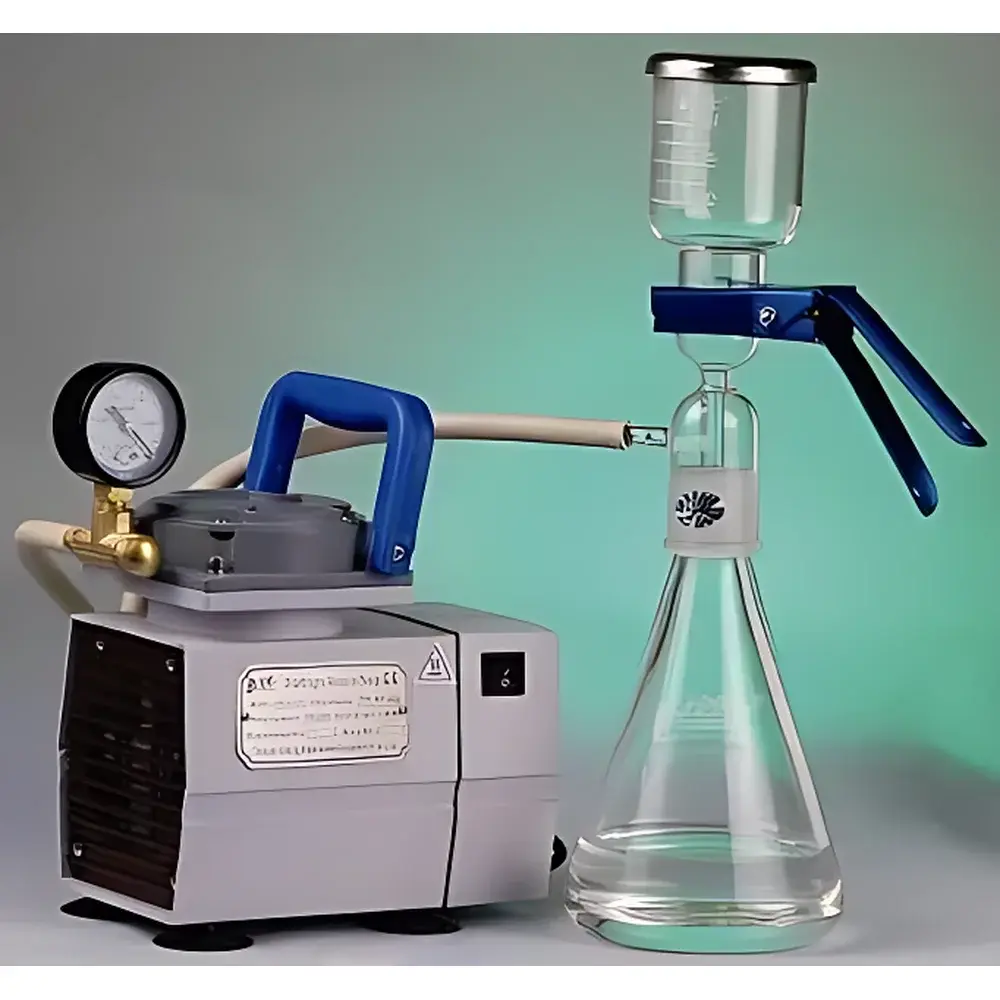
Solvent Filtration System with Diaphragm Vacuum Pump
| Origin | Tianjin, China |
|---|---|
| Manufacturer Type | Authorized Distributor |
| Origin Category | Domestic (China) |
| Model | Solvent Filtration System with Diaphragm Vacuum Pump |
| Pricing | Upon Request |
Overview
The Solvent Filtration System with Diaphragm Vacuum Pump is an integrated, laboratory-grade vacuum filtration platform engineered for precision solvent and mobile phase preparation in analytical and pharmaceutical laboratories. It operates on the principle of pressure-driven vacuum filtration, where a chemically resistant diaphragm vacuum pump generates negative pressure across a micro-porous membrane housed within a borosilicate glass filtration assembly. This system enables rapid, particle-free clarification of aqueous, organic, and mildly corrosive solvents—critical for high-performance liquid chromatography (HPLC), ultra-high-performance liquid chromatography (UHPLC), and other sensitive instrumental analyses requiring sub-micron particulate removal and effective dissolved gas reduction.
Key Features
- High-integrity borosilicate glass filtration components—including 1000 mL and 2000 mL triangular receiving flasks, 250 mL and 300 mL filter funnels, fritted glass filter heads (porosity grade G3/G4), and stainless-steel clamping fixtures—designed to ASTM E29 and ISO 3585 standards for dimensional consistency and thermal stability.
- Chemically inert, bubble-free glass construction with uniform wall thickness ensures mechanical robustness under vacuum (rated up to –0.095 MPa) and compatibility with autoclaving (121 °C, 20 min, saturated steam).
- Oil-free diaphragm vacuum pump delivers continuous 24-hour operation with noise level ≤52 dB(A), thermal overload protection, and service life exceeding 10,000 hours under typical lab load conditions.
- Integrated filtration manifold supports standard 47 mm and 90 mm diameter microporous membranes (e.g., nylon, PTFE, PVDF, cellulose acetate), enabling customizable pore size selection (0.1 µm to 5.0 µm) for sterilizing-grade or analytical-grade filtration.
- Optimized flow dynamics reduce foaming and channeling; inherent degassing effect minimizes dissolved oxygen and volatile entrainment—particularly beneficial for HPLC mobile phase conditioning prior to column injection.
Sample Compatibility & Compliance
This system is validated for use with water-miscible solvents (e.g., methanol, acetonitrile, buffer solutions), low-polarity organics (e.g., hexane, chloroform, ethyl acetate), and moderately aggressive media including dilute acids (≤1 M HCl, ≤0.5 M HNO₃) and bases (≤0.1 M NaOH). It conforms to USP for particulate matter testing, supports GLP-compliant documentation when paired with audit-trail-capable lab notebooks, and meets general requirements outlined in ISO/IEC 17025:2017 for sample preparation traceability. All wetted parts are non-leaching and extractables-tested per USP .
Software & Data Management
As a benchtop mechanical filtration platform, this system does not incorporate embedded firmware or digital control interfaces. However, it is fully compatible with laboratory information management systems (LIMS) and electronic lab notebooks (ELN) through manual entry of batch records, membrane lot numbers, filtration duration, and pre/post-filtration particulate counts (when used with light obscuration or microscopy-based QC protocols). For regulated environments, users may implement paper-based or electronic SOPs aligned with FDA 21 CFR Part 11 requirements via external documentation workflows.
Applications
- HPLC/UHPLC mobile phase and sample solution filtration (0.22 µm or 0.45 µm sterilizing grade)
- Pre-column inline filtration to extend analytical column lifetime and prevent detector fouling
- Microbial retention studies and sterility testing per ISO 11737-1 and Ph. Eur. 5.1.29
- Preparation of particle-free standards for ICP-MS, AAS, and UV-Vis spectrophotometry
- Removal of catalyst residues, precipitates, or colloidal aggregates from synthetic reaction mixtures
- Filtration of heat-labile biopharmaceutical intermediates without thermal degradation
- Environmental water analysis per EPA Method 160.1 and ISO 5667-12 for suspended solids characterization
FAQ
What membrane types are recommended for HPLC mobile phase filtration?
PTFE (hydrophobic) for organic solvents; nylon or low-protein-binding PVDF for aqueous and buffered solutions. Always verify chemical compatibility using manufacturer resistance charts.
Can the glass components be sterilized in an autoclave?
Yes—triangular flasks, funnels, and fritted heads are autoclavable at 121 °C for 20 minutes. Avoid thermal shock by allowing gradual cooling post-cycle.
Is the vacuum pump suitable for continuous overnight operation?
Yes—the diaphragm pump is rated for unattended 24/7 duty cycles under nominal vacuum load (≤–0.08 MPa) with ambient temperature ≤35 °C and relative humidity ≤80%.
Does this system support quantitative filtration (e.g., gravimetric residue analysis)?
Yes—when used with pre-weighed, ashless membrane filters and calibrated receiving flasks, it supports weight-loss or residue-gain protocols compliant with ASTM D2986 and ISO 12103-1.
How often should the diaphragm pump maintenance be performed?
No routine oil changes are required. Inspect inlet filters quarterly; replace diaphragms and valves every 2–3 years based on cumulative operating hours and performance drift.



