
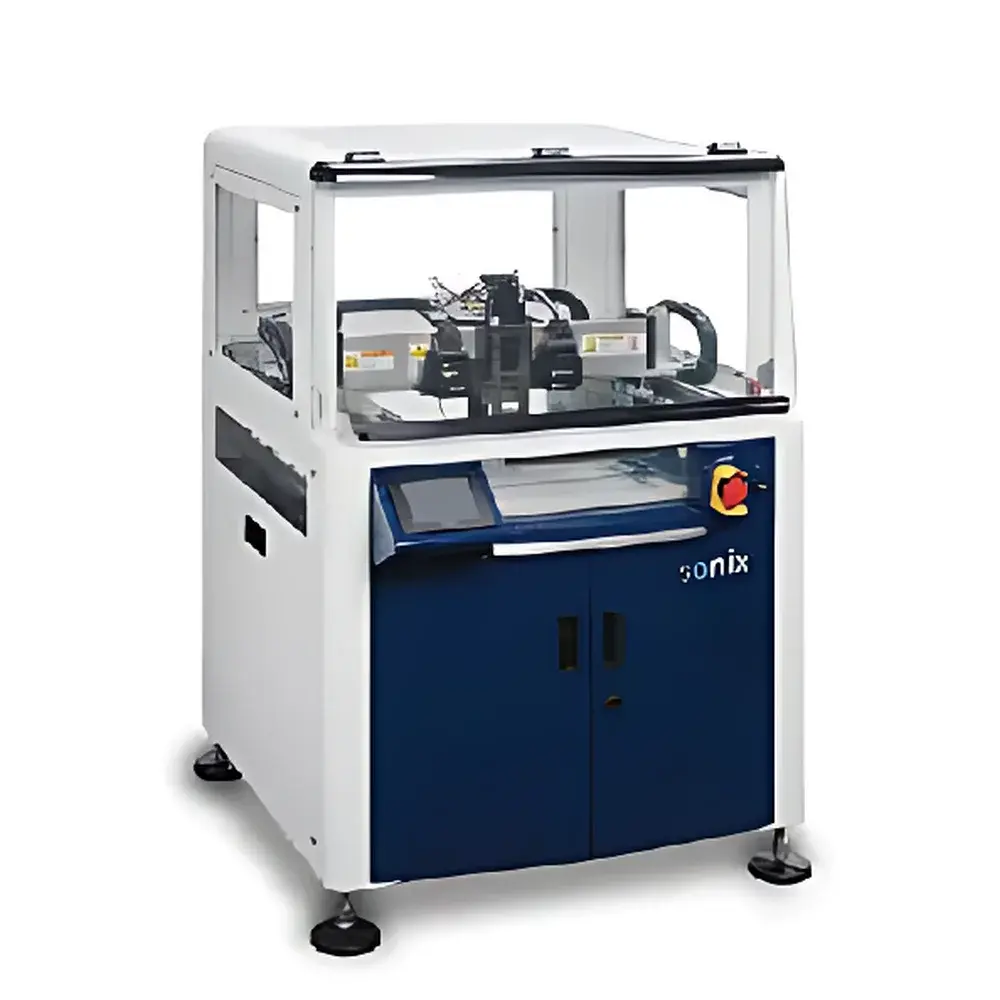
SONIX Echo-VS Ultrasonic Scanning Acoustic Microscope (SAM)
| Brand | SONIX |
|---|---|
| Origin | USA |
| Model | Echo-VS |
| Instrument Type | Ultrasonic Scanning Acoustic Microscope (SAM) |
| Detection Resolution | < 1 µm |
| Scan Speed | 2.5× faster than conventional SAM systems at high resolution |
| Transducer Frequency Range | Up to 200 MHz (typical for high-resolution failure analysis) |
| Dual-Mode Imaging | Pulse-Echo and Through-Transmission (PETT) |
| Software Features | TAMI tomographic imaging, FSF surface-following scan, ICEBERG offline analysis, programmable automated scan sequences |
Overview
The SONIX Echo-VS Ultrasonic Scanning Acoustic Microscope (SAM) is a high-precision, fully digital non-destructive evaluation (NDE) platform engineered for advanced failure analysis and internal defect characterization in microelectronic packaging, semiconductor devices, and advanced heterogeneous materials. Operating on the principle of high-frequency acoustic pulse-echo and through-transmission imaging, the Echo-VS utilizes focused ultrasonic energy (typically 30–200 MHz) to generate cross-sectional and volumetric C-scan, B-scan, and A-scan data without physical contact or sample preparation. Unlike optical or X-ray techniques, SAM provides exceptional sensitivity to interfacial delaminations, voids, cracks, and disbonds — especially critical in low-acoustic-impedance interfaces such as die attach layers, underfill (MUF), mold compound/substrate boundaries, and copper pillar solder joints. Designed for laboratory and high-reliability manufacturing environments, the Echo-VS meets the stringent spatial resolution (<1 µm lateral, sub-micron axial), repeatability, and thermal stability requirements of advanced packaging technologies including flip-chip, stacked-die, bonded wafers, and 2.5D/3D IC integration.
Key Features
- Sub-micron scanning resolution (<1 µm) enabled by proprietary high-frequency transducer-lens assemblies and ultra-stable linear servo motor positioning system
- 2.5× faster high-resolution scanning versus legacy SAM platforms, achieved via optimized motion control firmware and real-time signal processing architecture
- PETT (Pulse-Echo and Through-Transmission) dual-mode acquisition — simultaneous or sequential collection of reflection and transmission signals for comprehensive interface integrity assessment
- Integrated water temperature stabilization and UV sterilization subsystem — ensures consistent acoustic coupling medium properties during extended high-frequency operation (e.g., >100 MHz)
- Waveform Simulator and Beam Emulator software modules — enable predictive acoustic path modeling, focal zone optimization, and artifact mitigation prior to physical scanning
- Modular mechanical architecture with rigid granite base and vibration-damped enclosure — supports long-term metrological stability and ease of serviceability
Sample Compatibility & Compliance
The Echo-VS accommodates samples ranging from bare silicon wafers (up to 300 mm) to fully packaged ICs (BGA, CSP, QFN, MCM), MEMS devices, power modules, and automotive electronic assemblies. Its programmable Z-axis tracking (FSF — Flat Surface Following) compensates for non-planar topography, enabling uniform focus across warped substrates or uneven encapsulation surfaces. The system complies with industry-standard NDE workflows aligned with ASTM E1781 (Standard Practice for Acoustic Microscopy), ISO 17845 (Non-destructive testing — Qualification of ultrasonic testing equipment), and supports audit-ready documentation per GLP/GMP and FDA 21 CFR Part 11 requirements when configured with optional electronic signature and audit trail modules. All image metadata — including transducer ID, frequency, gain, gate settings, water temperature, and scan parameters — is embedded in DICOM-compliant file formats for traceability.
Software & Data Management
SONIX proprietary software provides a unified environment for acquisition, reconstruction, visualization, and quantitative analysis. TAMI (Tomographic Acoustic Microscopic Imaging) enables depth-resolved slicing with user-defined thickness partitioning — generating up to 200 co-registered C-scan images from a single volumetric scan. ICEBERG offline analysis permits post-acquisition reprocessing on standard Windows workstations using identical algorithms as the instrument host — ensuring method consistency across R&D, FA labs, and contract test facilities. Automated scripting (via Python API) supports integration into automated test sequences and statistical process control (SPC) pipelines. Raw RF data export (in HDF5 and MAT formats) facilitates custom algorithm development and machine learning model training for defect classification.
Applications
- Detection and quantification of sub-50 nm interfacial delaminations in Cu-pillar bump structures and hybrid bonding interfaces
- Through-mold inspection of molded-underfill (MUF) integrity beneath stacked-die configurations
- Void mapping in die-attach layers and thermal interface materials (TIMs) for power electronics reliability assessment
- Non-destructive cross-sectioning of fan-out wafer-level packages (FOWLP) and silicon interposers
- Quality assurance of MEMS cavity sealing and hermeticity validation
- Root-cause analysis of early-life failures in automotive-grade ICs subjected to thermal cycling and mechanical shock
FAQ
What is the minimum detectable delamination thickness the Echo-VS can resolve?
The system achieves detection sensitivity down to 0.05 µm for planar interfacial separations under optimal conditions (e.g., 200 MHz transducer, low-noise coupling, stable temperature).
Does the Echo-VS support automated pass/fail criteria based on area or depth thresholds?
Yes — custom defect rules can be defined in software, triggering automated flagging, reporting, and export upon violation of user-specified dimensional or amplitude thresholds.
Can the system be integrated into a cleanroom environment?
The Echo-VS is compatible with Class 1000 (ISO 6) cleanrooms; optional HEPA-filtered air purge and static-dissipative components are available upon request.
Is remote diagnostics and software update support available?
SONIX provides secure remote access for technical support, firmware updates, and calibration verification — compliant with enterprise IT security policies.
What transducer frequencies are supported out-of-the-box?
Standard configurations include 50 MHz, 100 MHz, and 200 MHz focused transducers; custom broadband or immersion transducers can be qualified per application requirements.



