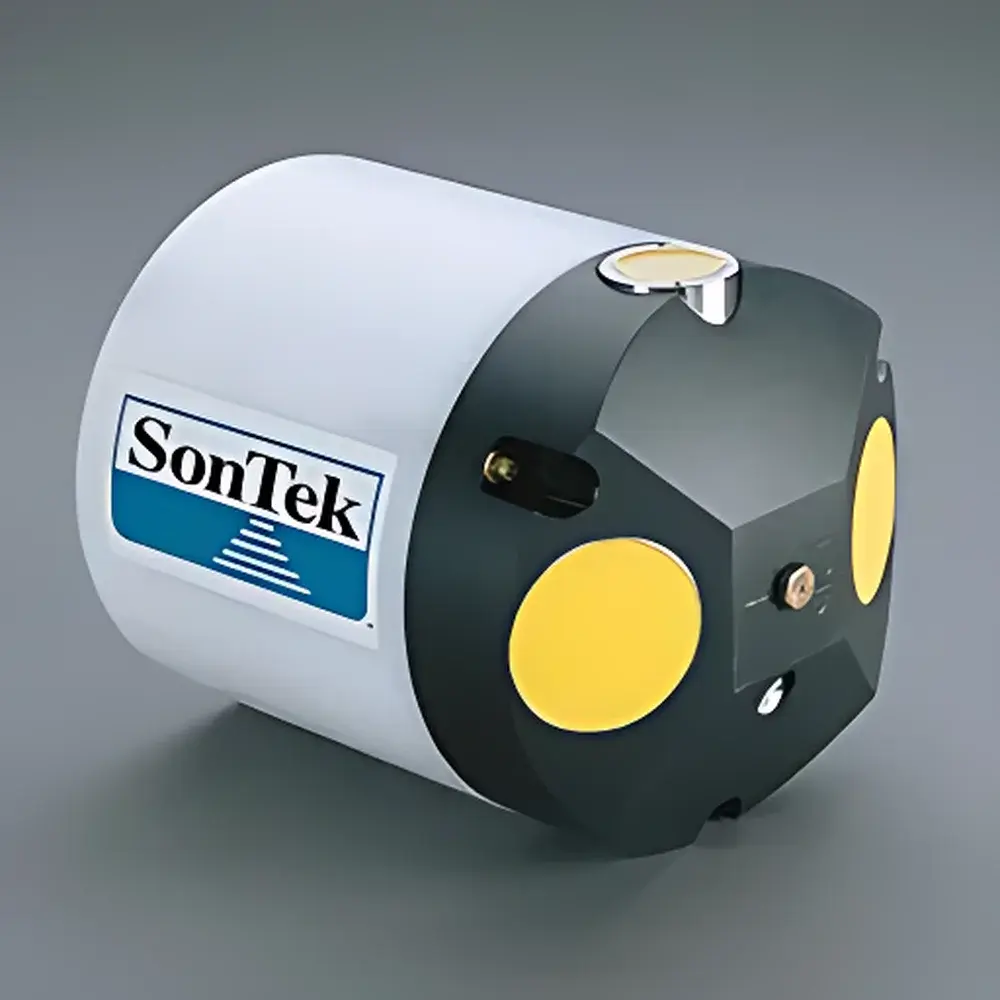
SonTek ADP Acoustic Doppler Profiler
| Origin | USA |
|---|---|
| Manufacturer Type | Distributor |
| Origin Category | Imported |
| Model | ADP |
| Pricing | Upon Request |
| Velocity Range | ±10 m/s |
| Velocity Resolution | 0.1 cm/s |
| Velocity Accuracy | ±1% of measured velocity or ±0.5 cm/s (whichever is greater) |
| Maximum Ensembles | 100 cells per profile |
| Operating Frequencies | 250 kHz, 500 kHz, 1000 kHz, 1500 kHz, 3000 kHz |
| Max Profiling Range | 3–180 m (frequency-dependent) |
| Power Supply | 12–24 V DC |
| Continuous Power Consumption | 2.0–2.5 W |
| Sleep Mode Power | <1 mW |
| Internal Memory Options | 128 MB / 512 MB / 1024 MB |
| Compass & Tilt Sensor Resolution | 0.1° (heading, pitch, roll) |
| Compass Accuracy | ±2° (heading), ±1° (pitch/roll) |
| Pressure Sensor Options | Strain-gauge (±0.1% FS) or Resonant quartz (±0.01% FS) |
| Transducer Configurations | 3-beam vertical, 2-beam side-looking, 4-beam Janus, 4-beam with vertical beam |
| Software Suite | RiverSurveyor, CurrentSurveyor, CurrentMonitor, ViewADP, SonWave |
| External Sensor Interfaces | CTD (Sea-Bird MicroCAT), Turbidity (D&A OBS), Pressure (Paroscientific quartz) |
Overview
The SonTek ADP Acoustic Doppler Profiler is a field-proven, high-precision instrument engineered for continuous, non-intrusive measurement of three-dimensional water velocity profiles in rivers, estuaries, coastal zones, harbors, and offshore environments. Based on the physical principle of acoustic Doppler shift, the ADP transmits short pulses of sound at user-selectable frequencies (250–3000 kHz) and analyzes the frequency shift of backscattered signals from suspended particles to compute radial velocity components. These are then resolved into orthogonal u/v/w vectors using multi-beam geometry—typically three or four transducers arranged in Janus or vertical configurations. The profiler operates in both moored (fixed) and vessel-mounted (moving-boat) modes, supporting bottom-tracking navigation and integration with GPS for georeferenced discharge estimation. Its robust architecture, low-power design, and wide dynamic range make it suitable for long-term deployments under GLP-compliant monitoring programs and regulatory reporting frameworks such as ISO 748, ASTM D5389, and USGS TWRI 3-A16.
Key Features
- Digital signal processor optimized for real-time ensemble averaging and noise rejection in turbulent or low-SNR environments
- Triple-beam transducer configuration for direct 3D velocity vector resolution without assumptions about flow homogeneity
- Shielded transducer housing with minimized sidelobe radiation, ensuring high spatial fidelity across the profiling cell structure
- Large-diameter piezoceramic elements enabling narrow beamwidths and improved angular resolution at operational frequencies
- Concave waterproof connector interface rated for submersion up to oceanographic depth classes (e.g., 600 m or 1000 m options)
- Integrated temperature sensor and optional compass/2-axis tilt module for motion correction during moving-boat surveys
- Configurable memory capacity (128–1024 MB) supporting extended autonomous operation with timestamped binary data logging
Sample Compatibility & Compliance
The ADP is designed for deployment in natural and engineered aquatic systems containing sufficient acoustic scatterers—such as suspended sediment, plankton, or bubbles—to yield reliable Doppler returns. It complies with international standards governing velocity measurement instrumentation, including ISO 748:2021 (Measurement of liquid flow in open channels — Velocity-area method), ASTM D5389-22 (Standard Guide for Acoustic Doppler Current Profilers), and IEC 62053-21 (accuracy requirements for flow metering electronics). When equipped with Paroscientific resonant pressure sensors (±0.01% FS), it meets the hydrostatic pressure accuracy thresholds required for Class A stage-discharge rating curves per USGS guidelines. Data integrity is maintained through time-synchronized sampling, onboard clock drift compensation (<1 s/month), and audit-ready metadata tagging aligned with FAIR principles.
Software & Data Management
SonTek provides a comprehensive software ecosystem supporting acquisition, visualization, QA/QC, and export to industry-standard formats. RiverSurveyor enables real-time discharge computation during moving-boat surveys, applying bottom-tracking corrections and GPS-derived vessel motion models. CurrentSurveyor delivers high-resolution velocity cross-sections with configurable cell size and ping interval. CurrentMonitor supports unattended moored deployments with programmable duty cycles and alarm-triggered event logging. ViewADP performs post-processing tasks including despiking, coordinate transformation (ENU → XYZ), and turbulence parameter derivation (e.g., Reynolds stress, TKE). All applications generate ASCII, NetCDF, and CSV outputs compatible with MATLAB, Python (xarray, pandas), and GIS platforms. Software validation documentation satisfies FDA 21 CFR Part 11 requirements for electronic records and signatures where applicable.
Applications
- Riverine discharge monitoring for flood forecasting, water allocation, and hydropower optimization
- Estuarine circulation studies incorporating salinity-driven density gradients via integrated CTD inputs
- Port and harbor sediment transport modeling using time-series velocity profiles and wave spectra (SonWave package)
- Regulatory compliance reporting under EPA Clean Water Act Section 303(d) and EU Water Framework Directive Annex V
- Validation of numerical hydrodynamic models (e.g., Delft3D, MIKE 21, TELEMAC)
- Long-term ecological monitoring of benthic boundary layer dynamics and hyporheic exchange zones
FAQ
What frequency should I select for my deployment?
Selection depends on required profiling range and resolution: 3000 kHz for shallow streams (<6 m), 1500 kHz for rivers (15–25 m), 1000 kHz for estuaries (25–40 m), 500 kHz for continental shelf applications (70–120 m), and 250 kHz for deep-ocean profiling (up to 180 m).
Can the ADP operate autonomously for extended periods?
Yes—configured with 1024 MB memory and alkaline battery packs, it achieves >30 days of continuous operation at 5-minute sampling intervals in 5°C water; sleep-mode power draw (<1 mW) extends this further.
Is external sensor synchronization supported?
Yes—RS-232/485 and SDI-12 interfaces allow synchronized sampling with Sea-Bird MicroCAT CTDs, D&A OBS turbidimeters, and Paroscientific pressure transducers, with time alignment traceable to internal GPS PPS signal.
How does the ADP handle motion artifacts during vessel-based surveys?
By combining bottom-tracking Doppler velocity estimates with compass and tilt measurements, the system applies rigid-body motion correction algorithms compliant with ISO/IEC 17025 uncertainty propagation guidelines.
Does the ADP support remote data retrieval?
When integrated with telemetry modules (e.g., cellular or satellite modems), raw and processed data can be transmitted via FTP, MQTT, or custom API endpoints for ingestion into SCADA or cloud-based dashboards.