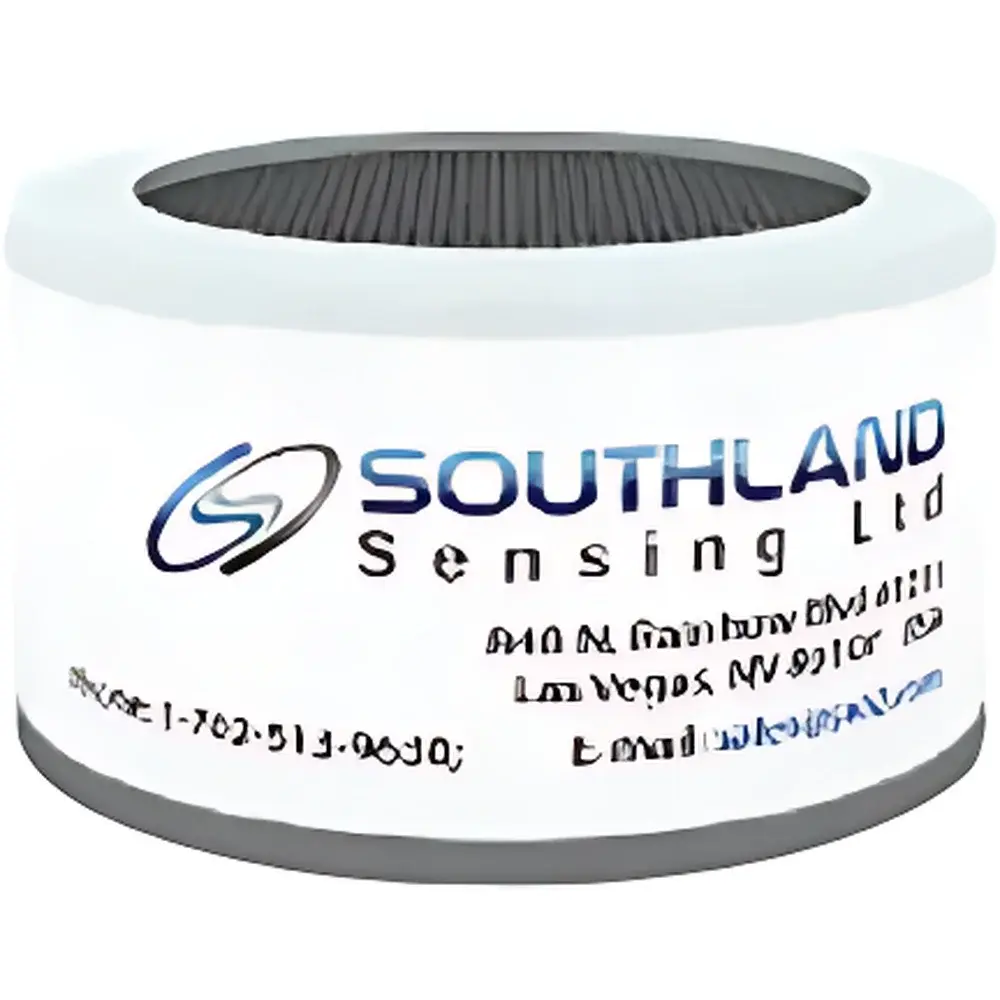
Southland MTO2-133 PPM Oxygen Analyzer Sensor
| Brand | Southland |
|---|---|
| Origin | Beijing, China |
| Model | MTO2-133 |
| Measurement Principle | Microcombustion Cell |
| Output Signal | 520–1020 µA |
| Range | 0–10 ppm (Low Range) / 0–10,000 ppm (Full Scale) |
| Response Time (T90) | 7 s |
| Accuracy | ±1% FS |
| Repeatability | ±0.5% FS |
Overview
The Southland MTO2-133 PPM Oxygen Analyzer Sensor is a high-stability electrochemical sensor engineered for continuous, trace-level oxygen monitoring in inert and reducing process atmospheres. It operates on the microcombustion cell principle—where oxygen molecules diffuse through a selective membrane and undergo catalytic oxidation at a heated anode, generating a current proportional to O₂ partial pressure. This amperometric detection method delivers stable, low-drift output with inherent immunity to background gas interference (e.g., N₂, Ar, H₂, CO, CH₄), making it suitable for applications requiring reliable sub-10 ppm detection in ultra-pure gases, semiconductor purge lines, heat-treatment furnaces, and hydrogen-cooled turbine systems. Unlike paramagnetic or zirconia-based analyzers, the MTO2-133 avoids temperature-dependent calibration drift and does not require reference gas or frequent zero/span adjustments under steady-state conditions.
Key Features
- Microcombustion cell architecture with integrated temperature-compensated electronics for consistent signal linearity across ambient operating temperatures (5–45 °C)
- Wide dynamic range: dual-range capability supports both ultra-trace (0–10 ppm) and extended (0–10,000 ppm) measurement without hardware modification
- Fast T90 response time of ≤7 seconds ensures timely detection of oxygen excursions during critical process transitions (e.g., furnace purging, glovebox regeneration)
- High metrological stability: ±0.5% FS repeatability enables robust trending analysis and long-term process validation
- Output signal standardized as a linear 520–1020 µA current loop, compatible with most industrial PLCs, DCS I/O modules, and dedicated oxygen transmitter units
- Robust stainless-steel housing with IP65-rated enclosure and optional VCR or Swagelok® compression fittings for leak-tight integration into high-integrity gas distribution systems
Sample Compatibility & Compliance
The MTO2-133 is validated for use in non-corrosive, dry, particle-free gas streams with dew point ≤ –40 °C. It is incompatible with halogenated compounds, sulfur oxides, heavy hydrocarbons (> C₄), and condensable vapors, which may poison the catalytic electrode surface. For compliance-critical environments—including pharmaceutical nitrogen blanketing, food packaging inerting, and electronics-grade gas supply—the sensor meets functional requirements aligned with ISO 8573-1 (Class 1 compressed air purity), ASTM D6866 (trace O₂ in high-purity gases), and EU GMP Annex 1 (oxygen control in aseptic processing isolators). When integrated into a full analyzer system with audit-trail-capable transmitter, it supports FDA 21 CFR Part 11 data integrity requirements via timestamped calibration logs and user-access controls.
Software & Data Management
As a field-replaceable sensor element, the MTO2-133 does not include embedded firmware or onboard software. Its analog 4–20 mA (or 520–1020 µA) output is designed for seamless integration with third-party transmitters featuring configurable scaling, linearization, temperature compensation, and digital communication protocols (HART®, Modbus RTU/TCP). Compatible platforms include Yokogawa UT55A, Siemens Desigo CC, and Emerson DeltaV DCS—all supporting automated calibration verification, alarm thresholding, and historical trend export compliant with ISA-84 and IEC 61511 safety lifecycle documentation standards.
Applications
- Monitoring residual O₂ in nitrogen or argon purge systems for semiconductor diffusion furnaces and CVD reactors
- Verification of oxygen depletion in pharmaceutical lyophilizer chambers and vial stoppering lines
- In-line verification of inert gas quality prior to aluminum welding or titanium powder handling
- Leak detection in vacuum-jacketed cryogenic pipelines using controlled helium backfill and O₂ ingress tracking
- Quality assurance of modified atmosphere packaging (MAP) headspace gases in food manufacturing
- Process safety interlock triggering in hydrogen-cooled generators when O₂ exceeds 10 ppm thresholds
FAQ
Can the MTO2-133 be used in hydrogen-rich environments?
Yes—it is specifically designed for operation in H₂, N₂, and Ar matrices with no cross-sensitivity to hydrogen concentration up to 100% vol.
What is the expected service life under continuous operation?
Typical operational lifespan is 18–24 months in clean, dry gas; replacement intervals should be scheduled based on performance validation per ISO/IEC 17025 internal calibration procedures.
Is recalibration required after sensor replacement?
Yes—each MTO2-133 unit is factory-calibrated with individual slope and zero coefficients; the host transmitter must be updated with new calibration constants using the provided certificate.
Does the sensor require a flow controller or sample pump?
No—diffusion-limited operation allows direct insertion into pressurized lines (up to 10 bar g) or static headspace monitoring without external flow regulation.
How is moisture exposure mitigated during installation?
A sintered stainless-steel particulate filter (5 µm) and optional integrated desiccant cartridge are recommended upstream to maintain dew point below –40 °C and prevent electrolyte dilution.