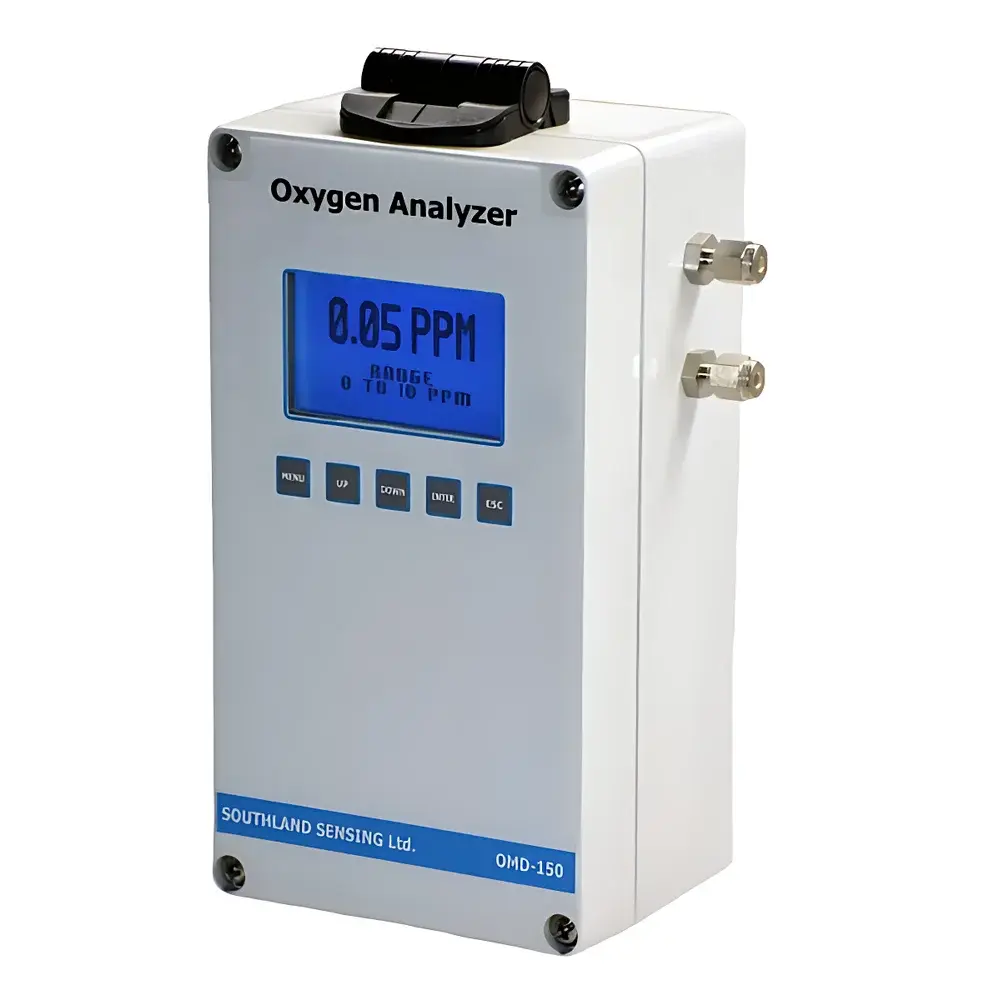
Southland OMD-150-M Micro-Oxygen Analyzer
| Origin | USA |
|---|---|
| Manufacturer Type | Authorized Distributor |
| Origin Category | Imported |
| Model | OMD-150-M |
| Price Range | USD 1,400 – 4,200 |
| Measurement Ranges | 0–10 ppm / 0–100 ppm / 0–1,000 ppm / 0–1 % / 0–25 % / 0–100 % (configurable per sensor variant) |
| Accuracy | < ±1 % FS |
| Certifications | CE |
| Dimensions | 241 × 165 × 96 mm |
| Operating Temperature | −10 to +50 °C |
| Temperature Compensation | Built-in |
| Sensor Type | Miniaturized Electrochemical Fuel Cell |
| Power Supply | 12–24 VDC |
| Current Consumption | 25 mA |
| Analog Output | 6-wire MODBUS RTU |
| Sample Flow Rate | 230–2500 mL/min |
| Compatible Media | N₂, Ar, He, H₂, hydrocarbon streams |
| Warranty | 12 months |
| Intrinsic Safety Option | Available with MTL Zener barrier integration |
Overview
The Southland OMD-150-M Micro-Oxygen Analyzer is a compact, field-deployable electrochemical analyzer engineered for continuous, real-time quantification of trace to percent-level oxygen concentrations in inert, reducing, and process gas streams. Utilizing a miniaturized, temperature-compensated fuel cell sensor, the instrument operates on the principle of galvanic oxygen reduction—where O₂ diffuses through a selective membrane and undergoes an electrochemical reaction at the cathode, generating a current linearly proportional to partial pressure. This measurement architecture ensures high specificity for molecular oxygen without cross-sensitivity to CO₂, H₂S, or hydrocarbons—provided appropriate sensor configuration (e.g., acid-resistant PO2-24 variant) is selected for corrosive gas matrices. Designed for integration into distributed control systems (DCS), programmable logic controllers (PLC), and centralized monitoring platforms, the OMD-150-M delivers stable baseline performance across ambient temperature fluctuations and extended operational cycles, supporting compliance-driven applications in semiconductor fabrication, nitrogen generation, hydrogen purification, and metallurgical off-gas monitoring.
Key Features
- Miniaturized electrochemical fuel cell sensor with inherent selectivity for O₂ and immunity to common interferents (N₂, Ar, CH₄, H₂) when configured correctly
- Configurable multi-range capability: factory-set or field-selectable spans including 0–10 ppm, 0–100 ppm, 0–1,000 ppm, 0–1 %, 0–25 %, and 0–100 % O₂
- Integrated temperature compensation circuitry ensuring measurement stability across −10 to +50 °C operating envelope
- Low-power design (25 mA @ 24 VDC) suitable for remote or battery-backed installations
- Intrinsically safe configuration option via certified MTL Zener barrier integration for Class I, Div 1/Zone 1 hazardous area deployment
- Robust mechanical housing (241 × 165 × 96 mm) with IP65-rated front panel and industrial-grade terminal block interface
- MODBUS RTU over 6-wire RS-485 output enabling direct integration with SCADA, DCS, and asset management systems
Sample Compatibility & Compliance
The OMD-150-M is validated for use with non-corrosive inert gases (N₂, Ar, He), reducing atmospheres (H₂, syngas), and saturated hydrocarbon streams. For applications involving acidic contaminants—including CO₂, H₂S, SO₂, or Cl₂—the PO2-24 acid-resistant sensor variant must be specified at time of order. This variant incorporates chemically stabilized electrodes and diffusion-limiting membranes resistant to passivation and electrolyte degradation. The analyzer complies with CE marking requirements under the EU Electromagnetic Compatibility (2014/30/EU) and Low Voltage (2014/35/EU) Directives. While not inherently 21 CFR Part 11 compliant, audit-ready data logging and user-access control can be implemented at the system level when paired with validated SCADA or MES platforms supporting electronic signatures and change tracking.
Software & Data Management
The OMD-150-M operates as a smart field device with embedded firmware—not requiring proprietary PC software for basic operation. Configuration, range selection, zero/span calibration, and diagnostic status are accessible via MODBUS register mapping (Function Codes 03h/06h). Full register documentation—including scaling factors, alarm thresholds, sensor health indicators, and calibration timestamps—is provided in the device Technical Reference Manual. When integrated into a larger automation ecosystem, the unit supports time-stamped analog-equivalent digital outputs compatible with historian databases (e.g., OSIsoft PI, AVEVA Historian) and predictive maintenance workflows. No local data storage is included; all data persistence and trending occur upstream in the control system.
Applications
- Monitoring residual O₂ in glovebox and dry room purge atmospheres (≤10 ppm detection limit critical for Li-ion battery electrode manufacturing)
- Verification of nitrogen blanketing integrity in chemical reactors and storage vessels (0–100 ppm range)
- In-line verification of oxygen removal efficiency in pressure swing adsorption (PSA) and membrane-based nitrogen generators
- Control of protective atmospheres in annealing furnaces and sintering lines (0–25 % range)
- Leak detection and purity assurance in hydrogen refueling infrastructure (0–1 % range, H₂-compatible sensor)
- Process gas quality assurance in semiconductor CVD/PVD tool purge lines and bulk gas delivery systems
FAQ
What sensor technology does the OMD-150-M employ?
It uses a miniaturized, temperature-compensated electrochemical fuel cell optimized for long-term stability in low-oxygen environments.
Can the OMD-150-M measure oxygen in CO₂-rich streams such as biogas or flue gas?
Standard TO2-1x or TO2-2x sensors are not recommended; the PO2-24 acid-resistant variant must be specified for reliable operation in CO₂/H₂S-containing media.
Is field calibration supported?
Yes—zero and span calibration can be performed using certified gas standards via MODBUS commands or hardware jumper settings; calibration intervals depend on application severity and are typically 3–6 months.
Does the unit support HART or 4–20 mA analog output?
No—it provides MODBUS RTU over RS-485 only; external signal converters are required for 4–20 mA integration.
What is the expected service life of the fuel cell sensor?
Typical operational lifetime is 24–36 months in clean, non-acidic environments; reduced to 12–18 months in high-humidity or trace-acid conditions—even with PO2-24 configuration.
Related Products