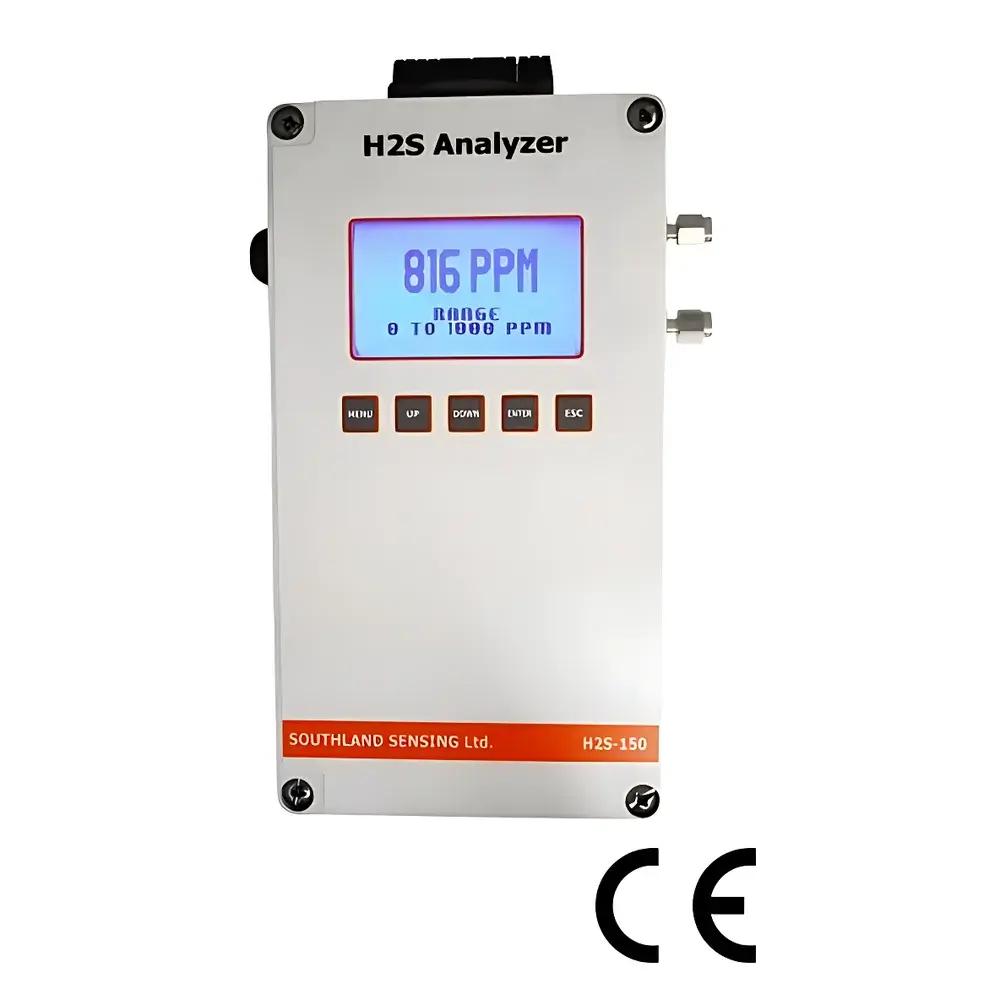
Southland Sensing H2S-150 Economic Hydrogen Sulfide Analyzer
| Origin | USA |
|---|---|
| Manufacturer Type | Authorized Distributor |
| Origin Category | Imported |
| Model | H2S-150 |
| Price Range | USD 1,400 – 4,200 |
| Measurement Ranges | 0–10, 0–50, 0–100, 0–200, 0–500, 0–1,000, 0–2,000 ppm (selectable, auto/manual switching) |
| Accuracy | < ±2% FS |
| Certifications | CE, UL Class I, Div 1, Groups B, C, D |
| Dimensions | 241 × 165 × 96 mm |
| Operating Temperature | −10 to +50 °C |
| Temperature Compensation | Built-in |
| Sensor Type | Electrochemical Fuel Cell (H₂S-specific) |
| Power Supply | 12–24 VDC |
| Current Draw | 25 mA |
| Output Signals | 4–20 mA, 0–10 VDC, MODBUS RTU over RS-485 (ASCII bi-directional) |
| Sample Flow Rate | 230–2500 mL/min |
| Enclosure Rating | IP65 |
| Warranty | 12 months |
| Sample Media | Natural gas streams, biogas, sour gas, treated/untreated process gas |
Overview
The Southland Sensing H2S-150 Economic Hydrogen Sulfide Analyzer is a purpose-engineered, field-deployable electrochemical gas analyzer designed for continuous, real-time monitoring of hydrogen sulfide (H₂S) concentrations in industrial process and safety-critical environments. It employs a proprietary, temperature-compensated fuel cell sensor optimized for selective detection of H₂S in complex gas matrices—including natural gas, biogas, landfill gas, and refinery off-gas—without cross-sensitivity to CO, SO₂, or hydrocarbons under typical operating conditions. Unlike optical or semiconductor-based alternatives, the H₂S-150’s electrochemical architecture delivers stable baseline performance with minimal drift, eliminating the need for frequent zero/span calibration in steady-state applications. Its compact form factor and Class I, Div 1 hazardous area certification enable direct installation in Zone 1 locations per NEC/CEC standards, supporting both upstream production and midstream transmission infrastructure where intrinsic safety and long-term reliability are non-negotiable.
Key Features
- Electrochemical fuel cell sensor with proven selectivity for H₂S across seven user-selectable ranges (0–10 ppm to 0–2000 ppm), configurable via front-panel interface or MODBUS command
- Automatic range switching logic triggered by concentration thresholds, ensuring optimal signal-to-noise ratio without manual intervention
- Integrated temperature compensation circuitry maintaining measurement integrity across −10 °C to +50 °C ambient operation
- Dual alarm relays (programmable high/low setpoints) compliant with SIL 2 functional safety requirements per IEC 61508
- Backlit graphical LCD display with intuitive menu navigation, real-time concentration readout, and diagnostic status indicators
- Simultaneous analog outputs (4–20 mA and 0–10 VDC) plus MODBUS RTU over RS-485 for seamless integration into DCS, PLC, or SCADA systems
- IP65-rated NEMA 4X enclosure with stainless steel mounting hardware suitable for outdoor and corrosive atmospheres
- No consumables or electrolyte refills required; sensor service life exceeds 24 months under typical field conditions
Sample Compatibility & Compliance
The H2S-150 is validated for use with dry or moderately humid natural gas (up to 60% RH), biogas (CH₄/CO₂/H₂S mixtures), and treated sour gas streams containing up to 5% CO₂ and trace mercaptans. It is not intended for use in condensing, particulate-laden, or highly acidic (pH < 4) sample streams without upstream conditioning (e.g., coalescing filter, thermal mass flow controller, and moisture trap). The analyzer meets CE marking requirements under Directive 2014/30/EU (EMC) and 2014/34/EU (ATEX/IECEx equivalent for North America). Its UL listing to Class I, Div 1, Groups B, C, D confirms suitability for installation in hazardous locations where flammable gases may be present during normal operation. All firmware and configuration data adhere to NIST-traceable calibration protocols and support audit-ready documentation per ISO/IEC 17025 and API RP 14C guidelines.
Software & Data Management
Configuration, diagnostics, and historical trend review are supported via the optional Southland Sensing Configuration Utility (Windows-based PC software) using standard USB-to-RS485 adapters. The device logs timestamped concentration values, sensor voltage, temperature, and alarm events internally for up to 30 days at 1-minute intervals. MODBUS register mapping includes all critical parameters—span/gain coefficients, alarm thresholds, relay states, and sensor health metrics—for third-party historian integration. Firmware updates are performed remotely via MODBUS or locally via micro-USB port, with checksum verification and rollback capability. Data export supports CSV format compatible with LIMS platforms and complies with FDA 21 CFR Part 11 requirements when deployed with electronic signature-enabled host systems.
Applications
- Natural gas gathering stations: Monitoring H₂S pre- and post-amine scrubbers to verify removal efficiency and ensure pipeline specification compliance (e.g., GPA 2261, ASTM D1945)
- Biogas upgrading facilities: Quantifying residual H₂S prior to membrane separation or pressure swing adsorption units
- Landfill gas collection systems: Detecting fugitive emissions and optimizing scavenger injection rates
- Refinery sour water strippers and Claus plant feed streams: Providing feedback control for sulfur recovery unit optimization
- Power generation using syngas or biomass-derived fuel: Ensuring turbine inlet gas purity and catalyst protection
- Research laboratories conducting corrosion studies on carbon steel or stainless alloys exposed to H₂S-bearing environments
FAQ
What is the recommended sample conditioning for high-moisture biogas?
A heated sample line (maintained above dew point) and particulate filter (≤1 µm) are mandatory; optional chemical scrubbers (e.g., activated carbon) may be used to remove siloxanes if present.
Can the H2S-150 be calibrated using certified gas standards?
Yes—zero gas (N₂ or synthetic air) and span gas (certified H₂S/N₂ mixture at target range midpoint) are required; calibration interval is typically 3–6 months depending on exposure history and regulatory requirements.
Is MODBUS communication compatible with Siemens S7-1200 PLCs?
Yes—the device implements standard MODBUS RTU protocol with configurable slave ID, baud rate (9.6–115.2 kbps), and parity; full register map is provided in the Engineering Manual.
Does the analyzer support HART protocol?
No—only 4–20 mA analog output and MODBUS RS-485 are supported; HART-capable variants (e.g., H2S-250 series) are available upon request.
What is the expected sensor lifetime in a 50 ppm H₂S continuous exposure environment?
Typical operational life exceeds 18 months; accelerated aging tests per IEC 60068-2-60 confirm >12,000 hours of stable response at 50% of full scale under controlled humidity and temperature conditions.