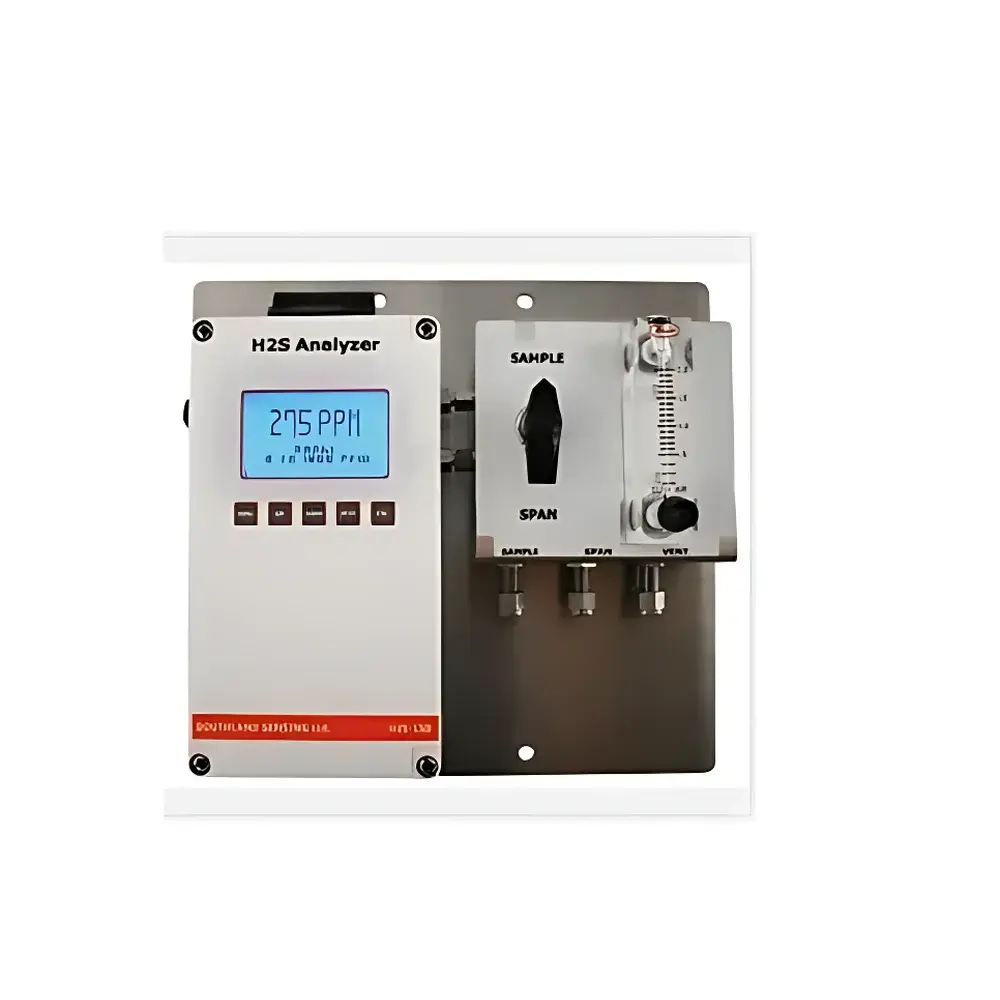
Southland Sensing H2S-150-NG Natural Gas-Specific Hydrogen Sulfide Analyzer
| Origin | USA |
|---|---|
| Manufacturer Type | Authorized Distributor |
| Origin Category | Imported |
| Model | H2S-150-NG |
| Measurement Range | 0–10 / 0–50 / 0–100 / 0–200 / 0–500 / 0–1000 / 0–2000 ppm (selectable, auto/manual switching) |
| Accuracy | < ±2% FS |
| Certifications | CE, UL Class I, Div 1, Groups B, C, D |
| Dimensions | 241 × 165 × 96 mm |
| Operating Temperature | –10 to +50 °C |
| Temperature Compensation | Yes |
| Sensor Technology | Electrochemical Fuel Cell (H₂S-specific) |
| Power Supply | 12–24 VDC |
| Current Consumption | 25 mA |
| Output Signals | 4–20 mA, 0–10 VDC, MODBUS RTU over RS-485 (ASCII bi-directional) |
| Sample Flow Rate | 230–2500 mL/min |
| Sample Medium | Natural gas streams (pre- and post-desulfurization), landfill gas, refinery off-gas |
| Warranty | 12 months |
Overview
The Southland Sensing H2S-150-NG is a purpose-engineered electrochemical hydrogen sulfide (H₂S) analyzer designed specifically for continuous, real-time monitoring of trace H₂S concentrations in natural gas transmission, processing, and conditioning applications. Unlike generic toxic gas detectors, the H2S-150-NG integrates a proprietary micro-fuel-cell sensor optimized for hydrocarbon-rich, low-oxygen environments—ensuring stable baseline response and minimal cross-sensitivity to CO, SO₂, NO₂, or total reduced sulfur (TRS) compounds commonly present in sour gas streams. Its measurement principle relies on the selective oxidation of H₂S at the anode of a solid-electrolyte fuel cell, generating a linear current proportional to H₂S partial pressure. This amperometric detection architecture delivers high reproducibility (< ±2% full-scale accuracy) across dynamically varying gas matrices, making it suitable for custody-transfer adjacent monitoring, desulfurization unit feedback control, and compliance verification per ISO 8573-5 and ASTM D6299.
Key Features
- Gas-specific electrochemical fuel cell sensor with built-in temperature compensation and zero-drift suppression for long-term stability in unconditioned natural gas
- UL-listed Class I, Division 1, Groups B, C, D hazardous area certification—enabling direct installation in Zone 1/Division 1 locations without external purging or explosion-proof enclosures
- Multi-range configuration support: user-selectable or auto-switching spans from 0–10 ppm to 0–2000 ppm, accommodating both pipeline specification limits (e.g., ≤4 ppm for city gate) and upstream sour gas monitoring
- Dual analog outputs (4–20 mA and 0–10 VDC) plus MODBUS RTU over RS-485 for seamless integration into DCS, SCADA, and PLC-based process control systems
- Backlit LCD display with intuitive menu navigation, real-time concentration readout, alarm status indicators, and diagnostic logs accessible without external software
- Low-maintenance design: sensor lifetime exceeds 24 months under typical field conditions; no electrolyte refills, filter replacements, or calibration gas required for routine operation
Sample Compatibility & Compliance
The H2S-150-NG is validated for direct sampling of raw and treated natural gas, including high-BTU streams containing up to 95% methane, up to 15% ethane/propane, and trace levels of CO₂, N₂, and water vapor (dew point ≤ –20 °C). It meets EN 61000-6-2/-6-3 for electromagnetic compatibility and carries CE marking per the EU ATEX Directive 2014/34/EU (Category 2G). Its Class I, Div 1 rating conforms to NFPA 70 and NEC Article 500 requirements for flammable gas environments. While not intrinsically safe by default, its low-power architecture (25 mA @ 24 VDC) enables use with approved safety barriers in Class I, Zone 0 installations when configured per manufacturer’s wiring guidelines. The analyzer supports GLP-compliant data integrity through non-volatile memory storage of calibration history, alarm events, and sensor health metrics.
Software & Data Management
No proprietary PC software is required for basic operation. Configuration, span adjustment, and alarm threshold setting are performed via front-panel keypad and LCD interface. For advanced diagnostics and audit-ready reporting, optional MODBUS register mapping allows integration with third-party historian platforms (e.g., OSIsoft PI, Inductive Automation Ignition). All critical operational parameters—including sensor voltage, temperature-compensated output, and relay activation timestamps—are logged internally with time-stamped records retained for ≥30 days. The device supports MODBUS ASCII protocol for bidirectional communication, enabling remote firmware updates (via authorized service channels) and automated calibration validation reports compliant with ISO/IEC 17025 documentation requirements.
Applications
- Real-time H₂S monitoring at natural gas wellheads, compressor stations, and metering stations prior to odorization
- Feed and product stream analysis in amine, molecular sieve, and iron sponge desulfurization units
- Compliance verification against pipeline specifications (e.g., GPA 2261, AGA Report No. 8) and regulatory thresholds (e.g., EPA 40 CFR Part 60, Subpart OOOO)
- Landfill gas upgrading facilities tracking H₂S removal efficiency pre- and post-biogas cleaning
- Refinery fuel gas header monitoring and flare gas composition assurance
- Research applications in catalytic desulfurization kinetics and sorbent breakthrough studies
FAQ
Is the H2S-150-NG certified for use in hazardous areas?
Yes—it carries UL Class I, Division 1, Groups B, C, D listing and meets ATEX Category 2G requirements for installation in Zone 1 classified locations.
Does the analyzer require zero/span calibration with certified gas standards?
Field zero calibration is possible using certified nitrogen; span calibration is recommended annually using NIST-traceable H₂S-in-nitrogen standard gas (±2% uncertainty).
Can it operate continuously in high-humidity natural gas streams?
Yes—the sensor housing includes hydrophobic particulate filtration and is rated for sample dew points down to –20 °C; optional heated sample line kits are available for sub-zero ambient conditions.
What is the expected service life of the electrochemical sensor?
Under typical natural gas service (≤100 ppm H₂S average exposure), the fuel cell sensor maintains specified accuracy for ≥24 months before replacement is advised.
Is MODBUS communication compatible with Siemens S7 and Rockwell ControlLogix PLCs?
Yes—standard MODBUS RTU implementation over RS-485 ensures native interoperability; register maps and configuration templates are provided in the technical manual.
Related Products