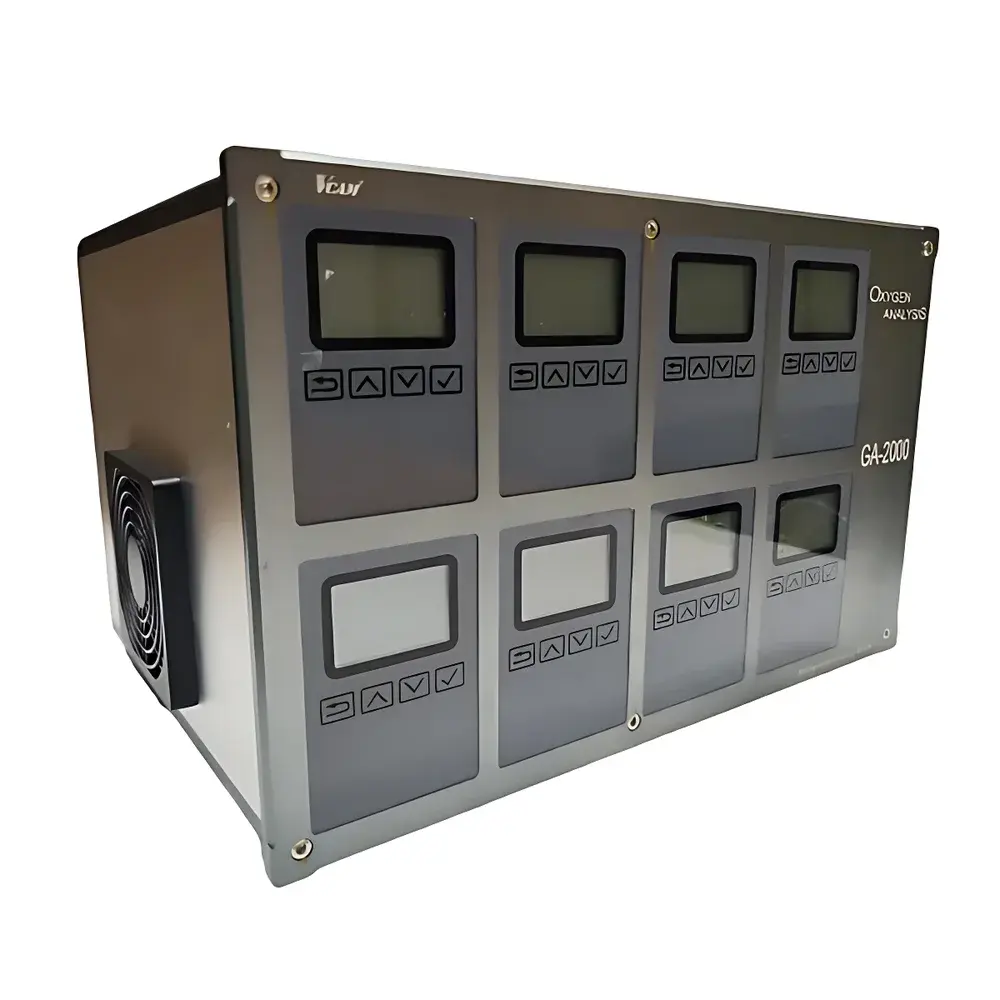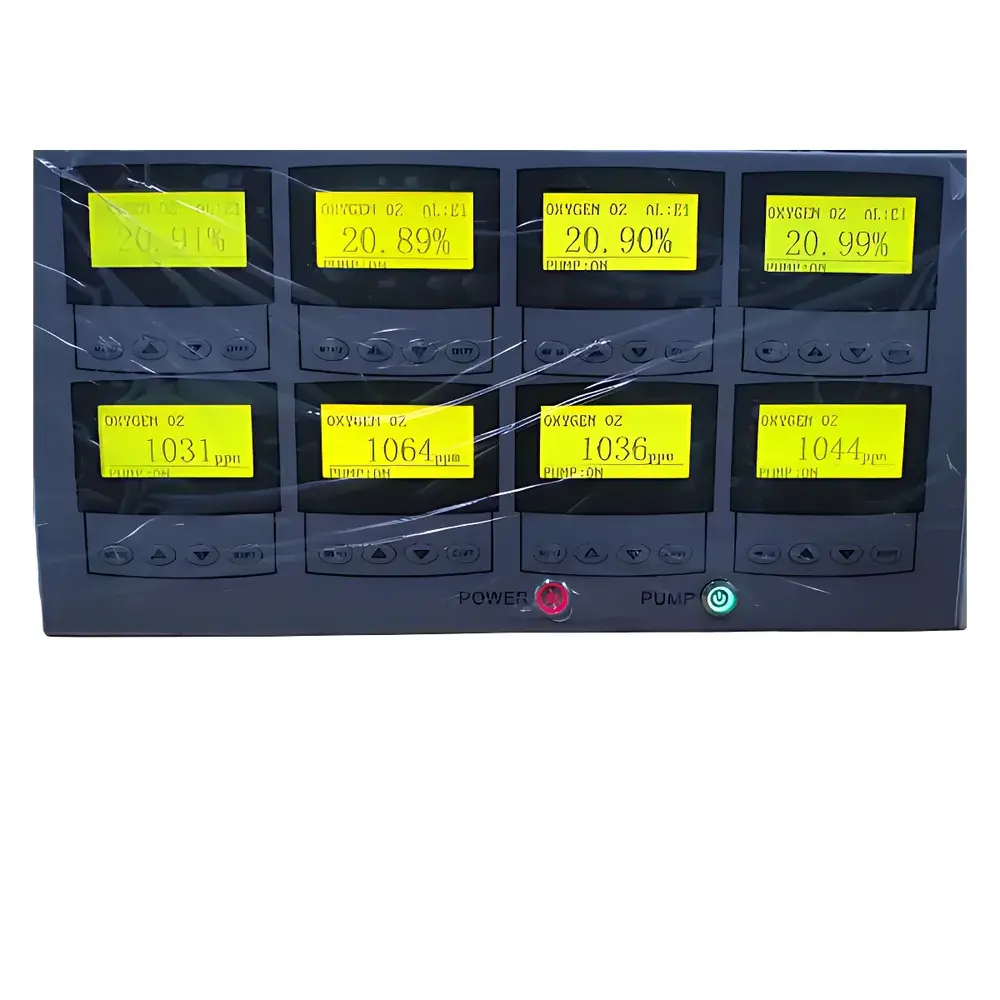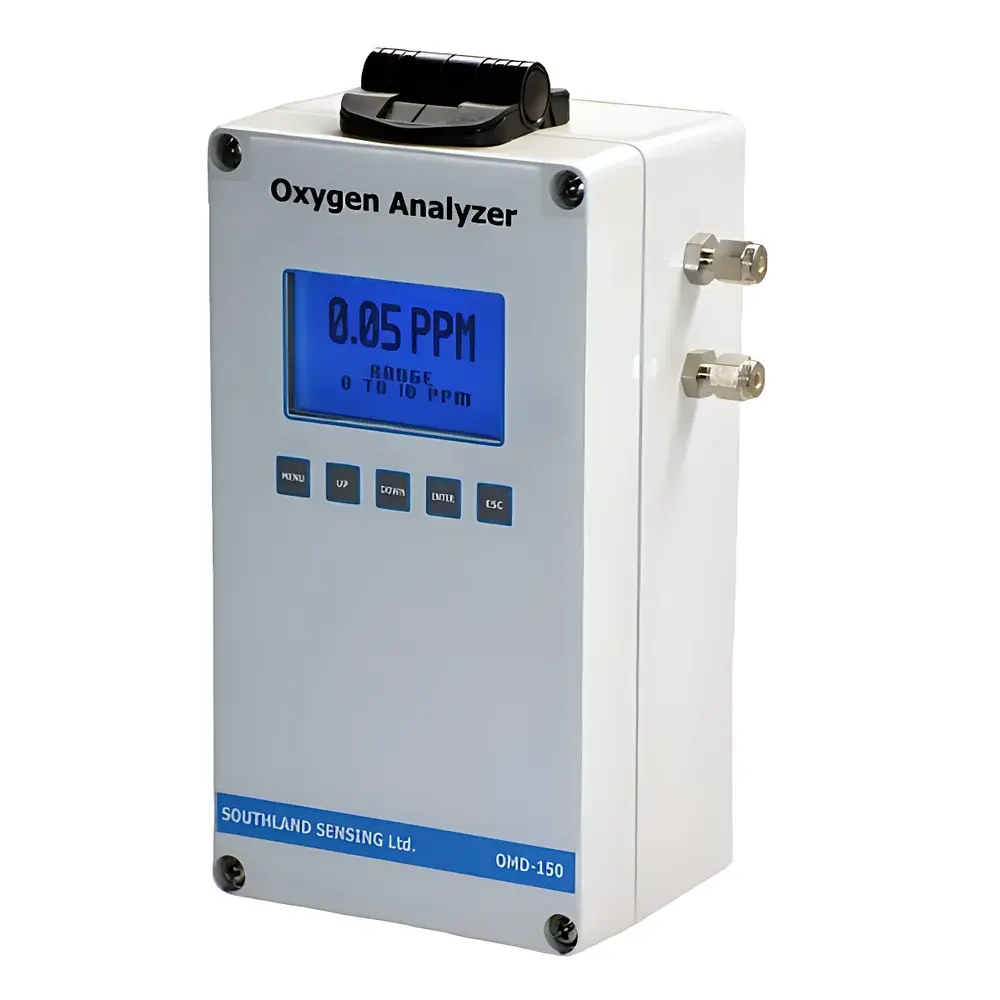
Southland Sensing OMD-150 Fuel Cell Oxygen Analyzer
| Origin | USA |
|---|---|
| Manufacturer Type | Authorized Distributor |
| Origin Category | Imported |
| Model | OMD-150 |
| Price Range | USD 1–9,999 |
| Safety Option | Intrinsically Safe (MTL Zener Barrier Compatible) |
| Measurement Ranges | 0–10 ppm, 0–100 ppm, 0–1,000 ppm, 0–1 %, 0–25 %, 0–100 % O₂ (configurable per sensor variant: TO2-1x, TO2-2x, PO2-160, PO2-24) |
| Accuracy | < ±1 % FS |
| Certifications | CE |
| Dimensions | 241 × 165 × 96 mm |
| Operating Temperature | –10 to +50 °C |
| Temperature Compensation | Integrated |
| Sensor Type | Miniaturized Electrochemical Fuel Cell |
| Warranty | 12 months |
| Power Supply | 12–24 VDC |
| Current Draw | 25 mA |
| Analog Outputs | 4–20 mA and 0–10 V (isolated) |
| Sample Flow Rate | 230–2500 mL/min |
| Compatible Gas Matrices | N₂, Ar, He, H₂, hydrocarbon streams |
| Enclosure Rating | IP65 (standard) |
Overview
The Southland Sensing OMD-150 is a high-stability, electrochemical fuel cell-based oxygen analyzer engineered for continuous, real-time monitoring of trace to percent-level O₂ concentrations in industrial process and inert gas streams. Unlike paramagnetic or optical sensors, the OMD-150 employs a solid-state, galvanic fuel cell principle—where molecular oxygen undergoes catalytic reduction at the cathode, generating a current linearly proportional to partial pressure. This architecture delivers inherently stable zero and span characteristics, minimal drift over extended operation, and immunity to background gas interference from non-acidic matrices such as nitrogen, argon, helium, hydrogen, and saturated hydrocarbons. Designed for integration into critical control loops, the analyzer meets the functional safety expectations of continuous emission monitoring systems (CEMS), glovebox atmosphere management, and high-purity gas production infrastructure.
Key Features
- Modular fuel cell sensor platform with field-replaceable cartridges—each calibrated and certified for a defined range (e.g., TO2-1x for 0–25 % O₂; PO2-24 for acidic gas environments)
- Intrinsically safe configuration option compliant with IEC 60079-11, supporting direct installation in Zone 1/2 hazardous areas when paired with MTL-certified Zener barriers
- Integrated temperature compensation circuitry ensures measurement stability across –10 to +50 °C ambient operating conditions without external thermostating
- Low-power design (25 mA @ 24 VDC) enables deployment in remote or energy-constrained locations, including mobile skids and ISO container-based analyzers
- Dual analog outputs (4–20 mA and 0–10 V) provide redundant signal routing to DCS, PLC, or data historians while maintaining electrical isolation per IEC 61000-4-5
- Robust aluminum enclosure rated IP65, with front-panel push-button interface for local zero/span verification and range selection
- Factory-calibrated with NIST-traceable standards; calibration certificates include uncertainty budgets per ISO/IEC 17025 requirements
Sample Compatibility & Compliance
The OMD-150 is validated for use with non-corrosive, dry process gases—including ultra-high-purity nitrogen, argon, hydrogen, and hydrocarbon mixtures. For applications involving CO₂, H₂S, SO₂, or other acidic species, the PO2-24 variant utilizes a proprietary acid-resistant electrolyte formulation and dual-membrane barrier, enabling reliable operation without premature sensor degradation. All configurations comply with CE marking directives (2014/30/EU EMC, 2014/35/EU LVD) and meet mechanical robustness requirements per EN 61000-6-2 (immunity) and EN 61000-6-4 (emissions). While not inherently FDA 21 CFR Part 11 compliant, the device supports audit-ready data logging when integrated with validated SCADA platforms adhering to GMP/GLP workflows.
Software & Data Management
The OMD-150 operates as a standalone analog transmitter and does not include embedded firmware-based data storage or USB connectivity. However, its 4–20 mA output is fully compatible with industry-standard asset monitoring systems—including Emerson DeltaV, Honeywell Experion PKS, Siemens Desigo CC, and OSIsoft PI System—enabling time-series trending, alarm annunciation, and automated calibration event logging. When deployed with a certified HART-enabled I/O module, the analog signal can be augmented with diagnostic metadata (e.g., sensor health status, temperature reading, fault codes) via FDT/DTM or EDD frameworks. Calibration records, maintenance logs, and certificate archives are maintained externally per ISO 5667-3 and ASTM D6299 protocols.
Applications
- Continuous O₂ monitoring in nitrogen generation systems (PSA/VSA), ensuring purity compliance with ISO 8573-1 Class 1–3 specifications
- Trace oxygen detection (<10 ppm) in semiconductor fabrication gloveboxes and annealing furnaces under forming gas (N₂/H₂) or pure Ar atmospheres
- Process safety interlocks in hydrogenation reactors and catalytic reformers, where sub-ppm O₂ ingress poses explosion risk
- Quality assurance in cryogenic air separation units (ASUs), verifying O₂ bleed stream composition prior to liquefaction
- Leak detection in vacuum-insulated piping and LNG transfer lines using O₂-inert gas differential analysis
- Environmental monitoring of flue gas desulfurization (FGD) bypass streams where residual O₂ indicates incomplete scrubbing efficiency
FAQ
What sensor technology does the OMD-150 employ, and how does it differ from zirconia or paramagnetic analyzers?
The OMD-150 uses a miniature electrochemical fuel cell—not zirconia (high-temp solid electrolyte) or paramagnetic (magnetic susceptibility-based) sensing. It offers lower power consumption, no heater-related thermal stress, and superior long-term baseline stability in low-flow, low-O₂ applications.
Can the OMD-150 measure oxygen in carbon dioxide-rich streams, such as biogas or food-grade CO₂?
Yes—but only when equipped with the PO2-24 acid-resistant sensor variant. Standard TO2-series cells degrade rapidly in CO₂ >1 % due to carbonate formation; PO2-24 includes chemically stabilized electrodes and hydrophobic diffusion barriers.
Is field calibration possible, and what tools are required?
Yes. Zero calibration requires certified nitrogen (99.999 % purity); span calibration uses certified O₂-in-N₂ standard gas matching the configured range. No proprietary software or PC interface is needed—adjustments are performed via front-panel buttons and analog meter verification.
Does the analyzer support HART communication or digital bus protocols?
No. The OMD-150 is an analog-only transmitter. For digital integration, it must be paired with a HART-enabled I/O card or a third-party analog-to-HART converter meeting IEC 61158 specifications.
What is the expected service life of the fuel cell sensor under typical operating conditions?
At 25 °C and <1 % O₂ exposure, the standard TO2-1x sensor exhibits a minimum operational lifespan of 24 months. In high-O₂ (21 %) or elevated-temperature environments, service life reduces proportionally—typically 12–18 months—with predictable linear decay in output signal amplitude.