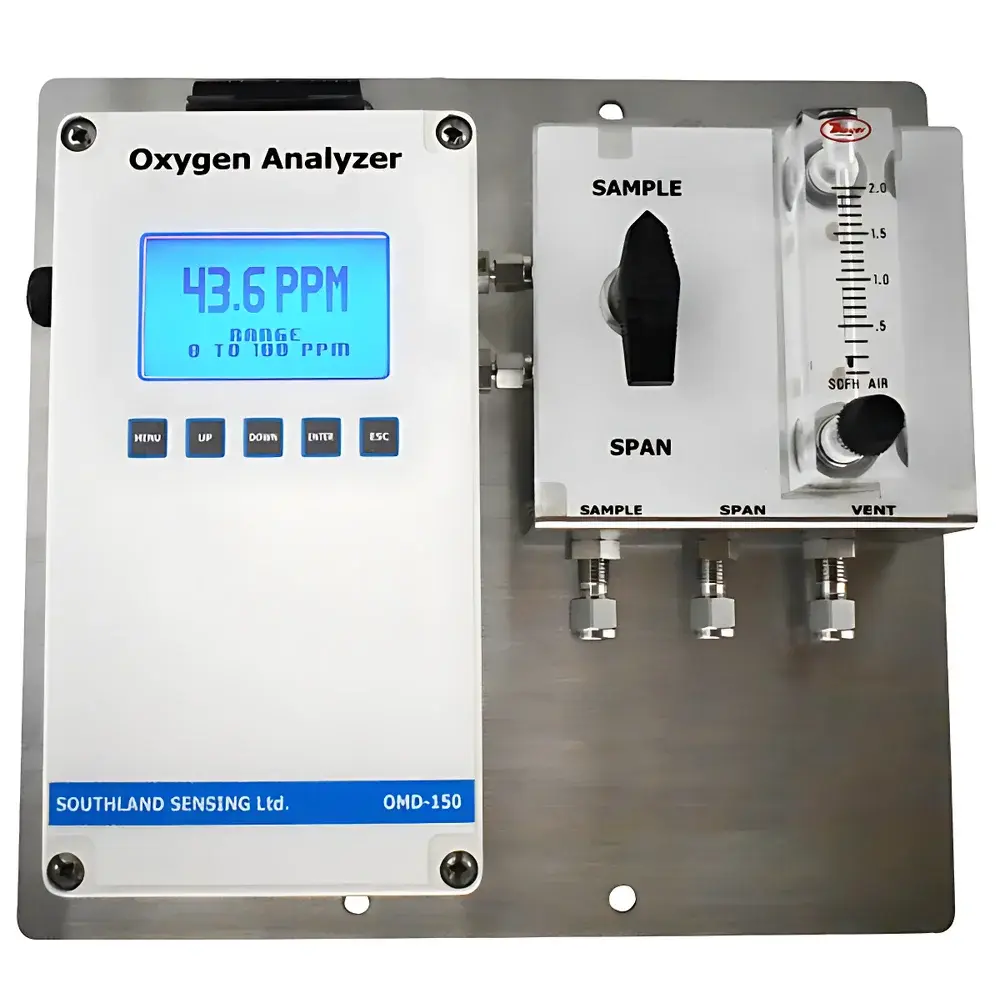
Southland Sensing OMD-150-NG Online Trace Oxygen Analyzer
| Origin | USA |
|---|---|
| Manufacturer Type | Authorized Distributor |
| Origin Category | Imported |
| Model | OMD-150-NG |
| Price Range | USD 4,200 – 7,000 |
| Accuracy | < ±1% of full scale |
| Measurement Ranges | 0–10 ppm, 0–100 ppm, 0–1,000 ppm, 0–10,000 ppm, 0–25% O₂ |
| Detection Limit | 100 ppb |
| Sensor Types | TO2-1x (ppm-level trace), TO2-2x (CO₂/H₂S-tolerant ppm), PO2-160 (percent-level), PO2-24 (CO₂/H₂S-tolerant percent) |
| Sensor Lifetime | 24 months at 25°C |
| Response Time (t₉₀) | ≤15 s |
| Linearity | >0.995 across all ranges |
| Pressure Range | 0–3 MPa inlet, vent to atmosphere |
| Sample Flow Rate | 0.25–2.5 L/min (recommended: 1 L/min) |
| Temperature Range | 5–45°C (TO2), –20–45°C (PO2) |
| Output | 4–20 mA analog |
| Power Supply | 9–28 VDC |
| Certifications | CE, ATEX/IECEx Class I, Div 1, Groups B, C, D (intrinsically safe) |
| Alarm Outputs | 2 relay outputs |
| Calibration | Certified standard gas at ~80% of selected span |
| Compensation | Automatic temperature and pressure compensation |
| Display | Backlit LCD, resolution 0.01 ppm |
| Enclosure | IP65-rated front panel |
| Wetted Materials | 316 stainless steel |
| Warranty | 12 months (instrument and sensor) |
Overview
The Southland Sensing OMD-150-NG is a high-stability, electrochemical trace oxygen analyzer engineered for continuous, real-time monitoring of oxygen concentrations in inert, reducing, and reactive process gas streams. It employs proprietary, sealed, maintenance-free fuel cell sensors—specifically the TO2-1x, TO2-2x, PO2-160, and PO2-24 variants—designed to deliver selective, drift-resistant O₂ measurement without electrolyte replenishment or electrode cleaning. Unlike paramagnetic or zirconia-based analyzers, this instrument leverages galvanic electrochemical principles: molecular oxygen diffuses through a selective membrane into an aqueous electrolyte, generating a current proportional to partial pressure. The resulting signal is linearized, temperature- and pressure-compensated, and converted to a calibrated concentration output. Its architecture supports deployment in demanding industrial environments—including Class I, Division 1 hazardous areas—making it suitable for critical purity verification in nitrogen blanketing, hydrogen purification, semiconductor purge lines, and high-purity air separation units.
Key Features
- True maintenance-free operation: Sealed electrochemical sensors require no electrolyte refills, membrane replacements, or periodic polarization cycles over their 24-month rated lifetime at 25°C.
- Multi-range flexibility: Eight programmable spans—from 0–10 ppm to 0–100% O₂—with automatic or manual range selection via front-panel controls.
- Hazardous area compliance: Certified intrinsically safe per ATEX/IECEx standards for Class I, Division 1, Groups B, C, D—enabling direct installation in explosive atmospheres without external barriers.
- Robust environmental compensation: Integrated temperature and absolute pressure sensors enable real-time correction of partial pressure effects, ensuring accuracy across variable process conditions.
- High-fidelity signal integrity: Linear response (>0.995 R²) across all ranges; <±1% full-scale accuracy; detection limit down to 100 ppb with 0.01 ppm display resolution.
- Industrial-grade interface: IP65-rated front panel with backlit LCD, waterproof keypad, and dual SPDT relay alarms for fail-safe process interlocks.
- Gas-selective measurement: Sensors exhibit negligible cross-sensitivity to CO₂, H₂S, hydrocarbons, helium, hydrogen, and nitrogen—validated for use in 100% background gases.
Sample Compatibility & Compliance
The OMD-150-NG is validated for continuous analysis of oxygen in inert carrier gases (N₂, Ar, He), reducing atmospheres (H₂, syngas), acid gas streams (CO₂-rich), and ultra-dry process lines (dew point < –70°C). All wetted parts—including sample inlet, sensor chamber, and exhaust path—are constructed from electropolished 316 stainless steel to prevent catalytic oxidation or surface adsorption artifacts. The analyzer complies with ISO 8573-1 (compressed air purity), ASTM D6866 (bio-based content verification via O₂ depletion), and USP (water-for-injection and purified water system monitoring). For regulated pharmaceutical or biotech applications, its 4–20 mA output and relay logic support integration into DCS/SCADA systems compliant with FDA 21 CFR Part 11 when paired with audit-trail-capable data historians.
Software & Data Management
While the OMD-150-NG operates as a standalone field instrument with local calibration and diagnostics, its 4–20 mA analog output enables seamless connection to distributed control systems (DCS), programmable logic controllers (PLCs), or centralized data acquisition platforms. Optional analog-to-digital converters with Modbus RTU or HART communication modules allow remote configuration, trend logging, and alarm event timestamping. Calibration records—including date, operator ID, standard gas lot number, and post-calibration zero/span verification values—can be documented manually per GLP/GMP requirements. No embedded firmware requires validation; however, users implementing automated calibration routines must validate the entire sequence per ISO/IEC 17025 clause 7.7.
Applications
- Monitoring residual O₂ in nitrogen-purged reactors, distillation columns, and storage vessels during chemical synthesis and polymer processing.
- Verifying oxygen purity in on-site nitrogen generators and membrane-based air separation units (ASUs) prior to distribution to cleanrooms or inerting systems.
- Controlling catalyst protection in hydrogen reformers and ammonia synthesis loops where sub-ppm O₂ prevents irreversible metal oxide formation.
- Ensuring process gas integrity in semiconductor fab tool purge lines, especially for ALD/CVD chambers requiring <1 ppm O₂ stability over 72-hour runs.
- Validating oxygen scavenging efficiency in food packaging headspace analysis and medical device sterilization tunnels using ethylene oxide or hydrogen peroxide vapor.
- Supporting safety-critical monitoring in confined-space entry protocols and life-support gas blending stations (e.g., hyperbaric chambers, aviation oxygen systems).
FAQ
What sensor technology does the OMD-150-NG use, and how does it differ from paramagnetic or zirconia analyzers?
It uses proprietary galvanic fuel cell sensors—electrochemical devices that generate current solely in response to O₂ partial pressure. Unlike zirconia cells, they operate at ambient temperature and require no reference gas; unlike paramagnetic analyzers, they offer superior selectivity in hydrocarbon-rich streams and lower power consumption.
Can the analyzer measure oxygen in 100% hydrogen or 100% CO₂ without interference?
Yes—the TO2-2x and PO2-24 sensor variants are specifically formulated to maintain accuracy and stability in backgrounds containing ≥0.5% CO₂ or H₂S, eliminating the need for external scrubbers in most refinery or biogas applications.
Is field calibration possible, and what standard gas is required?
Yes—calibration is performed using a certified NIST-traceable standard gas at approximately 80% of the selected measurement span. Zero calibration may be conducted using high-purity nitrogen (99.999%+) or certified zero gas.
What is the maximum allowable sample pressure, and is back-pressure regulation required?
The inlet accepts up to 3 MPa (435 psi); no external pressure regulator is needed if system pressure remains within specification. A built-in pressure relief valve safeguards the sensor assembly.
How is sensor lifetime defined, and does it vary with operating temperature or humidity?
Rated lifetime is 24 months at 25°C and 45°C or condensing moisture accelerates electrolyte evaporation and reduces functional longevity—hence the specified operating range limits.
Related Products