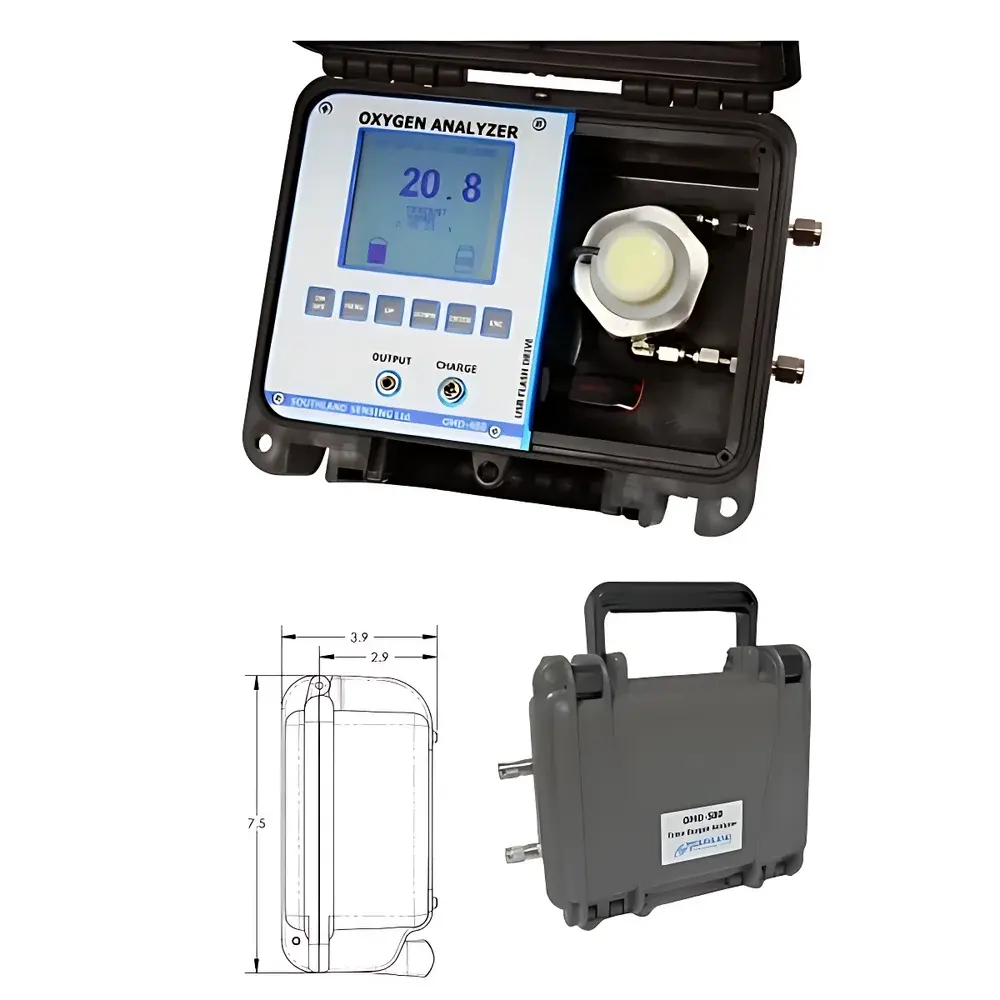
Southland Sensing OMD-480P Portable Pump-Aspirated Percent Oxygen Analyzer
| Origin | USA |
|---|---|
| Manufacturer Type | Authorized Distributor |
| Origin Category | Imported |
| Model | OMD-480P |
| Price Range | USD 4,200 – 7,000 (FOB) |
| Sensor Type | Micro-Fuel-Cell Oxygen Sensor |
| Measurement Range | 0–100% O₂ (selectable full-scale ranges: 1%, 5%, 10%, 25%, 100%) |
| Accuracy | < ±1% FS |
| Resolution | 0.01% O₂ (at 0–25% range) |
| Operating Temperature | –10 to +50 °C |
| Temperature Compensation | Built-in, automatic |
| Sample Flow Rate | 230–2500 mL/min |
| Power Supply | 12–24 VDC, 25 mA typical |
| Analog Outputs | 4–20 mA, 0–10 VDC |
| Digital Interface | MODBUS RTU over RS485 (ASCII protocol, bi-directional) |
| Data Storage | Removable 8 GB USB flash drive (log interval configurable) |
| Display | Backlit LCD, auto-ranging |
| Enclosure Dimensions | 241 × 165 × 96 mm (W × H × D) |
| Certifications | CE, RoHS |
| Warranty | 12 months from shipment |
| Compatible Gases | N₂, Ar, He, H₂, CH₄, CO₂ (with acid-resistant sensor option), C₂H₄, and other inert or reducing process gases |
| Optional Sensor Variant | Acid-Resistant Fuel Cell (for H₂S, SO₂, CO₂-containing streams) |
| Compliance | Designed per IEC 61000-6-2/6-4 EMC standards |
Overview
The Southland Sensing OMD-480P is a field-deployable, pump-aspirated oxygen analyzer engineered for high-reliability quantitative measurement of molecular oxygen concentration across industrial process gas streams. It employs an electrochemical micro-fuel-cell sensor — a galvanic cell technology that generates a current proportional to the partial pressure of O₂ in the sample gas, without requiring external polarization voltage or consumable electrolyte refills. This principle ensures long-term stability, low drift (<0.5% FS/month), and inherent immunity to background gas composition shifts when used within specified compatibility limits. The instrument is optimized for applications demanding rapid response (T₉₀ < 15 s), zero maintenance between calibrations, and operation under variable ambient conditions — including transient temperature gradients and moderate particulate load. Its compact form factor and integrated sampling pump enable direct insertion into gas manifolds, purge lines, or nitrogen blanketing systems without auxiliary vacuum sources.
Key Features
- True portable architecture with internal rechargeable battery option (optional) and integrated diaphragm sampling pump (230–2500 mL/min, adjustable flow control)
- Five selectable full-scale ranges (1%, 5%, 10%, 25%, 100% O₂) with automatic range switching and real-time %FS display
- High-resolution backlit LCD interface with intuitive menu navigation, on-screen calibration prompts, and live diagnostics
- Onboard 8 GB removable USB storage supporting time-stamped CSV data logging (user-configurable interval: 1 s to 60 min)
- Dual-output capability: isolated 4–20 mA analog output (HART-compatible) plus MODBUS RTU over RS485 for integration into DCS, SCADA, or PLC systems
- Temperature-compensated electronics with built-in Pt100 reference sensor ensuring accuracy across –10 to +50 °C ambient
- Optional acid-resistant fuel-cell sensor variant certified for continuous exposure to up to 100 ppm H₂S, 500 ppm CO₂, or 50 ppm SO₂
- CE-marked enclosure rated IP54 for dust and splash resistance; compliant with IEC 61000-6-2 (immunity) and IEC 61000-6-4 (emissions)
Sample Compatibility & Compliance
The OMD-480P is validated for use with non-corrosive, non-condensing process gases including nitrogen, argon, helium, hydrogen, methane, ethylene, and purified air. For applications involving acidic contaminants (e.g., CO₂-rich biogas, sour natural gas, or H₂S-laden synthesis gas), the optional acid-resistant sensor must be specified at time of order. The analyzer does not require catalytic scrubbers or external filters for standard inert gas analysis but recommends in-line 5 µm particulate filtration when sampling from unfiltered pipelines. It meets functional safety requirements for non-hazardous area deployment (Class I, Division 2 / ATEX Zone 2 equivalent). While not intrinsically safe, its low-power design (25 mA @ 24 VDC) minimizes thermal risk. Data integrity complies with ALCOA+ principles when paired with timestamped USB logs; audit trails support FDA 21 CFR Part 11 readiness via third-party validation protocols.
Software & Data Management
No proprietary PC software is required for basic operation. All configuration, calibration, and data review are performed locally via the front-panel interface. However, the MODBUS register map (available in datasheet Rev. 4.2+) enables seamless integration with industry-standard historian platforms such as Siemens Desigo CC, Honeywell Experion PKS, or Emerson DeltaV. USB log files follow ISO 8601 timestamping (YYYY-MM-DD HH:MM:SS) and include columns for O₂ reading (%), temperature (°C), sensor status flag, and flow rate (mL/min). Firmware updates are delivered via FAT32-formatted USB stick. Remote diagnostics and parameter readback are supported through ASCII command sets over RS485 — enabling automated QA/QC reporting in regulated manufacturing environments.
Applications
- Verification of nitrogen purge efficiency in pharmaceutical isolators and lyophilization chambers (USP , ISO 14644-1 Class 5–8)
- In-line monitoring of residual O₂ in modified atmosphere packaging (MAP) gas mixtures for food and medical device sterilization
- Leak detection and inerting validation in semiconductor fab tool chambers (N₂/H₂/Ar blankets for CVD/PVD processes)
- Quality assurance of hydrogen generator output purity prior to PEM electrolyzer feed
- Process gas verification in cryogenic air separation units (ASU) and membrane-based nitrogen generators
- Oxygen ingress monitoring in high-temperature furnace atmospheres (e.g., sintering, annealing, brazing under forming gas)
- Field verification of oxygen scavenger performance in closed-loop transformer oil systems
FAQ
What calibration gases are recommended for routine verification?
Certified zero gas (N₂ ≥99.999%) and span gas (O₂ in N₂ at 20.9% or user-selected range midpoint) traceable to NIST SRM. Calibration frequency depends on application criticality; typical intervals are 3–6 months for stable environments.
Can the OMD-480P measure oxygen in humid or saturated gas streams?
No. Condensation will damage the fuel-cell sensor. Sample gas must be dried to露 point ≤ –20 °C prior to entry. Use of a thermoelectric cooler or permeation dryer is strongly advised for wet process streams.
Is the instrument compatible with hazardous area installations?
Not out-of-the-box. It is rated for non-classified locations only. For Zone 1/Div 1 deployment, third-party explosion-proof enclosures with certified cable glands must be used — consult Southland Sensing Application Engineering before specifying.
Does the acid-resistant sensor require different calibration procedures?
No. Calibration methodology remains identical. However, initial stabilization time after installation in acidic service may extend to 48 hours due to surface passivation kinetics.
How is sensor lifetime defined, and what indicates end-of-life?
Rated lifetime is 24 months in clean N₂ or air. End-of-life is signaled by >15% deviation in zero/span response, increased T₉₀ (>30 s), or persistent “Sensor Fault” flag despite proper conditioning. No field replacement of internal electrodes is possible; full sensor module exchange is required.