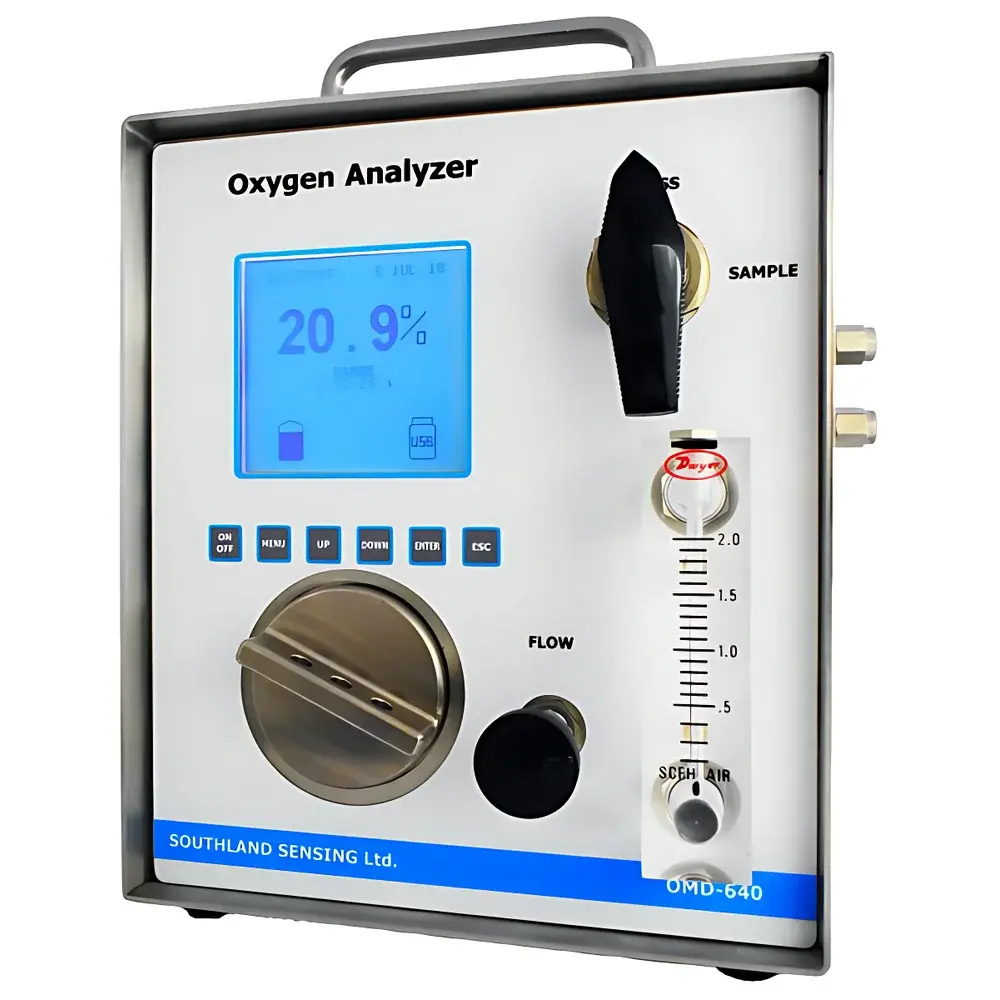
Southland Sensing OMD-645 Portable Trace Oxygen Analyzer
| Origin | USA |
|---|---|
| Manufacturer Type | Authorized Distributor |
| Origin Category | Imported |
| Model | OMD-645 |
| Price Range | USD 1,400 – 4,200 |
| Sensor Technology | Micro-Fuel-Cell |
| Measurement Range | 0–1 ppm / 0–10 ppm / 0–100 ppm / 0–1,000 ppm / 0–25% O₂ (auto-ranging) |
| Accuracy | < ±1% FS |
| Operating Temperature | −10 to +50 °C |
| Output Signals | 4–20 mA, 0–10 VDC, MODBUS RS485 (ASCII, bi-directional) |
| Power Supply | 12–24 VDC, 25 mA |
| Sample Flow Rate | 230–2500 mL/min (with integrated needle valve, bypass valve, flowmeter & 4-way selector) |
| Data Storage | Removable 8 GB USB flash drive |
| Display | Backlit LCD with auto-scaling range indication |
| Certifications | CE |
| Enclosure Dimensions | 241 × 165 × 96 mm |
| Temperature Compensation | Built-in |
| Compatible Gases | N₂, Ar, He, H₂, CH₄, C₂H₆, and other inert/reducing gases |
| Acidic Gas Options | Optional H₂S/CO₂/SO₂-resistant sensor variant available |
| Warranty | 12 months |
Overview
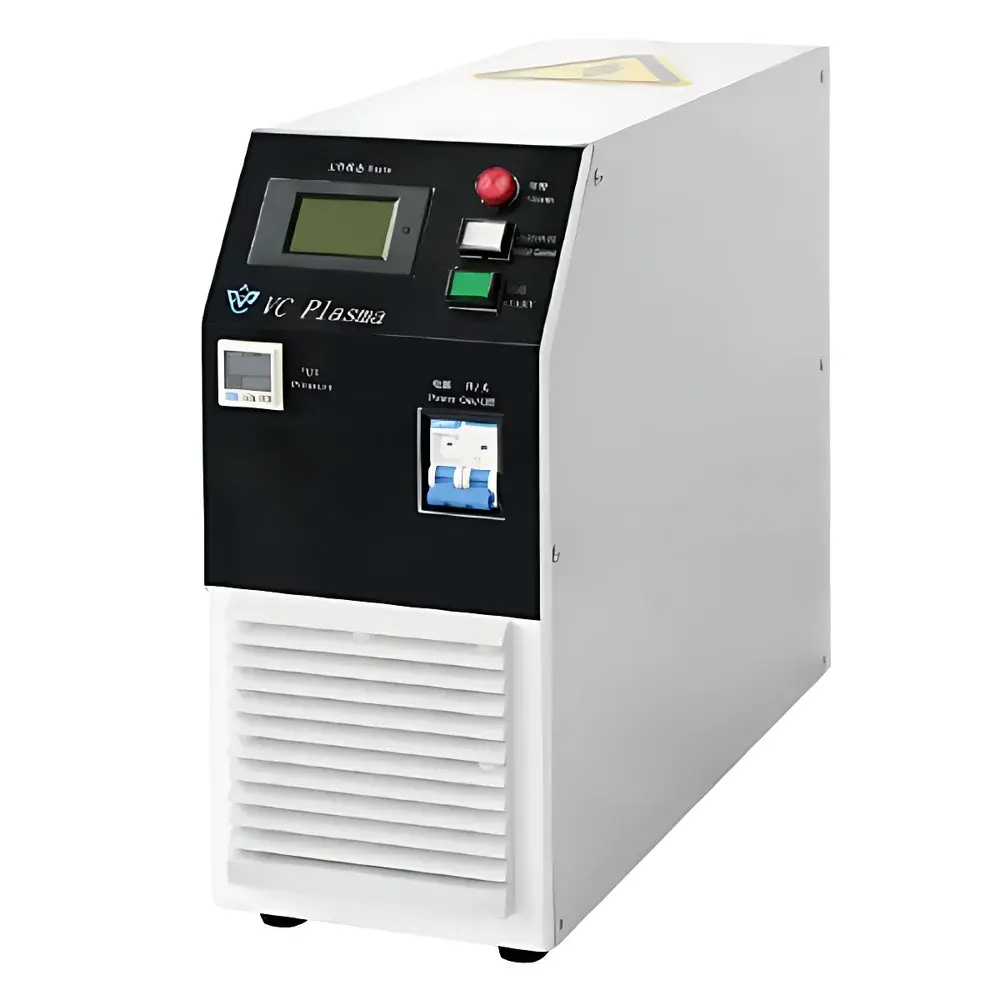
The Southland Sensing OMD-645 Portable Trace Oxygen Analyzer is an industrial-grade electrochemical analyzer engineered for high-stability, low-drift detection of oxygen at trace and percent-level concentrations in inert, reducing, and hydrocarbon-rich process streams. Utilizing a proprietary micro-fuel-cell oxygen sensor, the OMD-645 operates on the principle of galvanic electrochemical reduction: molecular oxygen diffuses through a selective membrane and undergoes catalytic reduction at the cathode, generating a current linearly proportional to partial pressure—enabling direct, zero-power-consumption measurement without external bias voltage. This architecture delivers intrinsic long-term stability, minimal calibration drift (<0.5% FS/month), and immunity to flow-rate fluctuations within its specified sample flow window (230–2500 mL/min). Designed for deployment in demanding field environments—from glovebox purging validation to natural gas pipeline integrity monitoring—the OMD-645 integrates temperature-compensated signal conditioning, auto-ranging firmware, and robust mechanical packaging compliant with IP54-rated ingress protection.
Key Features
- True portable form factor (241 × 165 × 96 mm) with integrated rechargeable battery option (sold separately) and ruggedized enclosure for mobile verification tasks
- Multi-range auto-switching capability: seamless transition across five calibrated spans—0–1 ppm, 0–10 ppm, 0–100 ppm, 0–1,000 ppm, and 0–25% O₂—without manual range selection or hardware reconfiguration
- Micro-fuel-cell sensor with >24-month typical service life under continuous operation; no warm-up time required; stable baseline within 30 seconds of sample introduction
- Onboard data logging via removable 8 GB USB storage, supporting timestamped CSV export compatible with LIMS and SCADA historian systems
- Simultaneous analog (4–20 mA / 0–10 VDC) and digital (MODBUS RTU over RS485, ASCII protocol) outputs for integration into DCS, PLC, or centralized monitoring platforms
- Configurable sample handling manifold: includes precision needle valve, three-position bypass valve, rotameter-based flowmeter, and 4-way selector for flexible connection to pressurized lines, vacuum systems, or ambient sampling points
Sample Compatibility & Compliance
The OMD-645 is validated for continuous measurement in non-corrosive, dry process gases including nitrogen, argon, helium, hydrogen, methane, ethane, and other saturated hydrocarbons. Its standard sensor is incompatible with acidic contaminants such as H₂S, SO₂, or CO₂ above 50 ppm; however, an optional acid-resistant sensor variant—featuring chemically stabilized electrolyte and corrosion-inhibiting electrode coatings—is available for applications involving sour gas blends or syngas streams. All units comply with CE marking requirements per Directive 2014/30/EU (EMC) and 2014/35/EU (LVD). While not intrinsically safe certified, the analyzer meets Class I, Division 2 (CID2) installation guidelines when used with appropriate barrier systems. It supports GLP-compliant operation through audit-trail-enabled configuration changes and timestamped calibration records stored on USB media.
Software & Data Management
No proprietary PC software is required for basic operation. Configuration, calibration, and diagnostic functions are accessible via front-panel keypad navigation and backlit LCD interface. For advanced data review and system integration, Southland Sensing provides open-protocol documentation for MODBUS register mapping—including real-time O₂ concentration, sensor health status, temperature reading, flow alarm state, and calibration due date. Logged data files adhere to ISO 8601 timestamp formatting and include header metadata (model, serial number, firmware version, user-defined site ID), enabling automated ingestion into enterprise analytics platforms. Firmware updates are performed via USB stick using signed binary images verified by onboard cryptographic checksum.
Applications
- High-purity nitrogen and hydrogen generation: real-time verification of generator outlet purity (≤1 ppm O₂) and leak-detection in purge cycles
- Glovebox and dry-room atmosphere control: continuous monitoring of O₂ levels during semiconductor wafer fabrication, lithium-battery electrode coating, and metal-organic chemical vapor deposition (MOCVD)
- Natural gas transmission: compliance verification against ASTM D1945 and ISO 8573-5 for oxygen content in pipeline-grade fuel gas
- Heat-treatment furnace atmospheres: monitoring residual O₂ in endothermic or dissociated ammonia carrier gases during annealing, brazing, and sintering
- Pharmaceutical inerting validation: documenting O₂ decay profiles during vessel blanketing per USP and FDA Process Validation Guidance
- Research laboratory gas delivery systems: quantifying cross-contamination in multi-gas manifold networks serving mass spectrometers, FTIR cells, or catalytic reactors
FAQ
What is the recommended calibration frequency for the OMD-645 in continuous operation?
For applications requiring ISO/IEC 17025 traceability, quarterly span calibration using certified zero gas (N₂ balance) and span gas (e.g., 10 ppm O₂ in N₂) is advised. In less critical monitoring roles, semi-annual calibration suffices if baseline stability remains within ±0.2 ppm drift.
Can the OMD-645 measure oxygen in humidified gas streams?
Condensable moisture must be removed upstream via chilled mirror dew point controller or permeation dryer. The micro-fuel-cell sensor is sensitive to liquid water ingress; operation above 90% RH without conditioning may accelerate electrolyte dilution and reduce sensor lifetime.
Is the MODBUS interface compatible with Siemens S7-1200 PLCs?
Yes—using standard MODBUS RTU over RS485 with configurable baud rate (9600–115200 bps), parity (none/even/odd), and slave ID. Register map documentation includes explicit coil and holding register addresses for O₂ value, unit scaling, and alarm status bits.
Does the analyzer support automatic temperature compensation across its full operating range?
Yes—integrated Pt100 RTD measures internal sensor block temperature, and firmware applies NIST-traceable polynomial correction coefficients to maintain accuracy from −10 °C to +50 °C.
How is sensor poisoning detected and mitigated?
The firmware continuously monitors open-circuit voltage and polarization resistance. A sustained drop >15% below nominal baseline triggers a “Sensor Health Warning” on display and MODBUS register flag, prompting preventive replacement before measurement error exceeds specification limits.