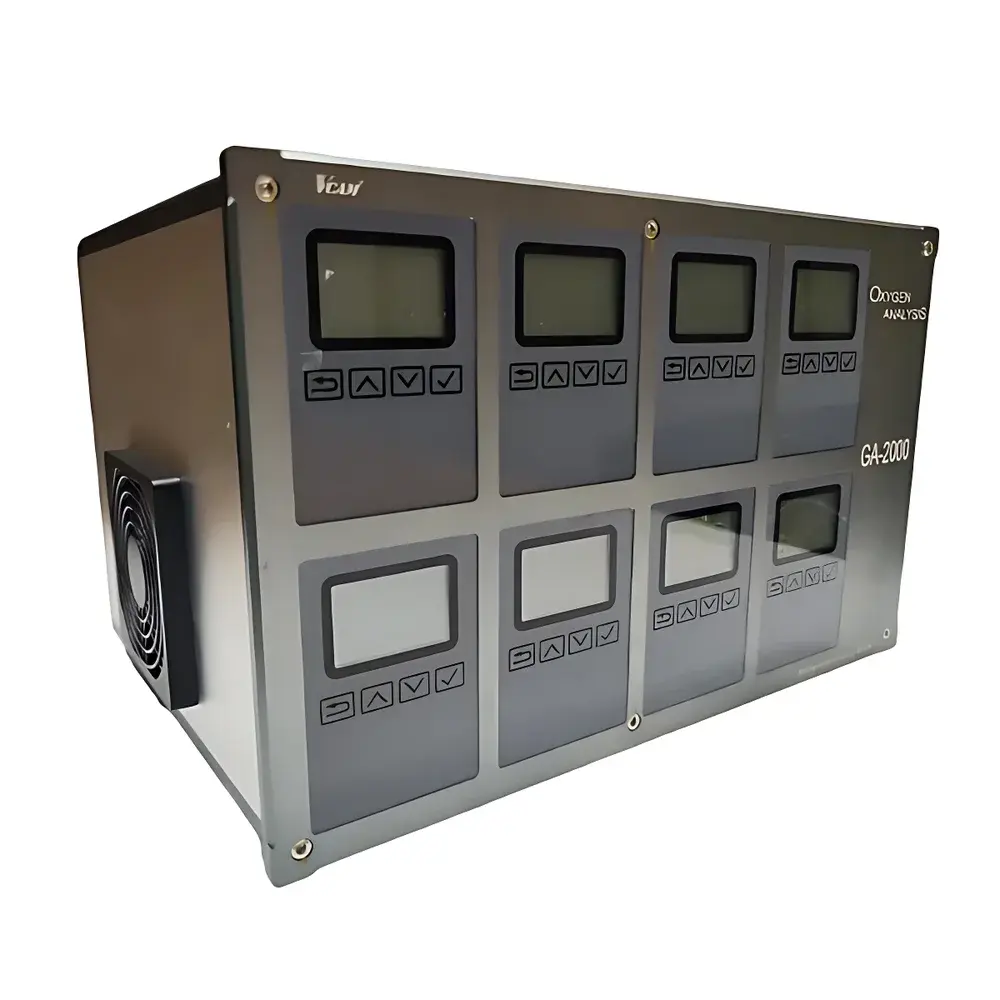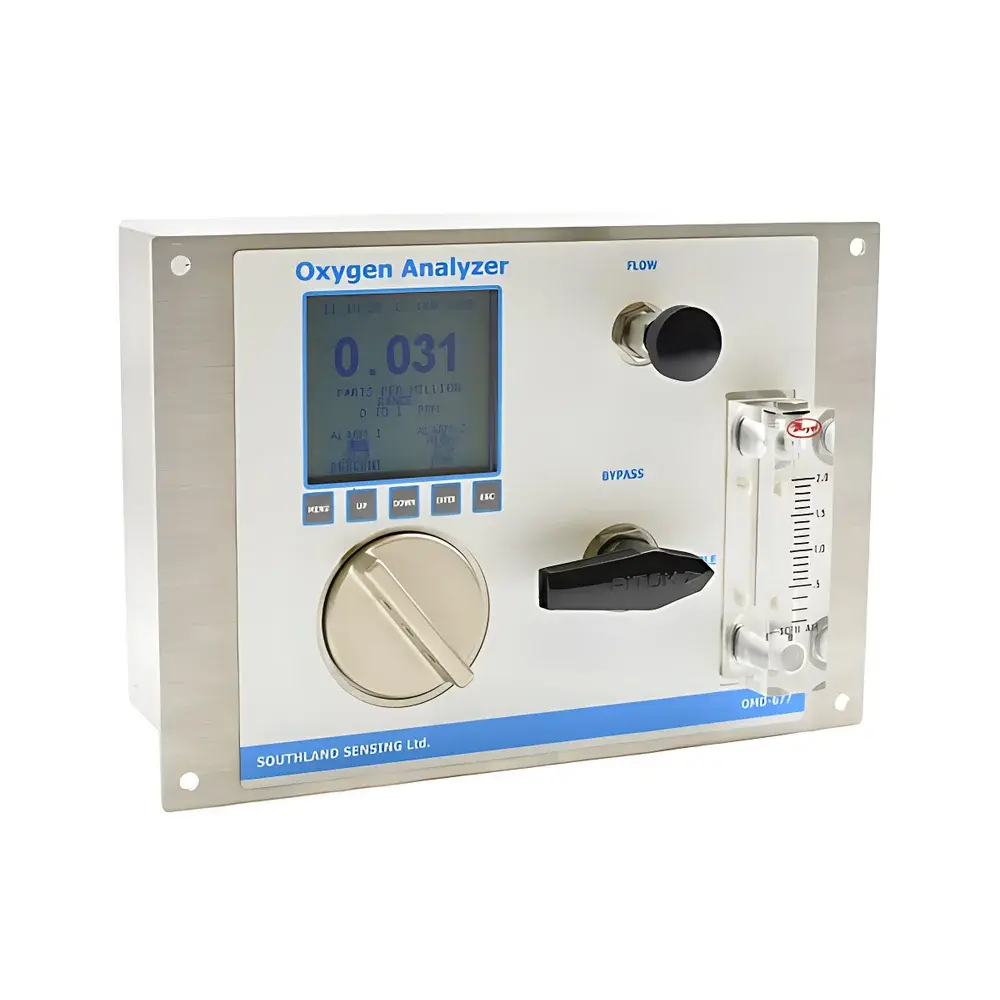
Southland Sensing OMD-677-1 Trace Oxygen Analyzer
| Origin | USA |
|---|---|
| Manufacturer Type | Authorized Distributor |
| Origin Category | Imported |
| Model | OMD-677-1 |
| Price Range | USD 4,200 – 7,000 |
| Measurement Range | 0–1 ppm, 0–10 ppm, 0–100 ppm, 0–1,000 ppm, 0–25% O₂ |
| Accuracy | < ±1% FS |
| Certifications | CE |
| Dimensions | 241 × 165 × 96 mm |
| Operating Temperature | −10 to +50 °C |
| Temperature Compensation | Built-in |
| Sensor Type | Micro-fuel-cell electrochemical sensor |
| Warranty | 12 months |
| Sample Gas Flow Rate | 230–2500 mL/min |
| Power Supply | 12–24 VDC |
| Current Consumption | 25 mA |
| Analog Outputs | 4–20 mA and 0–10 VDC |
| Compatible Gases | N₂, Ar, He, H₂, hydrocarbon streams (non-acidic) |
Overview
The Southland Sensing OMD-677-1 Trace Oxygen Analyzer is a precision-engineered electrochemical instrument designed for continuous, real-time measurement of oxygen concentrations at trace and percent-level ranges in inert, reducing, and process gas streams. Utilizing a proprietary micro-fuel-cell oxygen sensor, the analyzer operates on the principle of galvanic electrochemical reaction—where molecular oxygen diffuses through a selective membrane and undergoes reduction at a catalytic cathode, generating a current linearly proportional to the partial pressure of O₂. This zero-power-consumption sensing mechanism ensures intrinsic safety, long-term stability, and minimal drift—critical attributes for applications demanding high reproducibility in ultra-low-oxygen environments (down to 0–1 ppm). Unlike paramagnetic or zirconia-based analyzers, the fuel-cell architecture eliminates the need for reference gas, heated cells, or complex calibration routines, making the OMD-677-1 especially suited for integration into nitrogen generation systems, glovebox purging loops, semiconductor purge lines, and hydrogen purification skids.
Key Features
- Multi-range configurable measurement: factory-selectable spans including 0–1 ppm, 0–10 ppm, 0–100 ppm, 0–1,000 ppm, and 0–25% O₂—enabling single-instrument flexibility across purity verification and safety monitoring tasks.
- Integrated temperature compensation circuitry ensures stable output across −10 to +50 °C ambient operation without external thermostating.
- Low power consumption (25 mA @ 24 VDC) supports deployment in explosion-proof enclosures and remote locations with limited power infrastructure.
- Compact industrial enclosure (241 × 165 × 96 mm) with IP65-rated front panel facilitates wall-mount or panel-mount installation in control rooms and process skids.
- Dual analog outputs (4–20 mA and 0–10 VDC) enable simultaneous connection to DCS, PLC, and local display modules without signal splitting.
- Gas-selective sensor design validated for use with N₂, Ar, He, H₂, and saturated hydrocarbon streams; acid-resistant sensor variant available upon specification for sour gas applications containing H₂S, SO₂, or CO₂.
Sample Compatibility & Compliance
The OMD-677-1 is engineered for direct in-line or extractive sampling of dry, non-corrosive process gases. It meets CE marking requirements for electromagnetic compatibility (EMC Directive 2014/30/EU) and low-voltage safety (LVD Directive 2014/35/EU). While not intrinsically rated per ATEX or IECEx, the unit may be installed in Zone 2/Class I Div 2 areas when housed in certified barrier-protected enclosures. The analyzer complies with ISO 8573-1:2010 Class 1 moisture and particulate specifications when used with recommended inline filtration (0.1 µm sintered stainless steel filter) and desiccant conditioning. For regulated industries—including pharmaceutical nitrogen validation (USP ), semiconductor fab gas certification (SEMI F21), and food-grade inerting—the OMD-677-1 supports audit-ready documentation packages, including factory calibration certificates traceable to NIST standards and optional 21 CFR Part 11-compliant data logging via external SCADA integration.
Software & Data Management
The OMD-677-1 operates as a standalone transmitter with no embedded firmware interface; all configuration and diagnostics are performed via hardware DIP switches and analog output scaling. For centralized monitoring, it integrates seamlessly with industry-standard control systems using its 4–20 mA output (HART-enabled versions available on request). When connected to a supervisory system supporting Modbus RTU (via optional RS-485 adapter), users gain access to live sensor health status, temperature readings, and zero/span verification logs. All analog outputs include built-in short-circuit and overvoltage protection. Calibration verification is supported through manual zero-gas introduction (e.g., high-purity N₂) and span adjustment using certified standard gas mixtures (e.g., 10 ppm O₂ in N₂); full calibration procedures conform to ASTM D6299 and ISO 17025 laboratory practice guidelines.
Applications
- High-purity nitrogen generator outlet monitoring (ISO 8573-1 Class 1–2 oxygen purity verification)
- Glovebox atmosphere control in battery R&D labs and air-sensitive synthesis environments
- Hydrogen stream analysis pre- and post-palladium membrane purification
- Natural gas pipeline inerting verification and compressor station purge validation
- Heat-treatment furnace atmosphere control (e.g., annealing, sintering) where sub-10 ppm O₂ prevents oxidation
- Electronics manufacturing: argon/nitrogen blanketing in CVD/PVD tool chambers and wafer handling environments
FAQ
Does the OMD-677-1 require periodic recalibration?
Yes—annual calibration is recommended under normal operating conditions. Calibration frequency should increase to semi-annual in high-humidity or variable-flow environments. Calibration must be performed using traceable standard gases and documented per ISO/IEC 17025 requirements for accredited laboratories.
Can the sensor be exposed to hydrogen sulfide (H₂S)?
No—standard fuel-cell sensors are poisoned by H₂S, SO₂, and chlorine compounds. An acid-resistant sensor option is available for such applications; consult technical support prior to installation.
What is the typical sensor lifetime under continuous operation?
Under clean, dry gas conditions and nominal 0–10 ppm range usage, the micro-fuel-cell sensor maintains metrological integrity for 24–36 months. Lifetime decreases proportionally with exposure to elevated O₂ partial pressures (>1,000 ppm) or condensable vapors.
Is the analyzer compatible with wet gas streams?
No—condensate ingress will irreversibly damage the electrochemical cell. Use of a chilled mirror dew point monitor and coalescing filter upstream is mandatory for samples with dew points above −20 °C.
Does the unit support digital communication protocols natively?
The base model provides analog-only output. RS-485 Modbus RTU communication is available via an optional field-installable module, enabling integration into IIoT architectures and predictive maintenance platforms.
Related Products