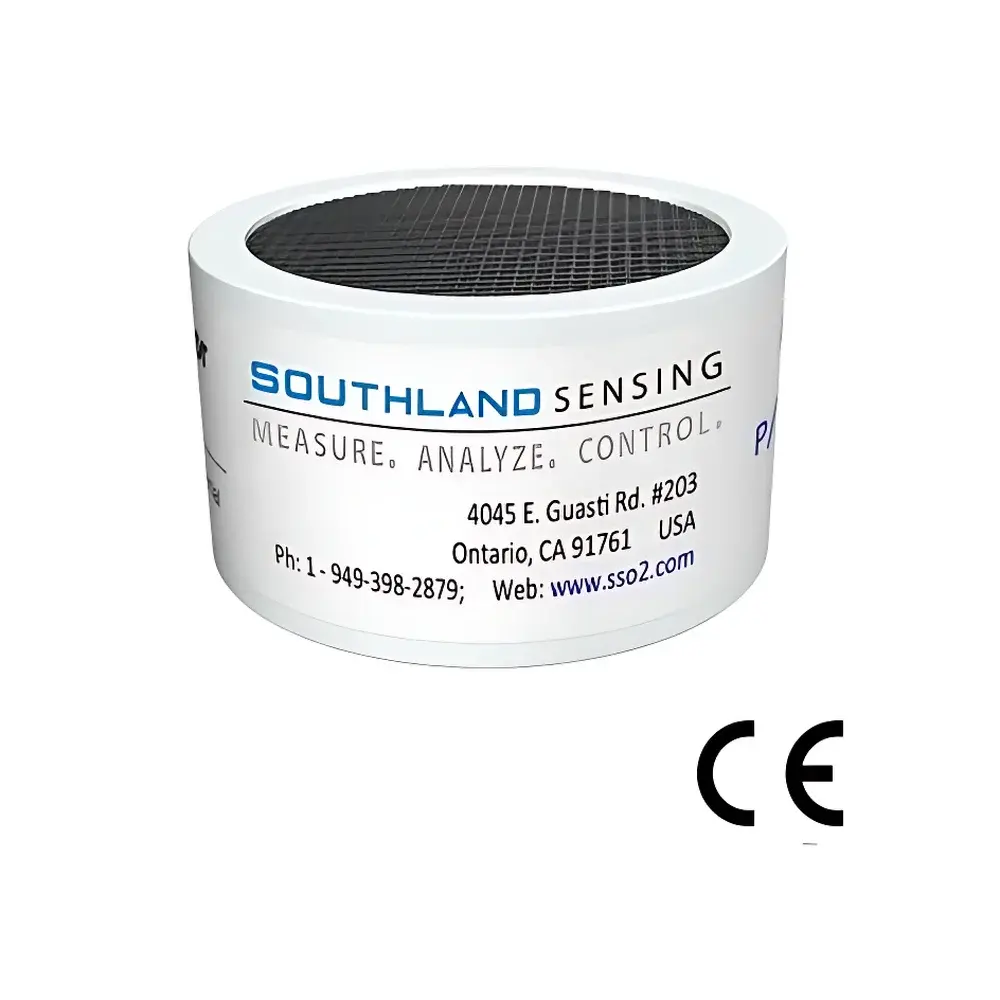
Southland Sensing TO2-1xL PPM-Level Electrochemical Oxygen Sensor
| Origin | USA |
|---|---|
| Manufacturer Type | Authorized Distributor |
| Origin Category | Imported |
| Model | TO2-1xL |
| Price Range | USD 1 – 9,999 |
Overview
The Southland Sensing TO2-1xL is a high-stability, electrochemical fuel cell-based oxygen sensor engineered for continuous, low-concentration oxygen monitoring in inert and reactive process gas streams. Unlike paramagnetic or zirconia-based analyzers, the TO2-1xL employs a miniature, self-powered galvanic fuel cell that generates a linear current output (285–590 µA) proportional to oxygen partial pressure—enabling trace-level detection from 0.01 ppm up to 25% O₂ without external bias voltage or consumable electrolytes. Its solid polymer electrolyte architecture eliminates liquid leakage, drift, and cross-sensitivity to CO₂, H₂O vapor, or hydrocarbons—making it ideal for demanding applications in semiconductor purge lines, nitrogen generator outlets, hydrogen purification loops, and high-purity inert gas distribution systems. Designed for integration into OEM analyzers and standalone transmitters, the TO2-1xL complies with fundamental functional safety expectations for continuous emission monitoring and process safeguarding in Class I Div 2 environments.
Key Features
- Ultra-low detection limit: 0.01 ppm O₂ (full-scale range selectable from 0–10 ppm to 0–10,000 ppm)
- Fuel cell technology: Self-powered, zero-power-consumption operation; no heater, no reference gas required
- Fast dynamic response: T₉₀ ≤ 13 seconds across full measurement span
- High metrological stability: ±1% of full scale accuracy, ±0.5% repeatability under controlled flow and temperature
- Robust environmental tolerance: Operates continuously at 0–50°C ambient; storage range 0–45°C; humidity tolerance 0–100% RH (non-condensing)
- Long service life: 20–25 months typical operational lifetime; 6-month shelf life prior to activation
- Standard electrical interface: PCB-mount configuration with center foil (cathode/negative) and outer foil (anode/positive); analog current output scalable to industry-standard 4–20 mA via external transducer
- Integrated diagnostics: Dual programmable relay outputs for high/low alarm signaling compliant with SIL 2 functional safety logic
Sample Compatibility & Compliance
The TO2-1xL is validated for use in non-corrosive, dry-to-moderately humid gas matrices including N₂, Ar, He, H₂, CH₄, C₂H₆, and synthetic air. It exhibits negligible interference from CO₂ (<0.1% signal deviation at 10% CO₂), CO, NOₓ, SO₂, and saturated hydrocarbons below 100 ppmv. While not intrinsically rated for hazardous areas, its low-energy design supports safe installation in Zone 2/Class I Div 2 enclosures when paired with appropriate barrier systems. The sensor meets general requirements for ISO 9001-aligned manufacturing control and conforms to ASTM D6245 (standard test method for oxygen in high-purity gases) for calibration traceability. For regulated environments—including pharmaceutical inerting, semiconductor fab gas cabinets, and aerospace ground support systems—the TO2-1xL supports audit-ready documentation packages aligned with FDA 21 CFR Part 11 data integrity principles when integrated with compliant host instrumentation.
Software & Data Management
As a component-level sensor, the TO2-1xL does not include embedded firmware or user-accessible software. However, its analog current output (µA) is fully compatible with third-party gas analyzer platforms supporting 4–20 mA input scaling, linearization, and digital compensation algorithms. When interfaced with Southland-certified transmitters or OEM control systems, users gain access to real-time temperature-compensated readings, auto-ranging logic, and configurable alarm hysteresis. Data logging, trend analysis, and remote diagnostics are enabled through standard Modbus RTU/TCP or HART 7 protocols on host devices. All calibration and maintenance events—including zero/span verification, sensor replacement timestamping, and relay state history—are retained in non-volatile memory per GLP/GMP record-keeping conventions.
Applications
- On-line purity verification in membrane and PSA nitrogen generators (O₂ < 10 ppm)
- Leak detection and blanketing gas monitoring in semiconductor wafer processing tools
- Oxygen ingress surveillance in hydrogen production and purification skids (PEM/alkaline electrolyzers)
- Quality assurance in medical gas manufacturing (USP , ISO 8573-1 Class 1)
- Process control of inert atmospheres in heat-treating furnaces, vacuum brazing, and additive manufacturing chambers
- Environmental monitoring in transformer oil gas analysis (DGA) sampling systems
- Research-grade oxygen profiling in catalytic reaction studies and plasma chemistry reactors
FAQ
What is the recommended sample flow rate for optimal performance?
A laminar flow of 0.5–5 SCFH (standard cubic feet per hour) is specified to ensure stable diffusion-limited response and minimize boundary layer effects.
Does the TO2-1xL require periodic recalibration?
Yes—annual zero and span verification is recommended using certified NIST-traceable gas standards; frequency may increase in high-dynamic or contaminated gas environments.
Can the sensor be used in high-pressure gas lines?
No—TO2-1xL is rated for ambient-pressure operation only; upstream pressure regulation and flow control are mandatory before sensor inlet.
Is condensation harmful to the sensor?
Yes—liquid water contact permanently degrades the cathode catalyst layer; always install with coalescing filter and dew point monitor upstream.
How is sensor lifetime defined and validated?
Lifetime is based on cumulative exposure time at rated operating conditions; accelerated aging tests per IEC 60751 demonstrate >90% signal retention after 22 months at 25°C and 50% RH.
Related Products