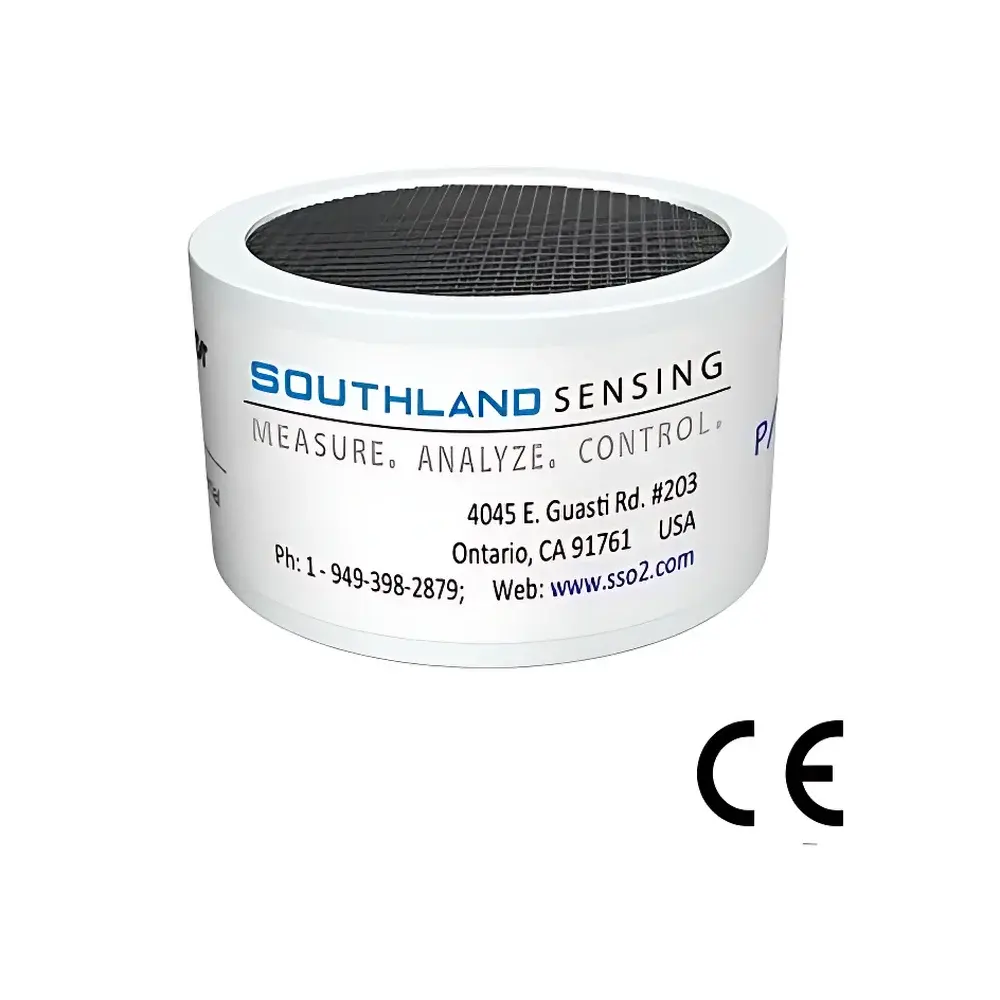
Southland Sensing TO2-238-T Fuel Cell-Based Trace Oxygen Analyzer
| Origin | USA |
|---|---|
| Manufacturer Type | Authorized Distributor |
| Origin Category | Imported |
| Model | TO2-238-T |
| Price Range | USD 1–9,999 |
| Sensor Technology | Micro-Fuel-Cell |
| Output Signal | 285–590 µA |
| Measurement Ranges | 0–1 ppm / 0–10 ppm / 0–100 ppm / 0–1000 ppm / 0–1% O₂ / 0–25% O₂ |
| Response Time (T₉₀) | ≤13 s |
| Full-Scale Accuracy | ±1% FS |
| Repeatability | ±0.5% FS |
| Temperature Coefficient | 2.54%/°C |
| Operating Temperature | 0–50°C |
| Storage Temperature | 0–45°C |
| Recommended Flow Rate | 0.5–5 SCFH |
| Humidity Range | 0–100% RH (non-condensing) |
| Expected Service Life | 20–25 months |
| Shelf Life (uninstalled) | 6 months |
| Warranty | 12 months |
| Electrical Interface | PCB-mounted |
Overview
The Southland Sensing TO2-238-T is a high-stability, electrochemical fuel cell-based trace oxygen analyzer engineered for continuous, real-time monitoring of oxygen concentrations across an exceptionally wide dynamic range—from sub-ppm levels (0.01 ppm detection limit) up to 25% volume in inert, reducing, or hydrocarbon-rich process streams. Unlike paramagnetic or zirconia-based analyzers, the TO2-238-T employs a proprietary miniature galvanic fuel cell sensor that generates a current proportional to ambient O₂ partial pressure—eliminating the need for external power to drive the sensing reaction. This self-powered, diffusion-limited design ensures intrinsic safety, long-term baseline stability, and immunity to background gas interference from N₂, H₂, Ar, He, CO₂, CH₄, and other non-reactive or mildly reducing matrices. The analyzer is widely deployed in critical applications where oxygen contamination compromises product purity, process safety, or material integrity—including nitrogen and hydrogen generation systems, semiconductor purge gas lines, aerospace inerting loops, and high-temperature furnace atmospheres.
Key Features
- Fuel cell sensor with no internal heating element—enabling Class I, Division 1 hazardous area compatibility when housed in appropriate enclosures
- Auto-ranging analog output with seamless switching between six factory-configurable spans: 0–1 ppm, 0–10 ppm, 0–100 ppm, 0–1000 ppm, 0–1%, and 0–25% O₂
- Backlit LCD display with real-time concentration readout, status indicators, and diagnostic prompts
- Two independently configurable SPDT alarm relays (dry contact, 2 A @ 24 VDC) supporting high/low or deviation-triggered actions
- Low-power circuit architecture featuring embedded microcontroller-based signal conditioning, temperature compensation, and linearization per ASTM D6297 and ISO 8573-3 protocols
- PCB-mount sensor module with standardized foil electrode configuration (center cathode, outer anode) for direct integration into OEM gas analysis subsystems
- No routine calibration required during normal operation; zero verification possible using certified nitrogen or argon blanks
Sample Compatibility & Compliance
The TO2-238-T is validated for use with dry or moderately humid (0–100% RH, non-condensing) sample gases containing nitrogen, hydrogen, argon, helium, methane, ethane, propane, carbon dioxide, and sulfur-free natural gas. It is not recommended for continuous exposure to chlorine, ammonia, halogenated hydrocarbons, or acidic vapors (e.g., SO₂, HCl), which may poison the electrolyte. The analyzer complies with CE marking requirements under the EU Electromagnetic Compatibility Directive (2014/30/EU) and Low Voltage Directive (2014/35/EU). Its measurement performance aligns with key industry standards including ASTM D6297 (Standard Practice for Calibration of Trace Oxygen Analyzers), ISO 8573-3 (Compressed Air — Part 3: Test Methods for Oil Vapor and Organic Solvent Content), and USP (Oxygen Indicators for Sterile Packaging). For regulated environments operating under FDA 21 CFR Part 11 or GMP/GLP frameworks, optional audit-trail-enabled firmware versions are available upon request.
Software & Data Management
While the TO2-238-T operates as a standalone analog transmitter (4–20 mA or 0–10 V output), it supports digital integration via optional RS-485 Modbus RTU interface (addressable, multi-drop capable). Configuration and diagnostics can be performed locally using the front-panel keypad or remotely via Modbus register mapping. All operational parameters—including span selection, alarm thresholds, damping time, and temperature compensation coefficients—are stored in non-volatile memory. Event logs capture relay activation timestamps, sensor health alerts, and out-of-range conditions. Data export functionality enables CSV-formatted reports compatible with LIMS platforms and SCADA historian systems. Firmware updates are delivered via secure USB programmer tool, ensuring traceability and version control in validation-critical deployments.
Applications
- Inert gas blanketing: Monitoring O₂ ingress in nitrogen-purged reactors, storage tanks, and pipeline pigging operations
- Hydrogen quality assurance: Verifying <1 ppm O₂ in PEM electrolyzer off-gas and fuel cell feed streams per ISO 8573-8
- Semiconductor manufacturing: Real-time verification of ultra-high-purity N₂/H₂/Ar purge gases in CVD, ALD, and etch tool cabinets
- Heat treatment atmospheres: Quantifying residual oxygen in vacuum furnaces, sintering tunnels, and brazing zones
- Natural gas transmission: Detecting low-level O₂ contamination in pipeline gas to prevent corrosion and catalyst deactivation
- Pharmaceutical packaging: Validating headspace O₂ levels in blister packs, vials, and flexible barrier films
- Research laboratories: Stable reference-grade oxygen monitoring in controlled-atmosphere gloveboxes and catalytic test rigs
FAQ
What is the minimum detectable oxygen concentration?
The TO2-238-T achieves a practical detection limit of 0.01 ppm O₂ when configured for the 0–1 ppm range and operated under optimal flow and temperature conditions.
Can the sensor be exposed to condensing humidity?
No. Condensation will irreversibly damage the fuel cell’s aqueous electrolyte membrane. Sample gas must remain dew-point controlled below the operating temperature.
How often does the sensor require replacement?
Typical field service life is 20–25 months under continuous operation at ambient temperatures; shelf life prior to installation is six months from date of manufacture.
Is the TO2-238-T suitable for hydrogen-rich environments?
Yes—provided H₂ concentration remains below 95% and no catalytic poisons (e.g., CO, H₂S, siloxanes) are present. Cross-sensitivity to H₂ is negligible within specification limits.
Does the unit support 21 CFR Part 11 compliance?
The base model does not include electronic signature or audit trail functions; however, a validated firmware variant with full Part 11 capabilities is available for pharmaceutical and biotech applications.
Related Products