
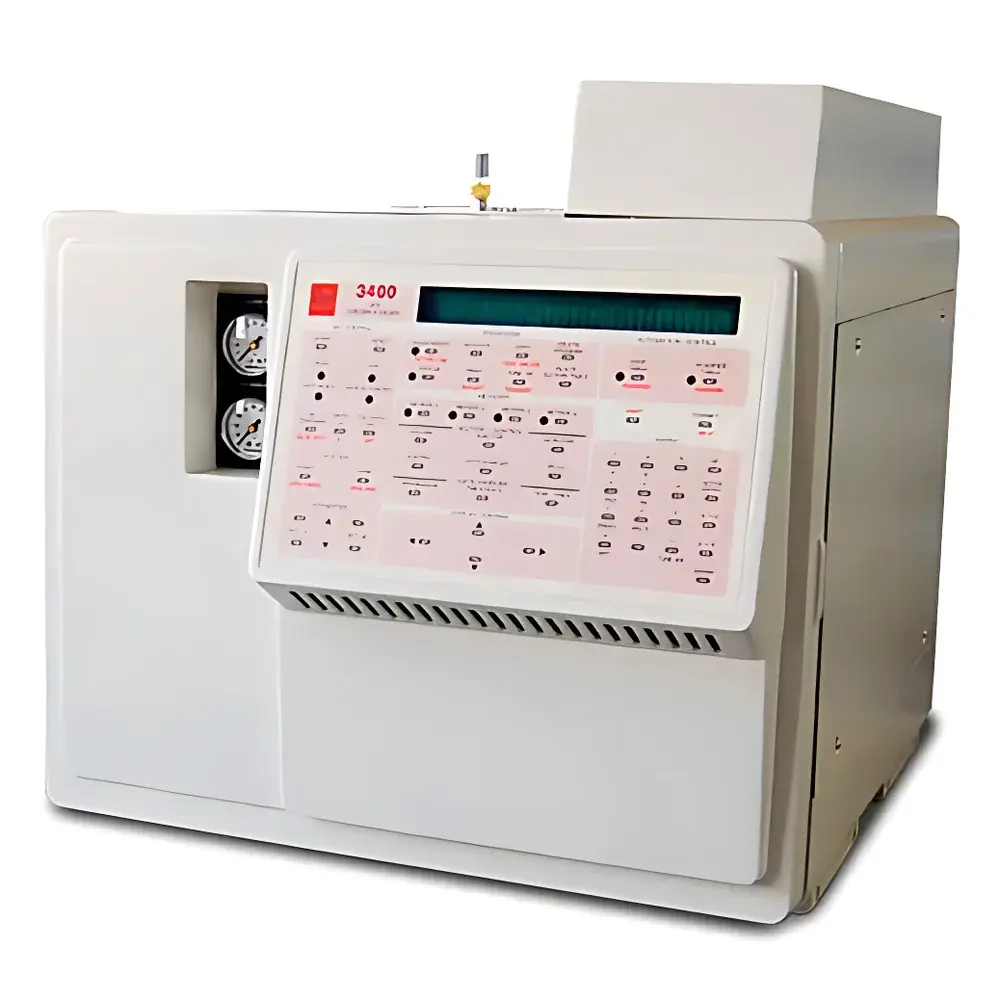
SP-3400 Gas Chromatograph with Microprocessor Control and Full-Keyboard Operation
| Brand | Beifen Sanpu |
|---|---|
| Origin | Beijing, China |
| Manufacturer Type | Direct Manufacturer |
| Regional Origin | Domestic (China) |
| Model | SP-3400 |
| Instrument Type | Online Gas Chromatograph |
| Application Scope | General-Purpose |
| Oven Temperature Range | 4°C to 450°C |
| Oven Ramp Rate | 0.1–39°C/min |
| Oven Cooling Time | ~6 min (from 450°C to 50°C) |
| Carrier Gas Flow Range & Control | 0.1–1200 mL/min |
| Carrier Gas Pressure Range & Control | ±0.05 kPa |
| Injector Maximum Operating Temperature | 450°C |
| Injector Pressure Setting Range | ±0.05 kPa |
| Injector Total Flow Setting Range | 0–1200 mL/min |
| Detector Options | TCD, FID, ECD, FPD, TSD |
| Injector Types | Packed Column Injector, Split/Splitless Capillary Injector |
| Method Storage Capacity | 4 methods |
| Key Features | Real-time self-diagnosis, programmable detector range/attenuation, automated valve & signal switching, multi-safety interlocks (TCD flow failure, overtemperature, FPD light leakage), microprocessor-based full-keyboard interface |
Overview
The SP-3400 Gas Chromatograph is a microprocessor-controlled, online-capable analytical instrument engineered for high reproducibility and operational stability in routine and research-grade chromatographic separations. Based on technology transfer from Varian (USA) and manufactured to internationally aligned specifications, the SP-3400 implements conventional gas chromatography principles—separation of volatile and semi-volatile compounds via differential partitioning between a mobile phase (inert carrier gas) and a stationary phase (capillary or packed column)—with robust thermal management and precise pneumatic control. Its design supports continuous unattended operation in industrial process monitoring, environmental emissions tracking, pharmaceutical impurity profiling, petrochemical feedstock analysis, and academic method development. The system’s core architecture integrates a temperature-programmable oven, electronically controlled gas delivery modules, configurable injection systems, and interchangeable detectors—all coordinated through an embedded microcontroller with full-keyboard human-machine interface (HMI).
Key Features
- Microprocessor-based control system with intuitive full-keyboard operation—no external PC required for basic method setup, run initiation, or real-time parameter adjustment.
- Comprehensive self-diagnostic capability: continuously monitors detector baseline stability, oven temperature deviation, carrier gas flow integrity, and injector pressure consistency; displays fault codes and context-sensitive troubleshooting guidance upon anomaly detection.
- Programmable detector settings: gain, attenuation time, and polarity can be defined per method step, enabling optimized signal-to-noise response across wide concentration ranges.
- Automated hardware coordination: integrated solenoid valves and detector signal routing allow seamless method-driven switching between columns, detectors, or inlet configurations without manual reconfiguration.
- Multilayer safety architecture: includes TCD filament protection against carrier gas interruption, oven overtemperature cutoff (hardware + software dual threshold), and FPD photomultiplier tube shielding against ambient light exposure.
- Onboard method storage: retains up to four complete analytical methods—including temperature programs, gas flows, detector parameters, and valve sequences—for rapid recall and execution.
Sample Compatibility & Compliance
The SP-3400 accommodates both packed and capillary column formats via interchangeable inlet modules: a standard packed-column injector (suitable for legacy ASTM D3606, D5186 methods) and a split/splitless capillary inlet (compatible with ISO 11843-7, USP , and EPA Method 8260D workflows). It supports universal carrier gases (He, H₂, N₂) with digital pressure and flow regulation meeting ISO 8573-1 Class 4 purity requirements for GC applications. All thermal zones (oven, injectors, detectors) are independently calibrated and traceable to NIST-certified references. While not pre-certified for 21 CFR Part 11, the system’s audit-ready log structure—including timestamped method changes, run records, and error events—facilitates validation under GLP and GMP frameworks when deployed with compliant data archiving practices.
Software & Data Management
Data acquisition and reporting are performed using the native SP-3400 Control Suite—a Windows-compatible application providing chromatogram visualization, peak integration (tangent skim, valley-to-valley, exponential skim), retention time locking, and customizable report templates (PDF/CSV export). Raw data files adhere to AIA/ANDI format standards for cross-platform compatibility with third-party chemometric tools (e.g., OpenChrom, Chromeleon). The system logs all operator actions, calibration events, and environmental deviations with immutable timestamps, supporting retrospective review during internal audits or regulatory inspections. Optional network interface enables remote monitoring and centralized fleet management in multi-instrument laboratories.
Applications
The SP-3400 delivers validated performance across diverse sectors: hydrocarbon speciation in refinery streams (ASTM D1319, D5769); residual solvent quantification in APIs (ICH Q2(R2)); VOC screening in ambient air and soil headspace (EPA TO-17); pesticide residue analysis in food matrices (EN 15662); and monomer purity assessment in polymer manufacturing. Its 450°C injector and oven capability permits analysis of high-boiling compounds such as polyaromatic hydrocarbons (PAHs), phthalates, and silicone oils—without cold trapping or cryofocusing. The modular detector selection allows method-specific optimization: FID for universal hydrocarbon detection, TCD for permanent gases, ECD for halogenated contaminants, FPD for sulfur/phosphorus compounds, and TSD for nitrogen- or phosphorus-selective trace analysis.
FAQ
Is the SP-3400 compatible with third-party chromatography data systems (CDS)?
Yes—the instrument outputs AIA/ANDI-compliant .cdf files and supports RS-232/USB virtual COM port communication for integration with major CDS platforms.
What maintenance intervals are recommended for long-term reliability?
Carrier gas filters should be replaced every 6 months; inlet liners and septa every 100 injections or monthly (whichever occurs first); and detector components (e.g., FID jet, TCD filaments) inspected quarterly per usage intensity.
Can the SP-3400 operate unattended for extended periods?
Yes—its auto-diagnostic engine, hardware interlocks, and programmable shutdown protocols enable 72+ hour无人值守 runs when paired with autosampler support (optional add-on).
Does the system meet international electromagnetic compatibility (EMC) standards?
It complies with GB/T 18268.1–2010 (equivalent to IEC 61326-1:2012) for laboratory equipment emission and immunity.
Is firmware upgrade support available post-purchase?
Beifen Sanpu provides free firmware updates via secure download portal, including enhanced peak detection algorithms, expanded method storage, and improved gas control linearity correction tables.




