
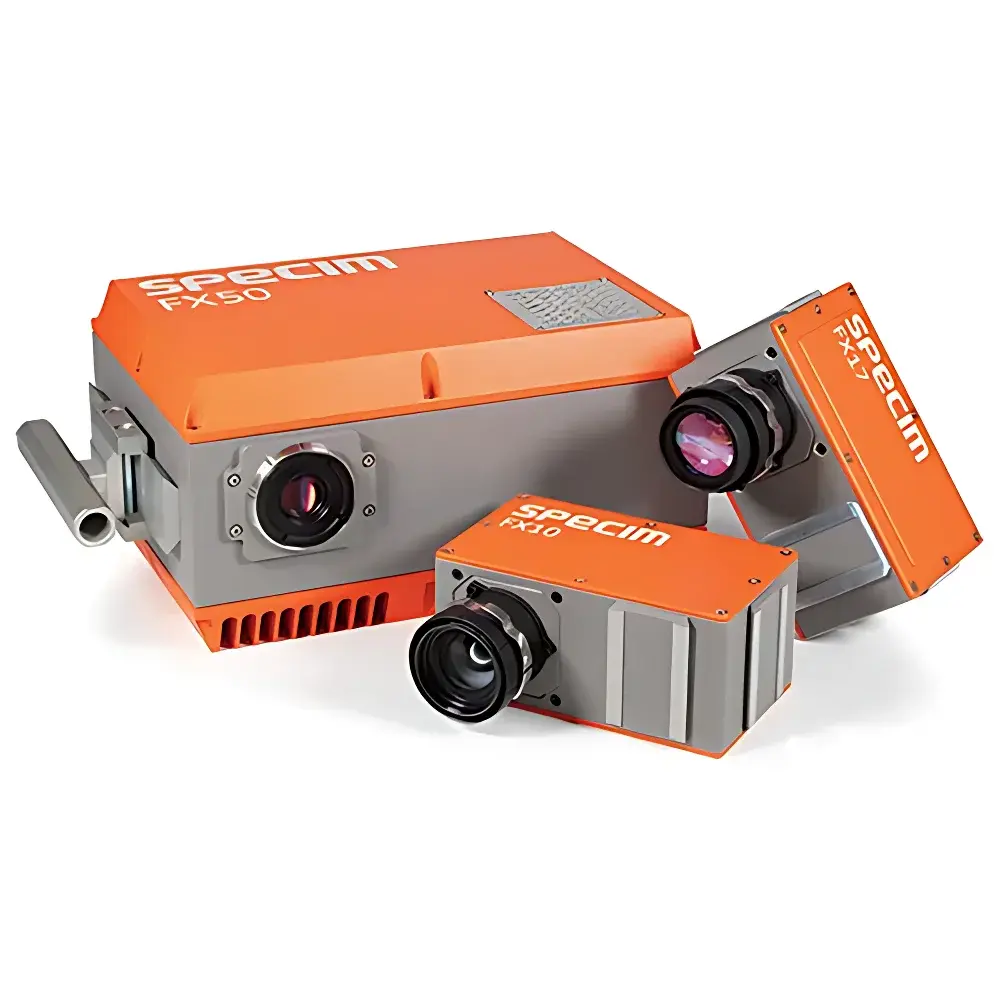
Specim FX10 / FX17 / FX50 Portable Hyperspectral Imaging Cameras
| Brand | Specim (Finland) |
|---|---|
| Origin | Finland |
| Model | FX10 / FX17 / FX50 |
| Imaging Modality | Push-broom line-scan |
| Platform | Ground-based |
| Spectral Range | 400–1000 nm / 900–1700 nm / 2.7–5.3 µm |
| Spectral Resolution | 5.5 nm / 8 nm / 35 nm |
| Spatial Resolution | 1024 pixels across track |
| Field of View (TFOV) | Configurable per lens |
| Instantaneous Field of View (IFOV) | Lens-dependent |
| Frame Rate | 330 fps / 670 fps / 380 fps |
Overview
The Specim FX10, FX17, and FX50 are compact, high-performance push-broom hyperspectral imaging cameras engineered for precision spectral data acquisition in field-deployable, laboratory, and industrial environments. Each model operates on the principle of spatial-spectral separation using a two-dimensional CMOS or InGaAs focal plane array: one dimension captures spatial information along a linear field of view (FOV), while the orthogonal dimension resolves spectral channels across the designated wavelength range. Mechanical motion—whether from a translation stage, conveyor belt, drone platform, or handheld rig—enables full two-dimensional spatial mapping. This architecture ensures pixel-aligned spectral fidelity: every spatial pixel retains its complete, un-mixed spectral signature without interpolation or reconstruction artifacts. Unlike snapshot or tunable-filter systems, the FX series delivers true simultaneous acquisition of all spectral bands per scan line, enabling high temporal coherence and radiometric stability essential for quantitative reflectance, emissivity, and fluorescence analysis.
Key Features
- Three dedicated spectral bands: FX10 (VNIR: 400–1000 nm), FX17 (SWIR: 900–1700 nm), and FX50 (MWIR: 2.7–5.3 µm), each optimized for detector quantum efficiency, noise floor, and thermal stability
- High-speed line-scan operation with frame rates up to 670 fps (FX17), supporting real-time inspection on fast-moving production lines or UAV-mounted surveys
- Native 1024-pixel spatial resolution across-track, compatible with interchangeable C-mount lenses to adjust TFOV and IFOV for macro, meso-, or micro-scale applications
- Integrated onboard FPGA for real-time dark current correction, non-uniformity compensation (NUC), and optional on-camera spectral binning or region-of-interest (ROI) extraction
- Ruggedized aluminum housing rated IP52, operating temperature range −10 °C to +50 °C, designed for continuous duty in variable ambient conditions
- GenICam-compliant interface (GigE Vision or Camera Link) ensuring seamless integration with third-party acquisition software and machine vision platforms
Sample Compatibility & Compliance
The FX series supports diverse sample geometries—from flat-plate specimens on motorized stages to irregularly shaped objects on conveyors or in situ terrain. Its ground-based deployment enables direct contact-free measurement of soils, vegetation canopies, manufactured parts, food produce, and forensic evidence under controlled illumination or ambient daylight (with calibrated reference panels). All models comply with CE marking requirements and meet electromagnetic compatibility (EMC) standards per EN 61326-1. Data integrity aligns with GLP and GMP documentation practices when used with Specim’s LUMO software suite, which provides audit-trail logging, user access control, and metadata embedding (including GPS, IMU, exposure time, and calibration timestamps). While not FDA 21 CFR Part 11–certified out-of-the-box, the system supports validated workflows when deployed within qualified laboratory information management systems (LIMS).
Software & Data Management
Acquisition and preprocessing are managed via Specim’s LUMO software—a modular, cross-platform application supporting live preview, automated calibration (white/dark reference), spectral library matching (e.g., USGS, JPL, ECOSTRESS), and export in ENVI, HDF5, or TIFF formats with embedded spectral headers. LUMO integrates with Python (via specim-sdk), MATLAB, and LabVIEW through documented APIs. For industrial automation, the SDK enables custom trigger logic, ROI masking, and real-time classification using trained models (e.g., SVM, PLS-DA, or CNN-based inference deployed on edge devices). Raw data files include full radiometric calibration coefficients and geometric metadata, facilitating traceable reprocessing and inter-instrument comparability per ISO 17025 guidelines.
Applications
- Agricultural phenotyping: chlorophyll content mapping, water stress detection, disease onset identification via VNIR/SWIR spectral indices (e.g., NDVI, PRI, MCARI)
- Mineralogical and geological surveying: carbonate, clay, and sulfide mineral discrimination using diagnostic absorption features in SWIR and MWIR
- Industrial sorting: black plastic identification in recycling streams (FX17), metal alloy verification (FX50), and pharmaceutical tablet coating uniformity assessment (FX10)
- Food quality assurance: bruise detection in apples, sugar content prediction in tomatoes, and mold contamination screening in grains
- Environmental monitoring: hydrocarbon spill characterization (MWIR C–H stretch bands), soil organic carbon estimation, and atmospheric gas column retrieval (e.g., CO, CH₄)
- Forensic document analysis: ink differentiation, latent fingerprint enhancement, and counterfeit currency verification via spectral reflectance anomalies
FAQ
What distinguishes push-broom imaging from snapshot or filter-wheel hyperspectral methods?
Push-broom acquisition captures full spectral data for an entire line of pixels simultaneously, eliminating motion blur and spectral misregistration common in sequential scanning techniques. It provides inherently higher signal-to-noise ratio (SNR) and superior radiometric consistency across frames.
Can the FX cameras be mounted on drones?
Yes—each model is certified for UAV integration with vibration-dampened gimbals and GNSS/IMU synchronization support. FX10 and FX17 are widely deployed on fixed-wing and multirotor platforms for precision agriculture and environmental mapping.
Is radiometric calibration included and traceable?
Every camera ships with NIST-traceable factory calibration data (relative spectral response, dark current, gain maps) and a certificate of conformance. Field recalibration kits (reflectance standards, integrating spheres) are available for routine validation.
How is data storage handled during high-speed acquisition?
Raw line data streams directly to host RAM or SSD via GigE Vision; sustained write speeds ≥ 800 MB/s are recommended for FX17 at full frame rate. Onboard buffer memory (up to 2 GB) prevents frame loss during transient network latency.
Are OEM integration services available?
Specim offers hardware design support, custom firmware development, and mechanical/electrical interface documentation for embedded system integrators under NDA.




