
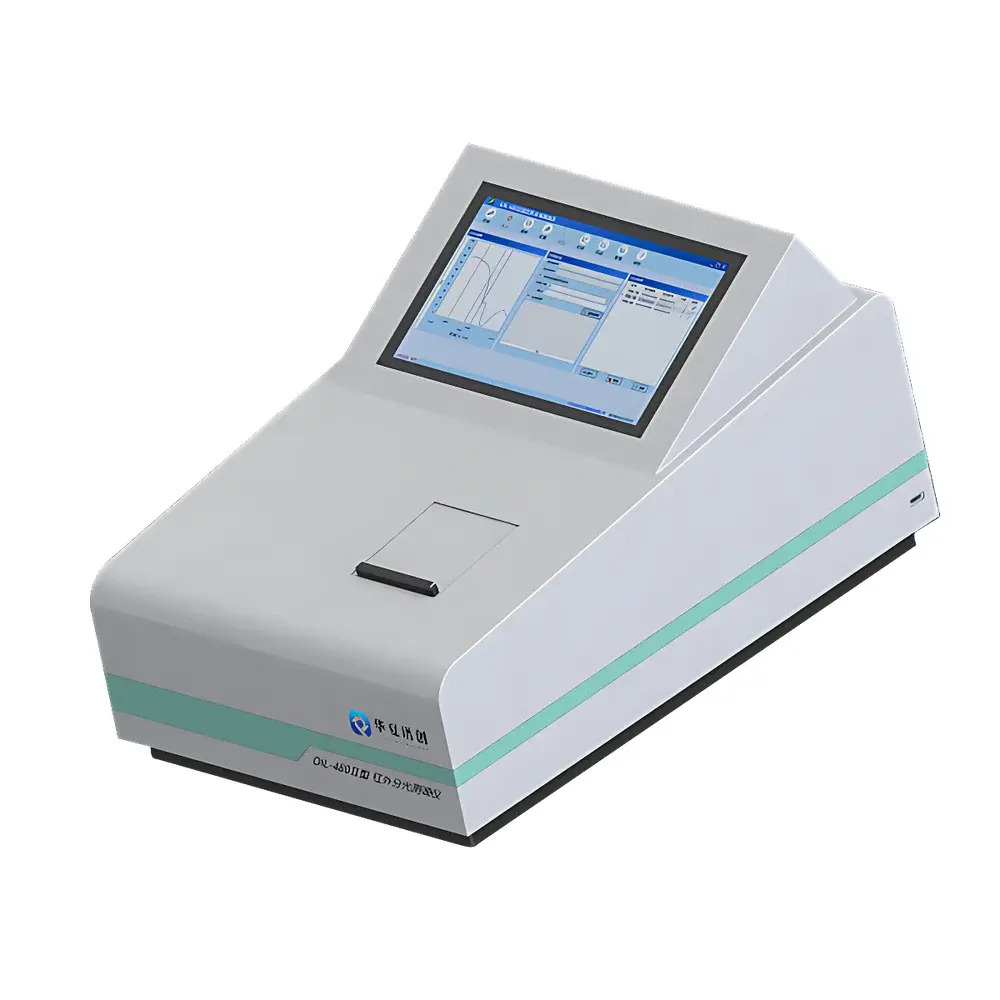
Spectra Invent OIL-480II Infrared Oil Content Analyzer
| Brand | Spectra Invent (Chinainvent) |
|---|---|
| Origin | Beijing, China |
| Instrument Type | Laboratory Benchtop Analyzer |
| Measurement Principle | Infrared Spectrophotometry (Triple-Wavelength Absorption at 2930 cm⁻¹, 2960 cm⁻¹, and 3030 cm⁻¹) |
| Detection Limit | 0.06 mg/L |
| Accuracy | ≤1% RSD (at 30–50 mg/L) |
| Compliance | HJ 637–2018, HJ 1051–2019, HJ 1077–2019, GB 5084–2021, GB/T 5750.7–2023, GB 5085.6–2007 |
| Sample Preparation | Liquid–liquid extraction with tetrachloroethylene (C₂Cl₄), optional CCl₄ mode |
| Cell Pathlength | 4 cm quartz cuvette |
| Reagent Purity Check Function | Automated spectral validation of C₂Cl₄ at key wavenumbers |
| Baseline Stability | Real-time zero-point auto-adjustment |
| Calibration Options | Multi-point standard curve, coefficient-based calculation, single-point verification |
| Light Source | Thermally stabilized, electronically modulated IR source (≥5000 h lifetime) |
Overview
The Spectra Invent OIL-480II Infrared Oil Content Analyzer is a dedicated benchtop spectrophotometer engineered for the quantitative determination of total petroleum hydrocarbons (TPH), petroleum hydrocarbons (petroleum oil), and non-petroleum hydrocarbons (animal and vegetable oils) in aqueous, soil, and gaseous emission matrices. It operates on the principle of infrared absorption spectroscopy, specifically measuring absorbance at three characteristic wavenumbers—2930 cm⁻¹ (asymmetric CH₂ stretch), 2960 cm⁻¹ (asymmetric CH₃ stretch), and 3030 cm⁻¹ (aromatic C–H stretch)—as defined in HJ 637–2018 and other national environmental standards. The instrument implements the dual-extraction methodology: first, acidified (pH ≤2) water samples are extracted with tetrachloroethylene to quantify total oil; second, the extract is passed through magnesium silicate adsorption to isolate petroleum hydrocarbons by removing polar interferences. The difference between total oil and petroleum oil yields the animal/vegetable oil concentration. This tri-wavelength algorithm eliminates interference from solvent impurities and matrix effects when properly calibrated and validated.
Key Features
- Integrated optical and electronic architecture minimizes thermal drift and electromagnetic interference, enhancing long-term measurement reproducibility.
- Real-time baseline auto-adjustment compensates for zero-point drift during extended operation or ambient temperature fluctuation.
- Dual-mode software platform supports both standardized infrared spectrophotometric analysis (per HJ 637–2018) and non-dispersive infrared (NDIR)-compatible workflows for cross-method comparability.
- One-click solvent switching between tetrachloroethylene (C₂Cl₄) and carbon tetrachloride (CCl₄), including automatic recalibration of pathlength and spectral response coefficients.
- Embedded reagent purity verification: automatically evaluates C₂Cl₄ quality by measuring absorbance at 2930, 2960, and 3030 cm⁻¹ against a dry 4 cm quartz reference cell; flags batches exceeding thresholds (A₂₉₃₀ ≤ 0.34, A₂₉₆₀ ≤ 0.07, A₃₀₃₀ = 0).
- Electronically modulated mid-infrared source ensures stable radiant output over ≥5000 hours without mechanical choppers, reducing thermal load and improving signal-to-noise ratio.
- Modular hardware design enables seamless field upgrade to the OIL-510 automated extraction and analysis platform via firmware and accessory retrofitting.
Sample Compatibility & Compliance
The OIL-480II is validated for use across multiple regulatory sample types: wastewater (industrial and municipal), surface and groundwater, soil leachates, edible oil-contaminated irrigation water (GB 5084–2021), drinking water (GB/T 5750.7–2023), solid waste extracts (GB 5085.6–2007), soil solids (HJ 1051–2019), and stack gas condensates (HJ 1077–2019). All analytical procedures align with GLP-aligned laboratory practices. While not pre-certified for FDA 21 CFR Part 11, the instrument’s audit-trail-capable software architecture supports configuration for regulated environments—including user access control, electronic signature prompts, and immutable data logging—when deployed with validated IT infrastructure.
Software & Data Management
The embedded Windows-based application provides full traceability from raw absorbance acquisition to final concentration reporting. Each analysis session records operator ID, date/time stamp, cuvette ID, solvent lot number, calibration history, and spectral QA/QC metrics. Data export conforms to ASTM E1447 and ISO/IEC 17025-compliant formats (CSV, PDF, XML). The software includes built-in uncertainty propagation per GUM (Guide to the Expression of Uncertainty in Measurement) for reported oil concentrations. Raw interferograms and processed spectra are stored with metadata tags enabling retrospective reprocessing under updated calibration models.
Applications
- Environmental monitoring laboratories performing routine compliance testing for discharge permits (e.g., NPDES equivalents in China’s discharge licensing system).
- Water treatment facilities assessing influent/effluent oil loading to optimize coagulation-flocculation and dissolved air flotation units.
- Soil remediation contractors quantifying residual TPH in excavated soils prior to backfill or off-site disposal.
- Food processing and agricultural regulators verifying irrigation water safety per GB 5084–2021 limits (≤10 mg/L petroleum oil).
- Research institutions conducting method validation studies comparing infrared vs. gravimetric or GC-FID approaches for complex emulsions.
FAQ
What extraction solvents are supported, and how is solvent purity verified?
The OIL-480II supports tetrachloroethylene (C₂Cl₄) and carbon tetrachloride (CCl₄). Purity verification is performed automatically using a dry 4 cm quartz cell as reference; absorbance thresholds at 2930 cm⁻¹ (≤0.34), 2960 cm⁻¹ (≤0.07), and 3030 cm⁻¹ (=0) are enforced.
Is the instrument compatible with LIMS integration?
Yes—via configurable ODBC drivers and ASCII-formatted data export; API-level integration requires optional middleware licensed separately.
Can the OIL-480II be used for solid-phase extraction (SPE) eluates?
Yes, provided the eluate volume is sufficient for 4 cm pathlength cuvette filling (typically ≥2.5 mL) and free of particulates or water droplets.
Does the system meet ISO/IEC 17025 requirements for accredited testing?
The hardware and software architecture support ISO/IEC 17025 implementation when paired with documented SOPs, metrologically traceable calibrations, and staff competency records.
What maintenance intervals are recommended for routine operation?
Optical alignment verification every 6 months; source intensity check quarterly; quartz cuvette cleaning after each batch using solvent-rinsed lint-free wipes; annual factory recalibration advised for compliance-critical applications.







