
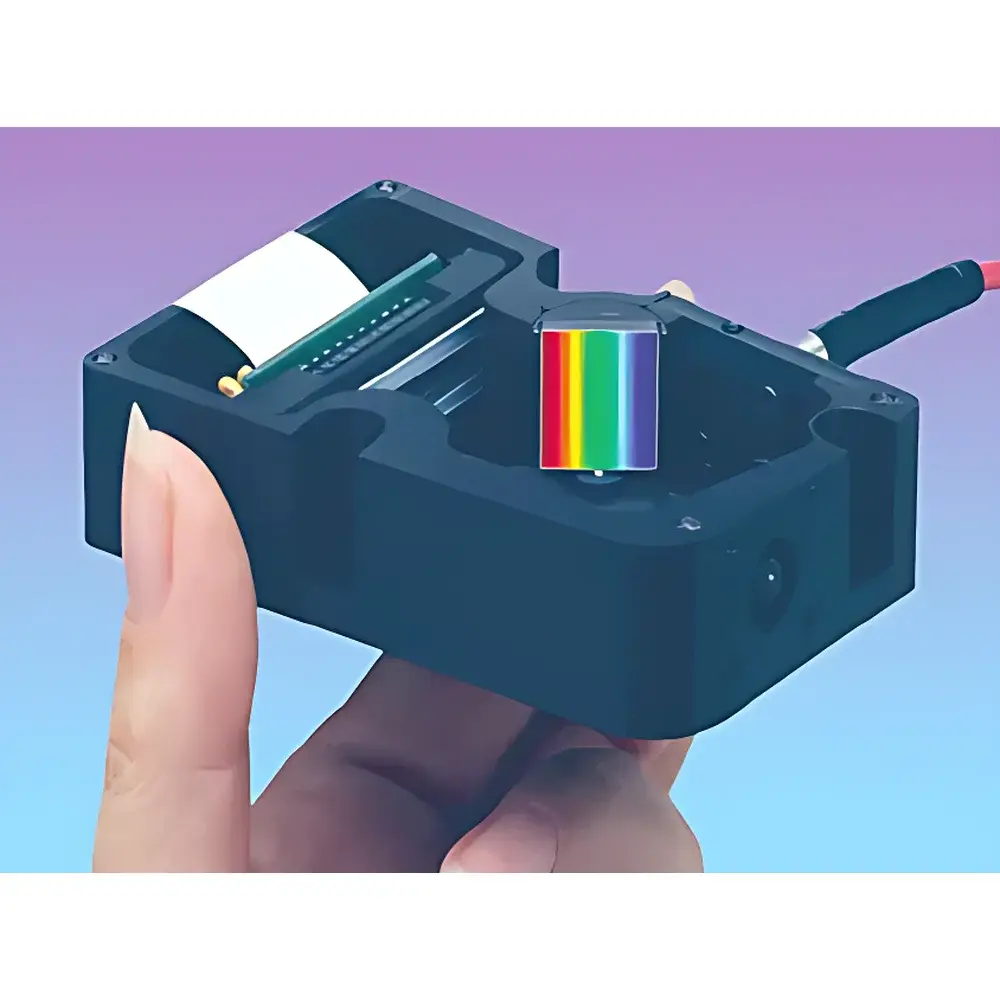
Spectral Products SM200/SM400 OEM CCD Fiber Optic Spectrometer
| Brand | Spectral Products |
|---|---|
| Origin | USA |
| Manufacturer Type | Authorized Distributor |
| Product Origin | Imported |
| Model | SM200 / SM400 |
| Spectral Range | 200–1050 nm |
| Detector Type | CCD |
| Optical Resolution | 0.15–10 nm (FWHM, slit- and grating-dependent) |
| Sensitivity | High quantum efficiency across UV-VIS-NIR |
| Signal-to-Noise Ratio | >300:1 (full well, typical integration time) |
| Dynamic Range | 16-bit digitization (65,536 counts) |
| Stray Light | <0.05% at 632 nm (<0.1% across full range) |
Overview
The Spectral Products SM200 and SM400 are compact, OEM-optimized fiber optic spectrometers engineered for high-stability spectral acquisition in embedded and industrial instrumentation platforms. Based on proven Czerny-Turner optical architecture, these devices utilize fixed-grating dispersion with entrance slits and collimating/focusing optics integrated into a rigid, thermally stable aluminum housing. The core measurement principle relies on wavelength-dispersive detection via linear CCD array sensors—Sony ILX511 (SM200) or Toshiba TCD1304AP (SM400)—coupled to low-noise, clock-optimized readout electronics. Designed explicitly for system integrators, the SM200/SM400 delivers a broad 200–1050 nm spectral window with configurable resolution (0.15–10 nm FWHM), determined by slit width, grating groove density, and detector pixel binning. Its modular mechanical design supports direct free-space coupling through an internal slit or flexible fiber-optic input via interchangeable SMA905, FC, or custom connector panels—enabling seamless integration into process analyzers, handheld diagnostics, or multi-channel monitoring systems.
Key Features
- Ruggedized aluminum chassis with passive thermal management, ensuring operational stability across –10 °C to +50 °C ambient conditions
- UV-enhanced anti-reflection coating on CCD sensor surface, improving quantum efficiency by 20–50% below 450 nm versus standard UV coatings
- 16-bit analog-to-digital conversion with hardware-level dark current compensation and programmable integration times (1 ms to 65 s)
- Support for multi-spectrometer configurations: up to eight units synchronously addressable via USB 2.0 hub architecture with external trigger capability
- OEM-focused interface flexibility: native USB 2.0 (class-compliant HID), optional PCI interface board, and TTL-compatible trigger I/O lines
- Modular detector compatibility: factory-configured for ILX511 or TCD1304AP; supports custom photodiode arrays or third-party DAQ integration upon request
Sample Compatibility & Compliance
The SM200/SM400 accommodates diverse optical input modalities—including collimated beams, fiber-coupled sources (e.g., deuterium/halogen lamps, LEDs, lasers), and diffuse reflectance probes—making it suitable for transmission, absorption, fluorescence, reflectance, and emission measurements. Its spectral fidelity meets routine requirements for ASTM E308 (colorimetry), ISO 13655 (spectral measurement of graphic arts), and USP (UV-Vis spectrophotometric system suitability). While not pre-certified for regulated environments, the platform’s deterministic timing, non-volatile calibration storage, and repeatable mechanical alignment support GLP/GMP-aligned validation protocols when deployed with appropriate SOPs and audit-trail-capable software.
Software & Data Management
Spectral Products provides SM32Pro—a Windows-based application offering real-time spectrum acquisition, baseline correction, peak identification, spectral math (ratio, subtraction, smoothing), and export to CSV, TXT, or SPC formats. For OEM deployment, a documented C/C++ DLL interface enables full control over exposure, averaging, region-of-interest selection, and dark/reference correction within custom host applications. All firmware and calibration data (wavelength, intensity, linearity) are stored onboard EEPROM, eliminating dependency on host-side calibration files. Raw frame data retains full 16-bit depth prior to processing, preserving quantitative integrity for post-acquisition reanalysis. Optional SDK extensions support 21 CFR Part 11 compliance when integrated with validated electronic lab notebook (ELN) or LIMS systems.
Applications
- Semiconductor process monitoring: plasma emission analysis, thin-film thickness verification via interference fringe tracking
- Pharmaceutical QA/QC: active ingredient quantification in dissolution testing, excipient identification via NIR fingerprinting
- Agricultural & food safety: chlorophyll index mapping, mycotoxin screening using fluorescence excitation-emission matrices
- Environmental sensing: dissolved organic carbon (DOC) estimation from UV absorbance at 254 nm, NO2/SO2 gas detection via differential optical absorption spectroscopy (DOAS)
- Biomedical research: LED-based flow cytometry spectral unmixing, label-free cell viability assessment via autofluorescence profiling
- Polymer & coating analysis: cure-state monitoring via carbonyl band evolution at 1720 cm−1 (using FT-IR-compatible sampling accessories)
FAQ
Can the SM200/SM400 be calibrated traceably to NIST standards?
Yes—Spectral Products offers factory calibration services traceable to NIST SRM 2031 (deuterium lamp) and SRM 2032 (tungsten halogen lamp), with certificate documentation including uncertainty budgets per ISO/IEC 17025.
Is cooling available to reduce dark current noise?
No built-in thermoelectric cooler is integrated; however, the low-dark-current design of the ILX511 and TCD1304AP—combined with hardware binning and multi-scan averaging—achieves effective SNR comparable to actively cooled units in most industrial settings.
What is the maximum allowable optical input power to avoid saturation or damage?
The absolute maximum irradiance is 10 mW/mm² at the entrance slit plane; sustained exposure above this threshold may induce nonlinear response or accelerated CCD degradation—especially in UV regions.
Does the USB interface support isochronous data streaming for real-time process control?
Yes—the USB 2.0 driver implements bulk transfer mode with guaranteed latency under 10 ms, enabling closed-loop feedback in PLC- or microcontroller-driven systems when paired with the optional external trigger synchronization module.





