
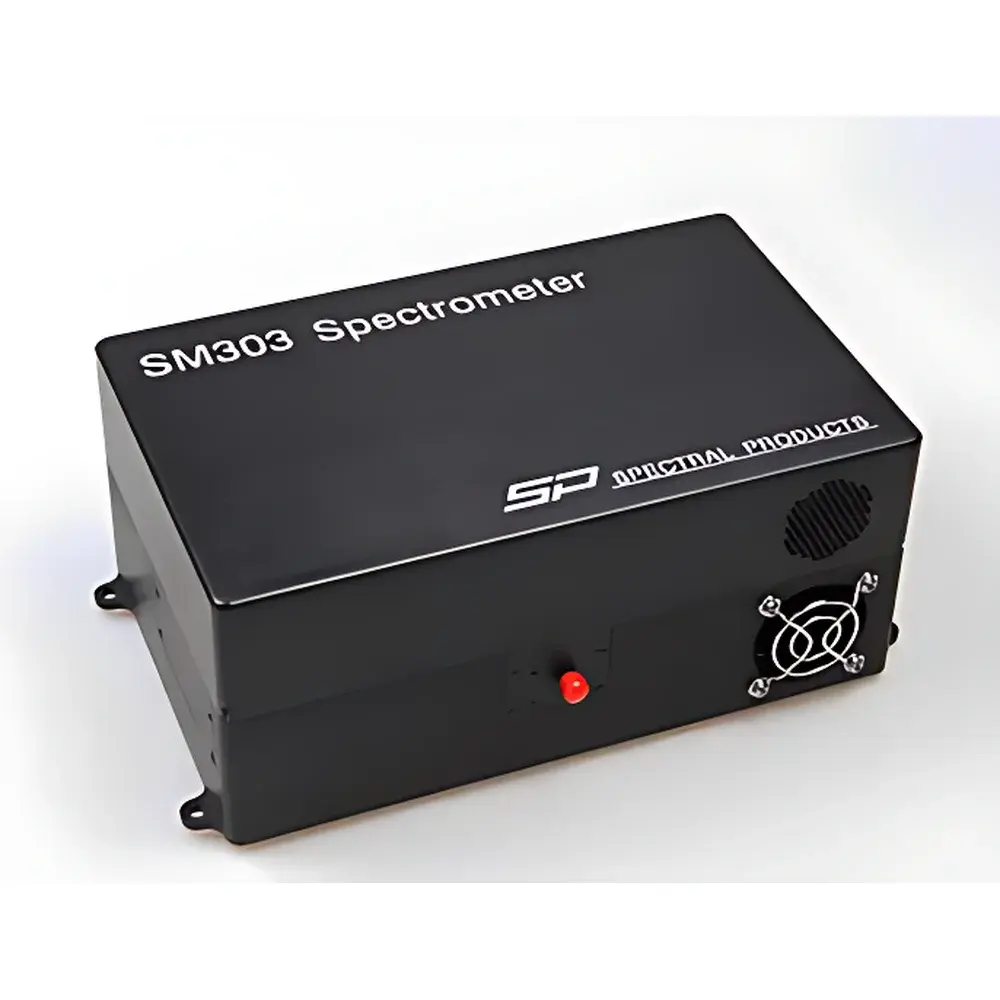
Spectral Products SM303 TE-Cooled Back-Illuminated CCD Fiber Optic Spectrometer
| Brand | Spectral Products |
|---|---|
| Origin | USA |
| Model | SM303 |
| Spectral Range | 200–1050 nm |
| Detector Type | Back-Illuminated CCD |
| Optical Resolution | 0.15–10 nm (FWHM, configuration-dependent) |
| Sensitivity | High UV Quantum Efficiency (>50% at 254 nm) |
| Signal-to-Noise Ratio | >1000:1 (at full well, 1 s integration) |
| Dynamic Range | >10,000:1 (typical, 16-bit digitization) |
| Stray Light | <0.01% at 632 nm |
| Cooling | Thermoelectric (TE), ΔT ≈ –45 °C below ambient |
| Interface | USB 1.1/2.0, 16-bit ADC |
| Pixel Array | 1024 × 64 (active 1024 × 1) |
Overview
The Spectral Products SM303 is a research-grade, thermoelectrically cooled fiber optic spectrometer engineered for high-fidelity spectral acquisition across the ultraviolet, visible, and near-infrared (UV-VIS-NIR) spectrum (200–1050 nm). It employs a back-illuminated CCD detector architecture—optimized for quantum efficiency exceeding 50% at 254 nm—to deliver exceptional photon collection capability in the deep UV region where conventional front-illuminated sensors exhibit significant quantum deficit. The instrument operates on the principle of Czerny-Turner optical design with fixed grating dispersion and slit-coupled fiber input, enabling precise wavelength calibration stability and minimal optical aberration. Its low-stray-light optical path (<0.01% at 632 nm), combined with TE cooling to approximately –45 °C below ambient, suppresses dark current by over two orders of magnitude relative to uncooled operation—making it suitable for long-integration measurements of weak emission sources such as fluorescence decay, Raman scattering, or low-intensity LED emissions.
Key Features
- Back-illuminated 1024-pixel CCD array with enhanced UV quantum efficiency and reduced etaloning effects in NIR
- Thermoelectric (Peltier) cooling system maintaining stable detector temperature for reproducible dark current suppression
- Optimized optical bench with ultra-low stray light performance (<0.01% at 632 nm), validated per ASTM E275 and ISO 17025-compliant characterization protocols
- Configurable spectral resolution from 0.15 nm to 10 nm (FWHM), determined by slit width, grating groove density, and focal length
- 16-bit analog-to-digital conversion with >10,000:1 dynamic range, supporting both high-intensity broadband and low-flux narrowband signal capture
- USB 1.1/2.0 interface compliant with Windows driver signing requirements; no external power supply required
Sample Compatibility & Compliance
The SM303 accepts standard SMA 905 fiber-optic inputs (core diameters 50–600 µm), enabling seamless integration with cuvette holders, integrating spheres, collimating optics, or remote sampling probes. Its broad spectral coverage supports compliance-driven applications including USP for UV-Vis absorbance validation, ASTM E308 for colorimetric analysis, and ISO/CIE 13406-2 for display spectral radiance profiling. The instrument’s thermal and mechanical stability meets GLP laboratory environmental control guidelines when operated within 15–30 °C ambient and <70% RH. All firmware and calibration data are traceable to NIST-traceable tungsten-halogen and deuterium lamp standards; factory calibration certificates include uncertainty budgets per ISO/IEC 17025 Annex A.3.
Software & Data Management
The SM303 ships with SM32Pro—a Windows-native application supporting Windows 7 through 11 (32- and 64-bit) for spectral acquisition, real-time baseline correction, and quantitative analysis of transmittance, reflectance, and absorbance. The software implements full audit trail functionality—including user login timestamps, parameter change logs, and raw data immutability flags—meeting FDA 21 CFR Part 11 requirements for electronic records in regulated environments. A comprehensive SDK (C/C++, Visual Basic, LabVIEW-compatible DLLs) enables custom automation in QC workflows, OEM integration, or synchronized multi-instrument control. Export formats include CSV, ASCII, JCAMP-DX, and HDF5, facilitating interoperability with MATLAB, Python (via NumPy/Pandas), and LIMS platforms.
Applications
- Fluorescence lifetime and quantum yield measurement in life science and material photophysics labs
- Raman spectroscopy with notch-filtered excitation and low-noise Stokes/anti-Stokes detection
- LED and OLED spectral power distribution (SPD) analysis per IES LM-79 and CIE S 025/E:2015
- Plasma emission monitoring in semiconductor process tools (e.g., endpoint detection in etch chambers)
- Environmental water quality assessment via UV-Vis absorbance (e.g., NO₃⁻, DOC, humic substances)
- Radiometric calibration of imaging sensors and display devices using calibrated integrating sphere sources
FAQ
What is the typical integration time range supported by the SM303?
Integration times span from 1 ms to 65 seconds, adjustable in 1-ms increments; TE cooling ensures dark noise remains sub-10 e⁻ RMS beyond 10 s integrations.
Can the SM303 be used for quantitative absorbance measurements under GLP conditions?
Yes—when paired with NIST-traceable reference standards and operated with SM32Pro’s audit-trail mode enabled, it satisfies GLP documentation requirements for method validation and instrument qualification.
Is grating exchange possible in the field?
No—the SM303 uses a permanently aligned, factory-optimized grating assembly; resolution and range are fixed per model configuration (e.g., SM303-250-1050).
Does the SDK support Linux or macOS development?
The official SDK targets Windows only; however, cross-platform access is achievable via USB CDC emulation or third-party libusb wrappers with appropriate kernel-level permissions.
How is wavelength calibration maintained over temperature fluctuations?
The optical bench incorporates low-expansion Invar mounts and passive thermal mass stabilization; calibration drift is <0.02 nm/°C over the operating range, verified during ISO 17025 accreditation testing.




