
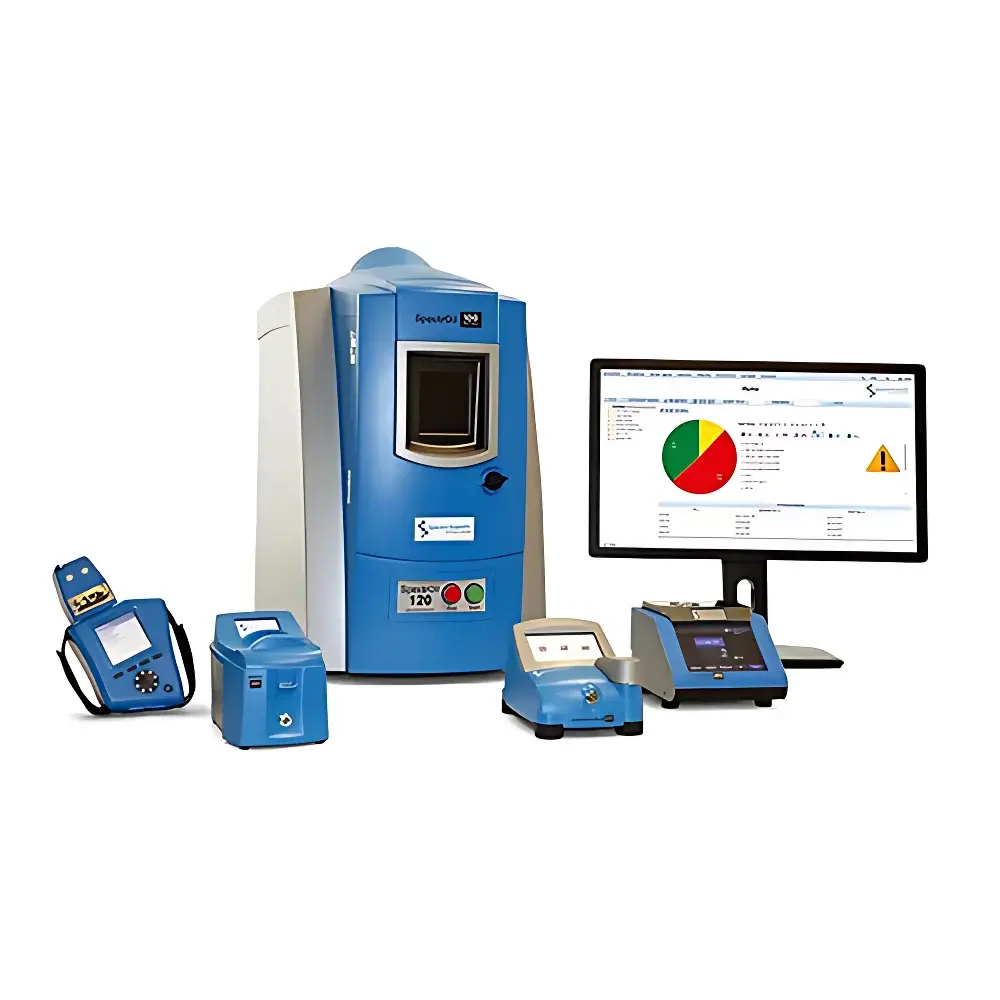
Spectro Scientific MiniLab EL Oil Analysis System
| Brand | Spectro Scientific |
|---|---|
| Origin | USA |
| Model | MiniLab EL |
| Type | Portable On-Site Engine Oil Monitoring System |
| Compliance | ASTM D6595, ISO 4406, ISO 11500, ISO 11171, SAE ARP5563, MIL-STD-2104 |
| Software | MiniLab Device Console (MDC) + MiniLab LIMS (Web-based, 21 CFR Part 11–ready audit trail & user role management) |
| Sample Volume | 4 mL |
| Analysis Time | <5 minutes per sample |
| Detection Principles | Rotating Disc Electrode Atomic Emission Spectrometry (RDE-AES), Ferrography (Analytical & Direct-Read), Particle Quantifier (PQ), Viscosity (Capillary), Water Content (FTIR) |
Overview
The Spectro Scientific MiniLab EL is a field-deployable, integrated oil analysis system engineered for non-destructive condition monitoring of high-performance internal combustion engines and gas turbine systems. Unlike conventional laboratory-based methods requiring centralized infrastructure and multi-day turnaround, the MiniLab EL implements five complementary analytical modules—Rotating Disc Electrode Atomic Emission Spectrometry (RDE-AES), Analytical Ferrography (AF), Direct-Read Ferrography (DR), Particle Quantifier (PQ), and Capillary Viscometry with FTIR-based water detection—within a single, ruggedized platform. This architecture enables quantitative elemental wear metal analysis (Fe, Cu, Al, Cr, Pb, Si, Na, Ca, Mg, etc.), ferrous particle morphology assessment, ferrous mass concentration quantification, kinematic viscosity measurement at 40 °C, and water-in-oil detection down to 100 ppm—all performed on-site without solvent use, sample dilution, or operator-intensive preparation. The system operates on the principle that lubricant serves as a continuous diagnostic medium: its physical and chemical properties, along with suspended particulate matter, reflect real-time mechanical integrity, contamination ingress, and degradation kinetics within critical rotating and reciprocating components.
Key Features
- Single-platform operation supporting both laboratory-grade accuracy and field-deployable robustness—validated against ASTM D6595 for RDE-AES and ISO 11171 for particle sizing calibration.
- Complete analysis in under 5 minutes per sample, using only 4 mL of undiluted oil—no centrifugation, filtration, or solvent handling required.
- Modular test architecture: each module functions independently yet shares a unified data pipeline, ensuring traceability and cross-correlation between elemental, morphological, and physical parameters.
- Integrated “Tri-Vector” diagnostic engine: simultaneously evaluates wear severity (elemental concentration), wear mechanism (ferrographic image classification), and wear rate (PQ index vs. iron concentration ratio), enabling root-cause identification beyond threshold-based alarms.
- Embedded expert logic engine provides context-aware interpretation, referencing OEM-specific wear limits, fleet historical baselines, and failure mode libraries to generate actionable maintenance recommendations.
- Full GLP/GMP-aligned software architecture with electronic signatures, audit trails, and configurable user roles—designed for environments requiring FDA 21 CFR Part 11 compliance and ISO/IEC 17025 traceability.
Sample Compatibility & Compliance
The MiniLab EL is validated for use with mineral, synthetic, and semi-synthetic engine oils—including aviation turbine oils (MIL-PRF-23699, MIL-PRF-6081), heavy-duty diesel engine oils (API CK-4, FA-4), and high-temperature jet engine lubricants. It complies with key international standards governing oil analysis practice: ASTM D6595 (wear metal quantification by RDE-AES), ISO 4406 (particle contamination code), ISO 11500 (automated particle counting), ISO 11171 (calibration standard for particle counters), and SAE ARP5563 (recommended practice for oil debris monitoring in gas turbine engines). All hardware and firmware undergo annual metrological verification per ISO/IEC 17025 requirements when deployed in accredited laboratories or regulated maintenance organizations.
Software & Data Management
The MiniLab software suite comprises two interoperable components: the MiniLab Device Console (MDC) and MiniLab LIMS. MDC runs locally on Windows-based host computers and manages instrument control, sample ID assignment, real-time data acquisition, and encrypted synchronization with the LIMS server. MiniLab LIMS is a browser-accessible, role-based platform deployable on-premises or via secure cloud hosting. It supports multi-site asset registration, customizable alarm thresholds (per asset, oil type, or operational phase), automated trend reporting with overlay-capable multi-parameter charts (e.g., Fe vs. PQ index vs. viscosity delta), and scheduled email notifications with embedded PDF reports. All data modifications are logged with timestamped, user-attributed audit trails compliant with FDA 21 CFR Part 11 Subpart B requirements for electronic records and signatures.
Applications
The MiniLab EL is deployed across mission-critical engineering domains where rapid, deterministic insight into tribosystem health directly impacts safety, reliability, and lifecycle cost. In aerospace R&D, it supports accelerated engine durability testing and hot-section component validation under transient load profiles. In rail transportation, it enables predictive maintenance of diesel-electric locomotive powertrains during dynamic duty cycles. Automotive OEMs integrate it into powertrain development labs for real-time feedback during dyno-based calibration and endurance testing. Research institutions utilize its high-temporal-resolution capability to correlate lubricant aging pathways with surface fatigue mechanisms under controlled boundary-lubrication regimes.
FAQ
Does the MiniLab EL require external calibration standards or consumables for routine operation?
No—RDE-AES modules use factory-calibrated electrodes and certified reference oils; ferrographic slides and capillary viscometer tubes are single-use but included in consumable kits with lot-traceable certification.
Can MiniLab LIMS integrate with existing CMMS or ERP platforms?
Yes—via RESTful API and configurable CSV/XML export protocols compatible with Maximo, SAP PM, and Infor EAM.
Is training and technical support available globally?
Spectro Scientific provides certified instructor-led courses (on-site or virtual), ISO 17025-compliant method validation documentation, and 24/7 remote diagnostics through authorized service partners in over 40 countries.
How does the system handle oil samples with high soot or oxidation byproducts?
The RDE-AES excitation process is insensitive to base oil degradation products; AF/DR modules include automated contrast optimization and focus correction algorithms to maintain particle resolution in darkened or viscous samples.
What cybersecurity measures are implemented in MiniLab LIMS?
LIMS employs TLS 1.2+ encryption, OAuth 2.0 authentication, RBAC (role-based access control), and optional FIPS 140-2 validated cryptographic modules for deployment in classified or defense-sector environments.






