
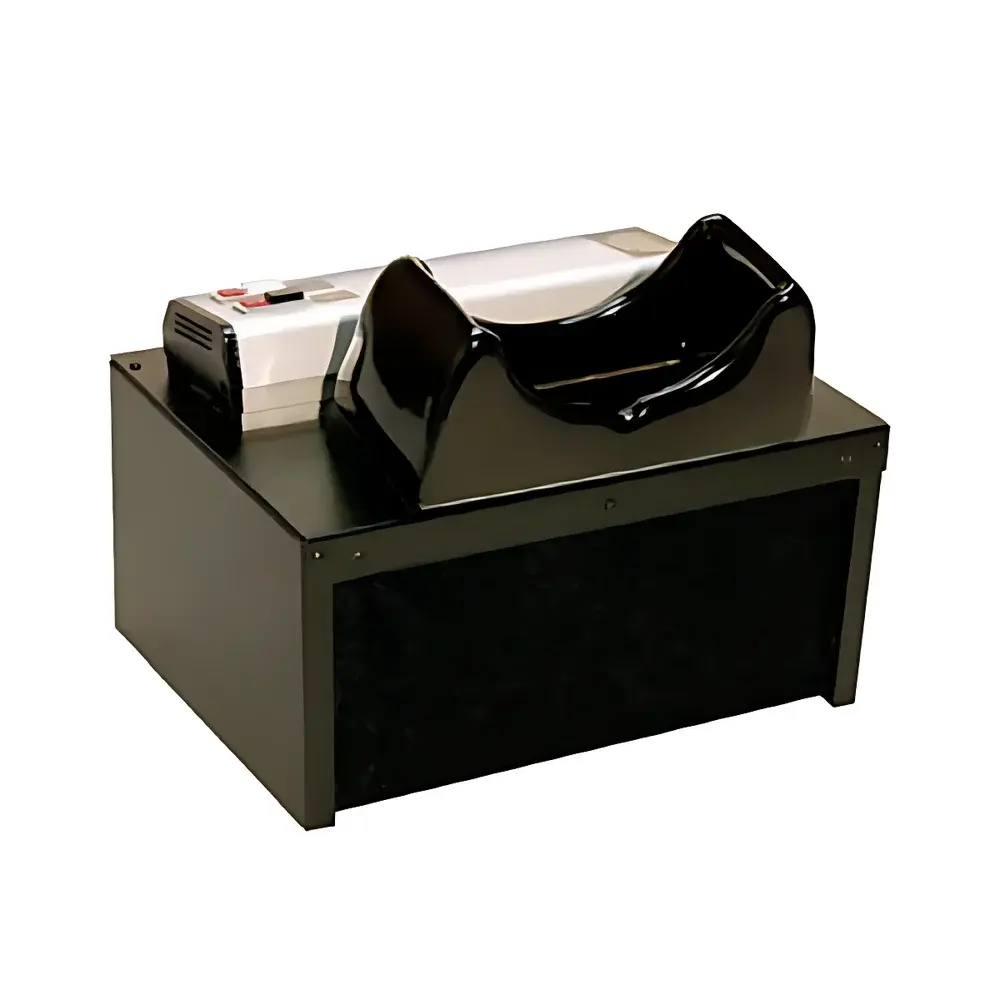
Spectro-UV CM Series UV Fluorescence Observation Cabinet
| Brand | Spectro-UV |
|---|---|
| Origin | USA |
| Model | CM-10A, CM-24A, CM-26A |
| Dimensions (L×W×H) | CM-10A & CM-26A: 30 × 22.8 × 16.5 cm |
| CM-24A | 61 × 26.7 × 35.6 cm |
| UV Irradiance | 300 µW/cm² at 365 nm (UVA), 310 µW/cm² at 254 nm (UVC) |
| Light Source Type | External-mount high-intensity UV lamps (E-series, ENF-240C, ENF-260C) |
| Illumination Mode | External irradiation |
| Compliance | Designed for ASTM E1417, ISO 3452-2, and forensic light source protocols per IAI/ENFSI guidelines |
Overview
The Spectro-UV CM Series UV Fluorescence Observation Cabinet is a purpose-engineered darkroom enclosure optimized for controlled excitation and visualization of fluorescence across forensic, geological, clinical, and materials science applications. Unlike generic UV cabinets or handheld lamps, the CM Series integrates calibrated external UV sources with light-tight structural design to eliminate ambient interference while preserving spectral fidelity and operator safety. Each model employs standardized UVA (365 nm) and UVC (254 nm) excitation—selected for their well-documented efficacy in eliciting characteristic emission from biological fluids, latent fingerprints, dyes, minerals, and polymer additives. The cabinet operates on the principle of photoluminescence detection: incident UV photons induce electronic transitions in fluorophores; emitted visible or near-visible photons are then observed under low-background conditions, enabling high-contrast identification without chemical enhancement. Its modular architecture supports integration into GLP-compliant workflows and routine QC environments where repeatability, traceability, and spectral consistency are mandatory.
Key Features
- Light-tight construction with dual-layer black felt curtains—enabling full sample access while maintaining >99.9% ambient light exclusion during operation
- External lamp mounting system—eliminates internal heat buildup, extends lamp life, and allows rapid source interchange between E-series, ENF-240C, and ENF-260C UV emitters
- Ergonomic interior geometry—angled viewing surfaces and non-reflective matte-black interior coating minimize stray light and maximize signal-to-noise ratio
- UL-listed power interface with integrated ballast and thermal cutoff—ensuring stable output and compliance with OSHA and IEC 62471 photobiological safety standards
- Modular footprint—CM-10A and CM-26A share identical compact dimensions (30 × 22.8 × 16.5 cm) for benchtop portability; CM-24A provides expanded working volume (61 × 26.7 × 35.6 cm) for larger evidence items or multi-sample screening
Sample Compatibility & Compliance
The CM Series accommodates diverse specimen formats—including swabs, glass slides, currency, textiles, rock slabs, and electronic components—without requiring surface modification or vacuum environments. All models meet ASTM E1417-22 (Standard Practice for Liquid Penetrant Testing) and ISO 3452-2:2022 (Non-destructive testing — Penetrant testing — Part 2: Testing of penetrant materials) requirements for UV irradiance uniformity and spectral output verification. For forensic laboratories operating under IAI Bloodstain Pattern Analysis or ENFSI Document Examination guidelines, the 254 nm / 365 nm dual-band capability supports validated protocols for semen detection (using 365 nm), ink differentiation (254 nm + 365 nm), and fingerprint development (e.g., cyanoacrylate fuming followed by dye staining). Cabinets are supplied with NIST-traceable irradiance calibration certificates and support annual recalibration per ISO/IEC 17025-accredited service providers.
Software & Data Management
While the CM Series is a hardware-only optical platform (no embedded processor or onboard imaging), it is fully compatible with third-party documentation systems including forensic photography workstations (e.g., Foster + Freeman FSI-2000), spectral imaging rigs (Specim IQ, Headwall Photonics), and digital microscopy suites (Olympus Stream, Zeiss ZEN). All models include standardized 1/4″-20 threaded mounting points and alignment reference marks to facilitate repeatable camera positioning. When used with FDA 21 CFR Part 11–compliant image acquisition software, the cabinet enables audit-trail generation, user authentication, and electronic signature capture—meeting GxP documentation requirements for regulated labs. Optional accessories include UV-blocking safety goggles (ANSI Z87.1+ rated), calibrated radiometers (International Light ILT2400), and wavelength-specific bandpass filters for spectral isolation.
Applications
- Forensic science: Detection of latent fingerprints, bodily fluids (semen, saliva), counterfeit document analysis, fiber and paint chip fluorescence profiling
- Geosciences: Rapid field and lab-based mineral identification (e.g., scheelite, fluorite, autunite) using characteristic long- and short-wave responses
- Life sciences: Visualization of GFP-tagged constructs, UV-excitable stains (DAPI, Hoechst), and protein gels post-electrophoresis
- Industrial QA/QC: Inspection of adhesive curing, coating integrity, and contaminant presence on machined parts or semiconductor wafers
- Conservation & art authentication: Non-invasive assessment of varnish layers, retouching history, and pigment degradation signatures
FAQ
What UV wavelengths are supported, and how are they verified?
The CM Series delivers calibrated output at 254 nm (UVC) and 365 nm (UVA), measured per ISO 15782 using a spectroradiometer traceable to NIST SRM 2032. Irradiance values are 310 µW/cm² (254 nm) and 300 µW/cm² (365 nm) at the working plane.
Can the cabinet be used with UV-sensitive cameras or CCD sensors?
Yes—its external illumination architecture eliminates internal reflections and electromagnetic interference. Mounting interfaces comply with C-mount and M42 standards for direct coupling to scientific-grade monochrome or UV-enhanced CMOS sensors.
Is ozone generation a concern with the 254 nm lamp operation?
No—ozone production is negligible at the specified irradiance levels and exposure durations typical for observation tasks. Ventilation is not required unless operated continuously for >4 hours in an unventilated space.
How does the CM Series differ from standard “black light” boxes?
Unlike consumer-grade enclosures, the CM Series incorporates metrologically validated irradiance, spectral purity certification, mechanical stability for repeatable positioning, and regulatory documentation support—making it suitable for evidentiary use and ISO-accredited testing.
Are replacement lamps and calibration services available globally?
Spectro-UV maintains an authorized distributor network across North America, EMEA, and APAC. All lamps ship with individual spectral output reports, and biennial calibration services are offered through ISO/IEC 17025-certified partners.





