
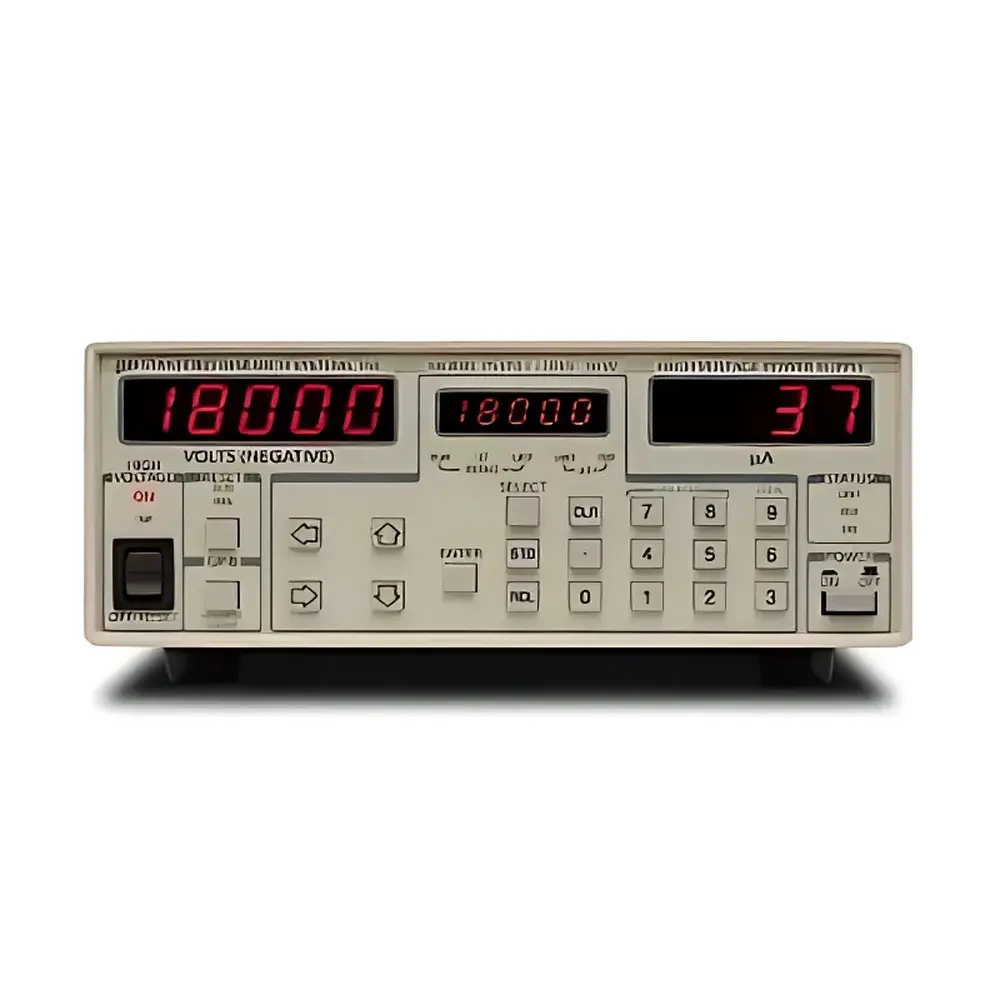
Stanford Research Systems PS300 Series Programmable High-Voltage Power Supply
| Brand | SRS/Stanford Research Systems |
|---|---|
| Origin | UK |
| Manufacturer Type | Authorized Distributor |
| Origin Category | Imported |
| Model | PS300 Series |
| Output Voltage Ranges | 1.25 kV, 2.5 kV, 5 kV, 10 kV, 20 kV |
| Voltage Resolution & Repeatability | 1 V |
| Voltage Setting Accuracy | ±0.01% of full scale |
| Voltage Regulation Accuracy | ±0.001% of full scale |
| Response Time | <10 µs |
| Output Ripple | 0.0015% of full scale |
Overview
The Stanford Research Systems PS300 Series Programmable High-Voltage Power Supply is a precision-engineered DC high-voltage source designed for demanding laboratory and metrology applications requiring stable, low-noise, and highly repeatable bias or excitation voltages. Based on linear regulation architecture with proprietary feedback control, the PS300 delivers exceptional voltage stability under dynamic load conditions—critical for electro-optic modulation, photomultiplier tube (PMT) biasing, electron beam focusing, electrostatic lensing, and precision charge control in optical interferometry and particle detection systems. Its fully floating, isolated output enables flexible grounding configurations essential for sensitive optical measurement setups where ground loops or common-mode noise must be minimized. The series complies with IEC 61010-1 safety standards for laboratory electrical equipment and incorporates redundant overvoltage, overcurrent, and arc-detection protection circuits to safeguard both user and connected instrumentation.
Key Features
- Five standard output voltage ranges: 1.25 kV, 2.5 kV, 5 kV, 10 kV, and 20 kV — selectable per model variant to match application-specific insulation and field-strength requirements
- Voltage resolution and repeatability of 1 V across all ranges, enabling fine-grained control for calibration-sensitive optical subsystems
- Setting accuracy of ±0.01% of full scale and regulation accuracy of ±0.001% of full scale — verified traceably to NIST-traceable standards
- Ultra-low output ripple: ≤0.0015% of full scale RMS, ensuring minimal amplitude modulation interference in laser cavity alignment or photodetector bias networks
- Sub-10 µs transient response time supports fast-pulse applications such as gated PMT operation or electro-optic shutter triggering
- Select models feature polarity-reversible output, facilitating bidirectional electric field generation in tunable Fabry–Pérot etalons or liquid crystal cell characterization
- Front-panel digital display with simultaneous voltage and current readout (4½-digit resolution), calibrated in real time against internal references
- Multiple control interfaces: local keypad, analog voltage input (0–10 V), RS-232 serial, and IEEE-488 (GPIB) — fully programmable via SCPI command set
Sample Compatibility & Compliance
The PS300 Series is routinely deployed in optical measurement environments involving vacuum chambers, cryogenic stages, and fiber-coupled photonic modules. Its compact 1U half-rack chassis minimizes footprint in space-constrained optical tables and cleanroom installations. All units are CE-marked and conform to EN 61326-1 (EMC for laboratory equipment) and EN 61000-4-x immunity standards. For regulated industries, the PS300 supports audit-ready operation when integrated into GLP/GMP-compliant workflows: GPIB logging enables timestamped parameter recording, and firmware supports user-accessible calibration history storage. While not inherently 21 CFR Part 11 compliant, its deterministic command-response behavior and non-volatile settings retention make it suitable for validated systems when paired with compliant data acquisition software.
Software & Data Management
SRS provides the free PS300 Control Utility for Windows/macOS/Linux, supporting full remote configuration, real-time monitoring, and script-based sequencing (e.g., voltage ramping for breakdown testing). The utility exports tab-delimited ASCII logs with millisecond timestamps, compatible with MATLAB, Python (via PyVISA), and LabVIEW. For enterprise integration, the device responds to standard SCPI commands (e.g., :VOLT?;:CURR?;:VOLT 5000) and supports IEEE-488.2 status reporting. All calibration constants and user-defined limits are stored in battery-backed memory, preserving integrity during power cycles. Firmware updates are delivered via USB-to-serial adapter and include cryptographic signature verification.
Applications
- Biasing photomultiplier tubes and avalanche photodiodes in low-light spectroscopy and time-resolved fluorescence
- Electro-optic modulator (EOM) drive in quantum optics experiments and coherent lidar systems
- Charging and stabilization of conductive optical substrates during thin-film deposition monitoring
- Electrostatic deflection control in scanning electron microscopes (SEM) and cathodoluminescence setups
- Calibration reference source for high-voltage probes and electrometer validation per ASTM E1009 and ISO/IEC 17025
- Field generation in optical trap (tweezer) systems requiring precise gradient force modulation
FAQ
Is the PS300 Series suitable for use with grounded optical detectors?
Yes — all models feature fully floating outputs with >100 MΩ isolation resistance and 1.5 kV isolation rating, allowing safe connection to grounded photodiode amplifiers or lock-in inputs.
Can output polarity be reversed without hardware modification?
Select PS300 variants (e.g., PS310, PS325) support polarity reversal via front-panel menu or remote command; others require physical jumper reconfiguration per the user manual.
Does the unit support analog modulation of output voltage?
Yes — the 0–10 V analog input accepts external modulation signals up to 10 kHz bandwidth, enabling real-time voltage shaping synchronized with optical choppers or function generators.
What maintenance is required to sustain calibration accuracy?
Annual verification using a NIST-traceable high-voltage meter is recommended; internal calibration coefficients remain stable for ≥12 months under typical lab conditions (23 ±2 °C, <60% RH).
Are safety interlocks supported for integration into interlocked optical enclosures?
Yes — the rear-panel INTERLOCK port accepts dry-contact closure (24 V max), disabling HV output immediately upon enclosure door opening or vacuum loss signal.




