Labsphere CSTM-VCSEL-PW-060-LIVT VCSEL Laser Power and LIVT Characterization System
| Origin | USA |
|---|---|
| Manufacturer Type | Authorized Distributor |
| Origin Category | Imported |
| Model | CSTM-VCSEL-PW-060-LIVT |
| Pricing | Available Upon Request |
Overview
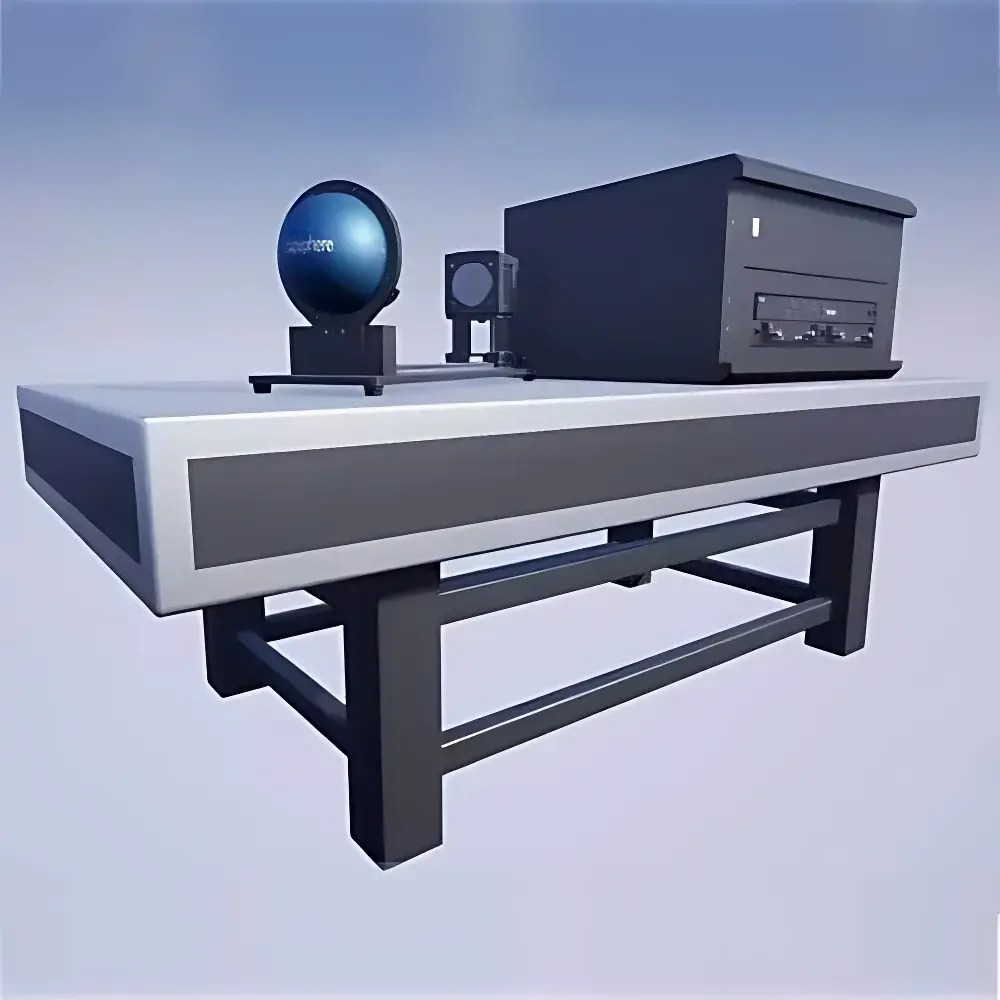
The Labsphere CSTM-VCSEL-PW-060-LIVT is a turnkey, NIST-traceable laser characterization system engineered for precise, repeatable Light–Current–Voltage–Temperature (LIVT) testing of Vertical-Cavity Surface-Emitting Lasers (VCSELs). Built upon Labsphere’s four-decade heritage in optical metrology, the system implements a calibrated radiometric architecture centered on high-diffuse-reflectance integrating spheres—Spectralon®, Permaflect®, or Spectraflect®—to capture divergent, low-coherence, pulsed VCSEL emissions across the 800–980 nm spectral band. Unlike conventional photodiode-based power meters, this system maintains spectral fidelity during high-speed pulse acquisition (up to 200 kHz), enabling simultaneous measurement of radiant flux, spectral centroid shift (T–λ drift), peak wavelength (λp), full-width-at-half-maximum (FWHM), and thermal transients under programmable drive conditions. Its design complies with fundamental principles of radiometric traceability per ISO/IEC 17025 and supports method validation aligned with IEC 60825-1 (laser safety) and JEDEC JESD22-A114 (thermal cycling reliability).
Key Features
- Automated, script-driven LIVT test sequences—including ramped current sweeps, pulsed DC, and user-defined duty cycles—with synchronized temperature control and spectral acquisition
- NIST-traceable 940 nm calibration source ensuring absolute radiometric accuracy within ±1% for power and ±0.1 nm for wavelength
- High-stability spectrometer with resolution selectable between 0.10 nm and 0.16 nm (FWHM) and wavelength repeatability ≤ ±0.05 nm over 24 h
- Spectralon® integrating sphere material rated for continuous operation up to +400 °C, enabling high-temperature aging tests without reflectance degradation
- Modular thermal stage with ±0.1 °C stability across 1–85 °C operating range; compatible with external chiller or Peltier-based controllers
- High-linearity (0.5%) fast-response photodetector with 5-digit effective resolution and 200 kHz maximum sampling rate for transient pulse analysis
- Fully programmable driver interface supporting variable pulse width (10 ns–10 ms), repetition rate (1 Hz–1 MHz), and voltage compliance limits
Sample Compatibility & Compliance
The CSTM-VCSEL-PW-060-LIVT accommodates bare-die, TO-can, and surface-mount VCSEL packages via standardized mechanical fixtures and thermally anchored mounting plates. Its 6-inch integrating sphere (customizable from 2″ to 12″) supports power ranges from 1 mW to 200 W at 940 nm, making it suitable for both R&D-grade prototype evaluation and high-throughput production line verification. All optical components meet RoHS 3 and REACH Annex XIV requirements. The system’s data integrity framework satisfies FDA 21 CFR Part 11 electronic record and signature criteria when operated with audit-trail-enabled software configuration, and supports GLP/GMP documentation workflows through exportable CSV, XML, and HDF5 file formats.
Software & Data Management
Labsphere’s proprietary LIVT Control Suite provides a deterministic, deterministic real-time acquisition environment with deterministic timing synchronization between current source, thermal controller, spectrometer, and detector. Users define multi-step test plans—including conditional branching based on threshold violations—and generate compliant reports containing LIV curves, T–λ drift maps, spectral evolution animations, and statistical summaries (mean, std dev, min/max across batches). Raw datasets retain full metadata: instrument serial numbers, calibration certificate IDs, environmental logs (ambient T/RH), and operator annotations. Export modules support direct integration into LabVIEW, Python (via PyVISA), MATLAB, and enterprise MES platforms via OPC UA.
Applications
- VCSEL wafer-level screening and binning in semiconductor fabs
- Thermal rollover and efficiency droop analysis under accelerated life testing (HTOL)
- Wavelength stability qualification for 3D sensing (e.g., iPhone Face ID, automotive LiDAR)
- Qualification of VCSEL arrays for optical interconnects and neural stimulation devices
- Development of feedback-controlled closed-loop drivers using real-time spectral centroid tracking
- Validation of packaging-induced thermal resistance (Rth,j-c) via transient thermal impedance modeling
FAQ
What calibration standards are used for radiometric traceability?
All systems ship with a NIST-traceable 940 nm tungsten-halogen reference source, certified by an ISO/IEC 17025-accredited laboratory. Spectral responsivity calibration is performed across the full 800–980 nm range using a primary-standard monochromator and cryogenic radiometer.
Can the system measure VCSELs emitting outside the 800–980 nm range?
The standard configuration is optimized for 800–980 nm. Optional spectrometer upgrades extend coverage to 350–1700 nm; however, integrating sphere coating selection (e.g., Spectraflect for UV-VIS or Permaflect for NIR) must be specified at time of order.
Is remote operation and automation supported?
Yes—full SCPI command set and Python SDK are provided. The system integrates with industrial PLCs via Ethernet/IP and supports unattended overnight testing with email/SNMP alerts on failure conditions.
How is temperature uniformity ensured across the VCSEL die during measurement?
The thermal stage features a machined copper cold plate with embedded PT1000 sensors and closed-loop PID control. Temperature gradients across a standard 1 mm² die are maintained below ±0.05 °C during steady-state operation.
Does the software comply with 21 CFR Part 11 for regulated environments?
When configured with role-based access control, electronic signatures, and audit trail logging enabled, the LIVT Control Suite meets all technical requirements of 21 CFR Part 11 for electronic records and signatures in pharmaceutical and medical device development.