
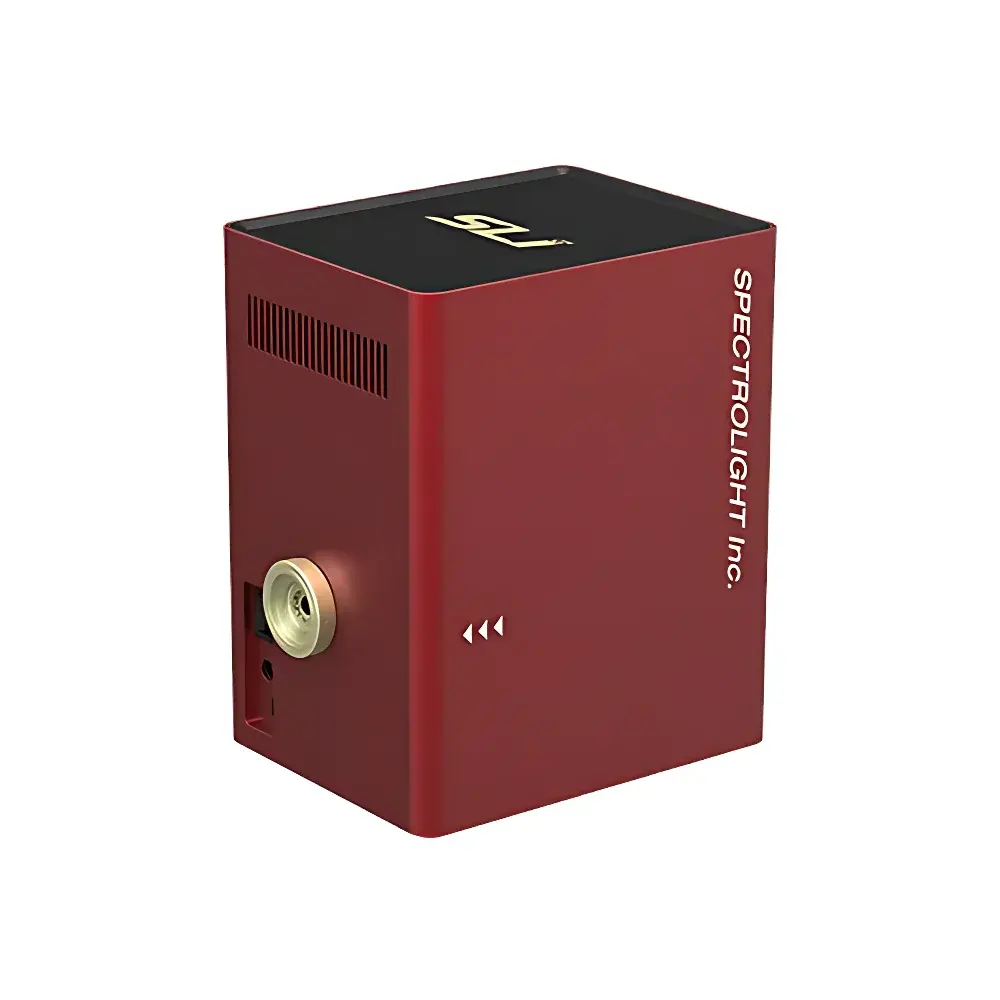
Spectrolight FWS Poly Automated Wavelength Selector
| Brand | Spectrolight |
|---|---|
| Origin | USA |
| Manufacturer Type | Authorized Distributor |
| Product Category | Imported Instrument |
| Model | FWS Poly |
| Price Range | USD 0–7,200 (approx.) |
| Spectral Range | UV–NIR (model-dependent, up to 358–900 nm) |
| FWHM Tuning Range | 3–15 nm |
| Aperture Size | 10 mm (standard), 3 mm (Laser Version) |
| Peak Transmission | >75% |
| CW Accuracy | ±0.5 nm |
| FWHM Accuracy | ±0.5 nm |
| Minimum CW Step | 0.2 nm |
| Minimum FWHM Step | 1 nm |
| Extinction Ratio | OD >6 (275–925 nm) |
| IR Cutoff | OD6 @ 930–1600 nm |
| Interface | USB 2.0 |
| Control Software | Windows-based GUI with API support (DLL/COM) |
Overview
The Spectrolight FWS Poly Automated Wavelength Selector is an engineered optical filtering solution designed for precision spectral selection in demanding laboratory and industrial environments. Based on Spectrolight’s proprietary TwinFilm™ technology, the FWS Poly merges the tunability of grating monochromators with the high-throughput, imaging-compatible performance of large-aperture interference filters. Unlike traditional filter wheels or acousto-optic tunable filters (AOTFs), the FWS Poly achieves continuous, motorized tuning of both center wavelength (CW) and full width at half maximum (FWHM) bandwidth without mechanical repositioning of discrete elements—enabling true analog-like spectral agility while preserving spatial coherence and throughput.
Each FWS Poly unit operates as a self-contained, USB-controlled module requiring no external power supply beyond the host PC connection. Its optical architecture is optimized for broadband illumination sources—including laser-driven white light sources (LDLS™), supercontinuum lasers, xenon arc lamps, and halogen sources—making it suitable for applications where spectral fidelity, temporal stability, and spatial uniformity are critical. The device delivers high transmission (>75% across its operational range), sub-nanometer wavelength repeatability (±0.5 nm), and robust extinction (OD >6 from 275 nm to 925 nm), satisfying requirements for fluorescence rejection, Raman background suppression, and multi-spectral calibration traceability.
Key Features
- Patented TwinFilm™ dual-interference-filter tuning mechanism enabling independent, continuous adjustment of center wavelength and FWHM bandwidth
- USB 2.0 interface with vendor-provided Windows GUI and programmable API (DLL/COM) for integration into LabVIEW, Python, MATLAB, and custom automation frameworks
- High optical throughput: >75% peak transmission across all standard models; >85% achievable in optimized configurations
- Precision actuation: 0.2 nm minimum CW step resolution; 1 nm minimum FWHM step resolution
- Exceptional spectral purity: Average optical density >6 over 275–925 nm; OD6 extended cutoff at 930–1600 nm for IR suppression
- Dual-platform design: Standard 10 mm aperture models for general-purpose broadband illumination; compact 3 mm aperture Laser Version variants optimized for collimated supercontinuum and LDLS™ beam coupling
- No alignment required: Factory-aligned optics ensure consistent beam pointing and minimal wavefront distortion across tuning range
Sample Compatibility & Compliance
The FWS Poly is compatible with a broad class of illumination sources used in analytical and life science instrumentation. It has been validated with Energetiq EQ-99X LDLS™ systems, NKT SuperK EXTREME supercontinuum lasers, and standard arc-lamp-based microscopes. All models meet RoHS Directive 2011/65/EU and CE marking requirements for electromagnetic compatibility (EMC Directive 2014/30/EU) and low-voltage safety (LVD Directive 2014/35/EU). While not certified to ISO/IEC 17025, the device supports GLP- and GMP-aligned workflows through software audit trail logging (via optional timestamped configuration export), deterministic tuning repeatability (<0.01% CV over 1000 cycles), and traceable factory calibration reports (NIST-traceable spectroradiometric verification available upon request).
Software & Data Management
Spectrolight provides a native Windows application supporting real-time CW/FWHM setting, preset library management, and sequential scan scripting. The underlying API enables full remote control—including simultaneous multi-device synchronization—essential for hyperspectral acquisition engines and automated assay platforms. All parameter changes are logged with timestamps and user-defined metadata tags. Export formats include CSV (wavelength/bandwidth/time), JSON (configuration snapshots), and XML (interoperable instrument definition files compliant with IEEE 11073-10201 SDC standards). No cloud dependency: all data remains local unless explicitly exported by the user. Software updates are delivered via signed installer packages with SHA-256 hash verification.
Applications
- Fluorescence Microscopy: Rapid switching between excitation bands without filter cube replacement; ideal for multicolor live-cell imaging and FRAP/FLIM setups
- Hyperspectral Imaging: Integration into push-broom or snapshot systems for real-time spectral unmixing in agriculture, pharmaceutical QC, and art conservation
- Life Science Instrumentation: Embedded spectral engine in flow cytometers, plate readers, and label-free biosensors requiring dynamic bandpass selection
- Machine Vision: Adaptive spectral inspection for semiconductor wafer metrology, food sorting, and polymer identification under variable ambient lighting
- Laboratory Research: Flexible source conditioning for ellipsometry, photoluminescence quantum yield measurement, and photochemical reaction monitoring
FAQ
What distinguishes the FWS Poly from conventional monochromators or AOTFs?
The FWS Poly avoids moving gratings or acoustic transducers—eliminating sensitivity to vibration, thermal drift, and polarization dependence. Its solid-state TwinFilm™ architecture ensures stable beam pointing, high transmission, and compatibility with imaging optics.
Can the FWS Poly be integrated into a vacuum or inert-gas environment?
Standard units are rated for ambient air operation only. Custom hermetic housings with fused silica windows and dry-nitrogen purge ports are available under OEM agreement.
Is firmware update capability supported in the field?
Yes—firmware updates are performed via USB using Spectrolight’s authenticated updater tool; no hardware modification or service visit is required.
Does the Laser Version compromise transmission or extinction performance?
No—Laser Version models maintain identical optical specifications (transmission, OD, accuracy); only the aperture size and input beam acceptance angle are modified to match typical supercontinuum divergence profiles.
How is wavelength calibration verified and maintained?
Each unit ships with a factory calibration certificate referencing NIST-traceable spectral lines (e.g., Hg/Ne lamp emissions). Users may perform in-situ verification using any calibrated spectrometer; recalibration services are offered biannually through Spectrolight’s ISO 9001-certified calibration lab.





