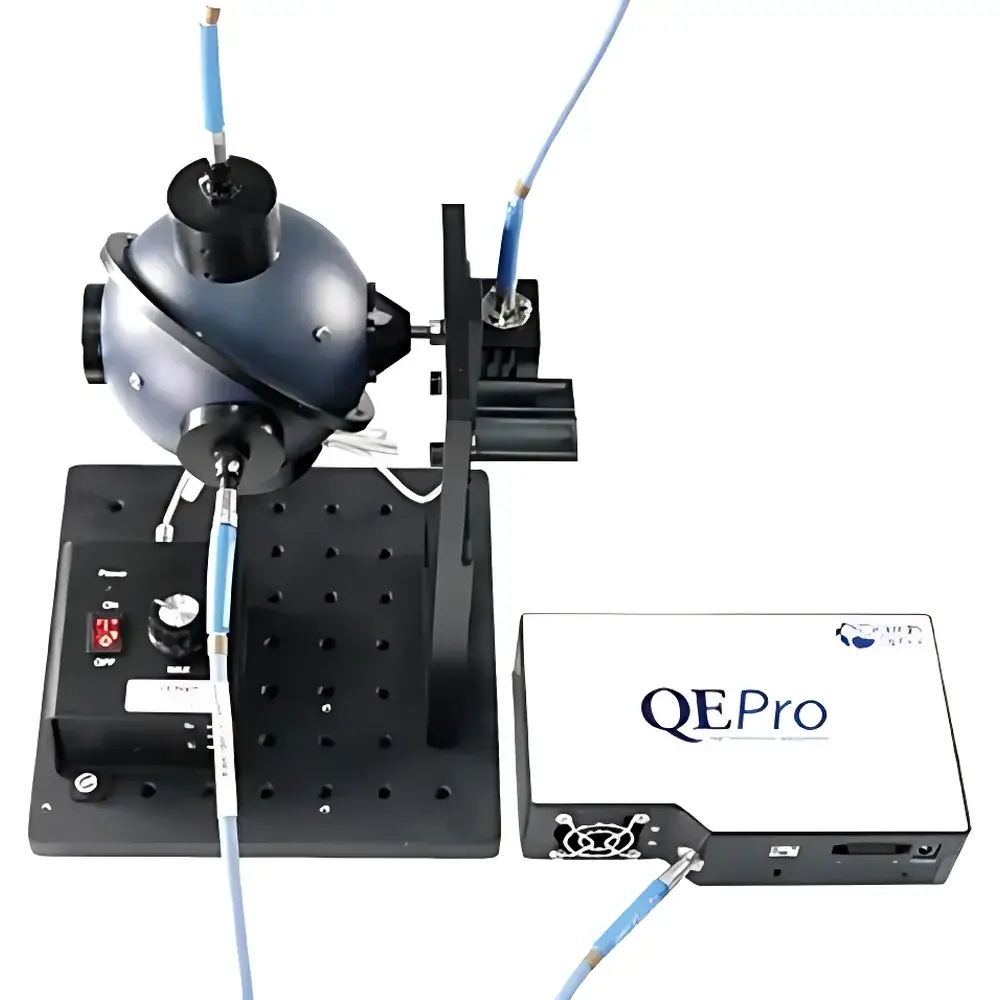
SpectrumTEQ-PL Photoluminescence Quantum Yield Measurement System
| Brand | Ocean Optics |
|---|---|
| Origin | USA |
| Manufacturer Type | Authorized Distributor |
| Product Origin | Imported |
| Model | SpectrumTEQ-PL |
| Spectrometer Options | QE Pro or QE65 Pro |
| Spectral Range | 350–1100 nm |
| SNR | 1000:1 |
| Optical Resolution (FWHM) | 2.5 nm |
| Dynamic Range | 85,000:1 (QE Pro, single acquisition) |
| 25,000 | 1 (QE65 Pro, single acquisition) |
| ADC Bit Depth | 18-bit (QE Pro) |
| Integrating Sphere Diameter | 3.3" |
| Sphere Coating | Spectralon® |
| Excitation Source | Fiber-coupled high-power LEDs, tunable wavelength range 365–880 nm, typical FWHM = 14 nm @ 405 nm |
Overview
The SpectrumTEQ-PL Photoluminescence Quantum Yield (PLQY) Measurement System is an engineered solution for absolute and comparative quantification of photoluminescent efficiency in solid-state and thin-film materials under controlled inert atmospheres. Based on the integrating sphere method compliant with ASTM E2797–16 and ISO 11623 standards, the system measures both excitation light and emitted luminescence simultaneously to compute absolute PLQY values—defined as the ratio of photons emitted via radiative recombination to photons absorbed. Its compact, modular architecture enables direct integration into nitrogen- or argon-purged gloveboxes (ISO Class 5 or better), eliminating air-sensitive sample exposure during measurement—a critical requirement for perovskite precursors, OLED emitters, quantum dot inks, and air-labile phosphors.
Key Features
- Glovebox-Compatible Design: Fully operational inside standard inert-atmosphere gloveboxes (minimum internal dimensions: 400 × 400 × 300 mm); no sample transfer required between synthesis and characterization environments.
- High-Fidelity Spectral Detection: Equipped with Ocean Insight’s QE Pro spectrometer (standard) or optional QE65 Pro—both featuring back-thinned CCD sensors, low-stray-light optical design, and thermoelectric cooling for stable dark current performance across extended integrations.
- Calibrated Excitation Flexibility: Interchangeable fiber-coupled LED sources (365–880 nm) with adjustable intensity control and narrow spectral bandwidth (FWHM ≤14 nm at 405 nm), enabling selective excitation matching absorption profiles of diverse emitters—from wide-bandgap metal oxides to near-infrared organic dyes.
- Traceable Sphere Metrology: 3.3-inch integrating sphere with Spectralon® coating (≥99% diffuse reflectance from 250–2500 nm), pre-characterized for sphere multiplier correction and validated against NIST-traceable standards.
- Minimal Maintenance Architecture: Rigid aluminum optical bench with kinematic mounts; factory-aligned collimation and coupling ensure long-term repeatability without routine recalibration.
Sample Compatibility & Compliance
The SpectrumTEQ-PL supports planar samples up to 25 mm × 25 mm × 5 mm (thickness), including spin-coated films, evaporated small-molecule layers, powder pellets, and encapsulated device substrates. Sample holders are compatible with standard quartz or fused-silica cuvettes and custom-stage adapters for lateral positioning. All optical paths comply with IEC 62471 (Photobiological Safety) for LED-based excitation. Data acquisition workflows support 21 CFR Part 11-compliant audit trails when deployed with validated software configurations, and measurement reports include metadata traceable to instrument serial numbers, calibration certificate IDs, and environmental logs (temperature/humidity if external sensors are integrated).
Software & Data Management
Control and analysis are performed via SpectrumTEQ Software v3.x—a Windows-based application built on .NET Framework with a guided workflow interface. The software automates dark/background subtraction, sphere correction factor application, spectral responsivity calibration (using supplied NIST-traceable lamp), and PLQY calculation using dual-beam reference methodology. Export formats include CSV (full spectral datasets), PDF (formatted reports with uncertainty propagation), and HDF5 (for batch processing in Python/MATLAB). Raw data retains full timestamping, integration time, grating position, and detector gain settings—enabling retrospective reprocessing without hardware interaction. Optional API access allows integration into LIMS or automated synthesis platforms via TCP/IP or DLL calls.
Applications
- Quantitative PLQY screening of halide perovskite nanocrystals before and after ligand exchange
- In-process evaluation of phosphor-converted LED (pc-LED) phosphor blends under blue pump conditions
- Stability assessment of thermally activated delayed fluorescence (TADF) emitters under inert gas purge
- Batch-to-batch consistency verification of down-conversion quantum dot inks for display manufacturing
- Correlation of PLQY with film morphology (via concurrent AFM or SEM) in solution-processed optoelectronic layers
- Validation of encapsulation integrity in flexible OLED test structures via in-glovebox aging + PLQY tracking
FAQ
Can the system measure PLQY under continuous-wave (CW) and pulsed excitation?
Yes—the LED excitation source operates in both CW and externally triggered pulsed modes (minimum pulse width: 10 µs), supporting time-resolved PLQY estimation when synchronized with gated detection (requires optional software module and timing adapter).
Is spectral calibration traceable to NIST standards?
Yes—each system ships with a factory-applied spectral calibration certificate referencing NIST SRM 2035 (tungsten halogen lamp) and SRM 2036 (mercury-argon emission lines), valid for 12 months under normal use.
What is the minimum detectable PLQY and associated uncertainty?
Under optimal signal conditions (high-emission quantum dots, 405 nm excitation), the system achieves ±0.8% relative uncertainty (k=2) for PLQY ≥5%, with lower limits of detection around 0.3% for highly scattering samples using extended integration and averaging.
Does the software support multi-sample sequential measurement?
Yes—batch mode enables unattended measurement of up to 99 samples with automated stage positioning (when integrated with third-party motorized XYZ stages) and report generation with pass/fail thresholds based on user-defined PLQY windows.