
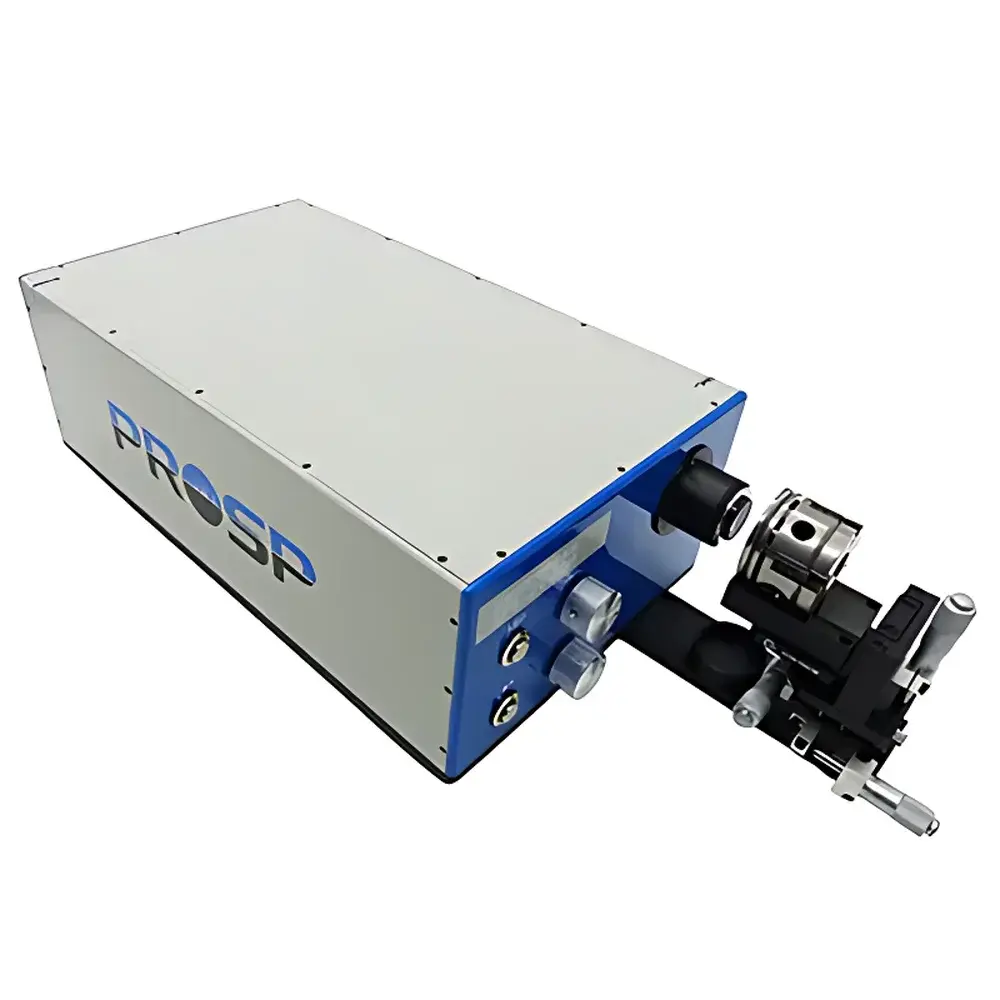
SPL SPL-2000H Integrated Ruby Fluorescence Pressure Calibration System
| Brand | SPL |
|---|---|
| Origin | Zhejiang, China |
| Model | SPL-2000H |
| Laser Wavelength | 405 nm |
| Pressure Range (RT) | 0–100 GPa |
| Pressure Resolution | 0.1 GPa |
| Objective Lens | 10×, WD = 34 mm |
| CCD | 1/2″ Color CMOS, 2048 × 1536 (3 MP) |
| Data Interface | USB |
| Power Input | 12 V DC |
| Software | Integrated spectral & CCD acquisition with automated R₁ peak detection and dual-mode pressure calculation (P ≤ 20 GPa: P = 2.74(λ − λ₀) |
| P > 20 GPa | P = 3.808{[1 + (λ − λ₀)/λ₀]⁵ − 1}) |
Overview
The SPL SPL-2000H Integrated Ruby Fluorescence Pressure Calibration System is a turnkey optical instrumentation platform engineered for precise, in-situ pressure determination in diamond anvil cell (DAC) experiments and high-pressure materials research. It operates on the well-established ruby fluorescence method, leveraging the pressure-dependent shift of the R₁ emission line (⁴A₂ → ²E transition) in Cr³⁺-doped α-Al₂O₃. At ambient conditions, the R₁ line is centered at 694.3 nm; under hydrostatic or quasi-hydrostatic compression, its wavelength redshifts monotonically and reproducibly—enabling quantitative pressure inference via calibrated empirical equations embedded in the system’s native software. Designed for laboratory environments where spatial constraints, operational simplicity, and measurement repeatability are critical, the SPL-2000H integrates the excitation laser (405 nm diode), spectrograph, fiber-coupled signal collection optics, and real-time imaging subsystem into a single rigid chassis. This monolithic architecture eliminates alignment drift between components, reduces optical path variability, and enhances long-term measurement stability—particularly important for time-resolved pressure monitoring during ramped compression or thermal cycling experiments.
Key Features
- Fully integrated optomechanical design: laser source, spectrometer, and CCD-based imaging module co-housed in a single aluminum enclosure with vibration-damped baseplate.
- Dual-function front panel controls: independent on/off switches and analog power adjustment knobs for both 405 nm excitation laser and auxiliary white LED illumination for sample visualization.
- Manual three-axis translation stage (X/Y/Z) with micrometer-driven precision positioning, mechanically anchored to the instrument base for minimized coupling of external mechanical noise.
- USB 2.0 interface for real-time spectral data streaming and synchronized CCD frame capture; no external DAQ hardware required.
- Onboard pressure computation engine implementing two ISO-aligned calibration regimes: linear approximation (P ≤ 20 GPa) and fifth-power polynomial (P > 20 GPa), both traceable to published ruby pressure scales (e.g., Mao et al., J. Geophys. Res., 1986; Dorogokupets & Dewaele, J. Appl. Phys., 2007).
- Real-time R₁ peak detection algorithm with user-selectable auto-search or manual cursor-assisted fitting, supporting baseline subtraction and Gaussian/Lorentzian line-shape modeling.
Sample Compatibility & Compliance
The SPL-2000H is optimized for ruby-fluorescing samples mounted in standard diamond anvil cells, including micro-pellet, thin-film, and powder configurations. Its 10× objective (34 mm working distance) accommodates common DAC geometries while maintaining sufficient clearance for gasket and pressure-transmitting medium integration. The system complies with general laboratory safety standards for Class 3B laser devices (IEC 60825-1:2014), with interlocked housing and visible status indicators. While not certified to GLP or FDA 21 CFR Part 11 out-of-the-box, the software supports audit-trail-enabling metadata logging (timestamp, λ₀ input, operator ID, instrument serial), facilitating internal validation protocols aligned with ISO/IEC 17025 requirements for calibration laboratories conducting high-pressure metrology.
Software & Data Management
The proprietary SPL-PressureSuite™ v3.x provides a unified graphical interface for simultaneous spectral acquisition (200–800 nm range, ~0.2 nm resolution) and live-color imaging (2048 × 1536 pixels). All acquired spectra are saved in HDF5 format with embedded calibration coefficients, detector gain settings, and environmental metadata. Pressure values are computed and displayed in real time at the lower-right corner of the GUI, updated with each new spectrum. Export options include CSV (peak position, FWHM, SNR, calculated P), PNG/JPEG (annotated spectra + image overlays), and XML (full experimental log). Batch processing mode enables retrospective recalibration across datasets using updated λ₀ references or alternative ruby scale models—essential for cross-laboratory data harmonization.
Applications
- In-situ pressure calibration during static high-pressure synthesis and phase-transition studies in geophysics and condensed matter physics.
- Validation of pressure gradients within non-hydrostatic DAC environments using multi-point R₁ mapping (with optional XY scanning add-on).
- Time-resolved pressure tracking during laser-heated DAC experiments, coupled with thermocouple or pyrometry systems.
- Teaching and training platforms for undergraduate and graduate solid-state physics laboratories requiring robust, low-maintenance pressure metrology tools.
- Quality assurance in industrial high-pressure device development (e.g., sintering dies, shock-compression fixtures) where traceable pressure feedback is required.
FAQ
What is the recommended procedure for determining λ₀ prior to pressure measurement?
λ₀ must be measured under zero-pressure conditions using a stress-free ruby chip mounted on a quartz substrate or equivalent low-stress support. Users input this reference value manually into the software before initiating any pressurized experiment.
Can the SPL-2000H be upgraded to support Raman spectroscopy?
No—the SPL-2000H is dedicated exclusively to ruby fluorescence detection. For combined fluorescence/Raman capability, SPL recommends the SPL-Micro2000 vertical configuration, which integrates a 785 nm Raman excitation channel and modular microscope coupling.
Is temperature compensation built into the pressure calculation?
The current firmware implements isothermal ruby scaling only. For experiments involving significant temperature variation (>50 K), users must apply empirically derived thermal correction factors post-acquisition, as described in the literature (e.g., Akahama & Kawamura, J. Appl. Phys., 2004).
What maintenance is required for long-term stability?
Annual verification of laser output power (±3% tolerance) and spectrometer wavelength calibration using a neon lamp standard is recommended. No consumables or optical alignments are required under normal operating conditions.






