
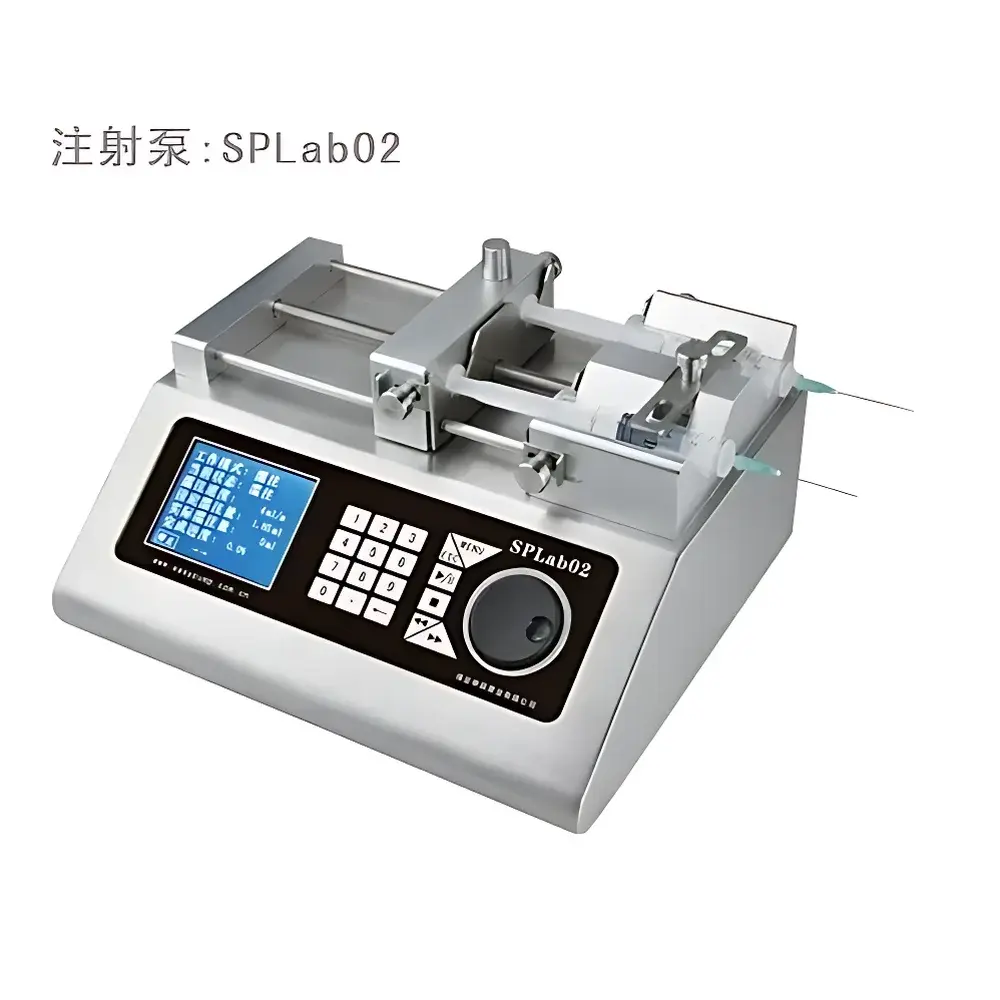
SPLab02 Dual-Channel Push-Pull Syringe Pump & SPLab01 Single-Channel Syringe Pump
| Origin | Shanghai, China |
|---|---|
| Manufacturer Type | Authorized Distributor |
| Regional Origin | Domestic (PRC) |
| Model | SPLab02 |
| Price | USD 1,020 (FOB Shanghai) |
| Display | 4.3-inch TFT Color LCD |
| Control Interface | Front-panel keypad + TTL-level digital input (start/stop) |
| Operating Modes | Infuse, Withdraw, Infuse-Then-Withdraw, Withdraw-Then-Infuse, Continuous Cycle, Bubble-Expel Sequence |
| Syringe ID Input | Select from built-in library (1–100 mL) or manual bore diameter entry (0.1–30 mm) |
| Flow Calibration | User-executed volumetric calibration with real-time correction factor application |
| Stall Detection | Mechanical load sensing with automatic halt and audible alert |
| Power Backup | Non-volatile memory retains all parameters and runtime settings after power loss |
| Compliance | CE-marked per EN 61326-1 (EMC) and EN 61010-1 (Safety) |
Overview
The SPLab02 Dual-Channel Push-Pull Syringe Pump and its single-channel counterpart, the SPLab01, are precision fluid delivery systems engineered for laboratory-scale quantitative liquid handling in non-clinical research environments. Based on stepper motor-driven linear actuation and calibrated syringe displacement, these pumps operate on the principle of volumetric displacement control—where flow rate is derived from piston travel speed and syringe cross-sectional area. Unlike peristaltic pumps, which rely on tube compression and exhibit pulsatile output and tubing fatigue, syringe pumps deliver laminar, pulse-free flow with high reproducibility across low-flow regimes (nanoliter to milliliter per minute). The SPLab series is specifically optimized for applications requiring bidirectional control, programmable sequencing, and traceable parameter retention—making it suitable for analytical sample introduction, microfluidic interface priming, reagent dosing in reaction kinetics studies, and automated chromatography auxiliary systems.
Key Features
- 4.3-inch full-color TFT LCD with intuitive icon-based navigation and real-time display of volume delivered, flow rate, remaining time, and current operating mode.
- Dual independent channels on SPLab02 support synchronized or asynchronous operation—enabling push-pull configurations for zero-net-displacement fluid exchange or gradient mixing via alternating infuse/withdraw cycles.
- Comprehensive syringe compatibility: accepts standard Luer-lock syringes from 1 µL to 100 mL; bore diameter can be entered manually (0.1–30 mm) or selected from an embedded database covering common glass and plastic syringe types.
- Six preconfigured operational modes—including Infuse, Withdraw, Infuse-Then-Withdraw, Withdraw-Then-Infuse, Continuous (repeating), and Bubble-Expel (infuse → withdraw → rapid purge)—each storing dedicated parameters without cross-contamination of settings.
- Real-time volumetric calibration routine allows users to verify and adjust delivery accuracy using gravimetric or volumetric reference methods; correction factors are applied dynamically during subsequent runs.
- Integrated stall detection monitors motor current draw and mechanical resistance; upon exceeding threshold torque, motion halts immediately and a 1 kHz audible alarm activates—preventing syringe breakage or seal damage.
- TTL-compatible external control interface enables integration into larger automated platforms via programmable logic controllers (PLCs) or DAQ systems for trigger-based start/stop sequencing.
Sample Compatibility & Compliance
The SPLab02 and SPLab01 are compatible with chemically inert syringes (glass, polypropylene, PTFE-coated) and standard Luer-lock fittings. No wetted parts beyond the syringe barrel and plunger tip contact fluid—eliminating concerns about material leaching or reactive surface adsorption. These instruments comply with EN 61010-1:2010 for electrical safety in laboratory equipment and EN 61326-1:2013 for electromagnetic compatibility. They are CE-marked and supplied with Declaration of Conformity documentation. Per regulatory classification, they are designated as “non-medical laboratory equipment” and are not certified under ISO 13485, FDA 21 CFR Part 820, or IEC 62304. Users deploying them in GLP or GMP-aligned workflows must validate performance per internal SOPs and document calibration against traceable standards (e.g., NIST-traceable balances or calibrated volumetric flasks).
Software & Data Management
While standalone operation requires no PC connection, optional RS-232 or USB-to-serial adapters enable command-line control via ASCII protocol (SCPI-like syntax). All parameter sets—including mode selection, volume targets, rates, dwell times, and calibration offsets—are retained in non-volatile flash memory. Power interruption does not erase active configurations or historical run logs (last 10 executed sequences stored with timestamps). Audit-ready data export is achievable through terminal capture or custom scripting; however, native software does not provide FDA 21 CFR Part 11-compliant electronic signatures, audit trails, or user role management. For regulated environments, integration with validated third-party lab automation software (e.g., LabVIEW, Python-based PySerial frameworks with logging wrappers) is recommended to meet ALCOA+ data integrity principles.
Applications
- Controlled reagent addition in kinetic assays (e.g., stopped-flow simulation, enzyme inhibition titrations)
- Gradient eluent delivery in preparative HPLC or LC-MS sample loading manifolds
- Microfluidic chip priming and pressure-balanced buffer exchange
- Automated calibration standard preparation for ICP-MS or AAS dilution series
- Gas-phase humidification control via precise water vapor injection into carrier streams
- Long-duration infusion experiments in materials science (e.g., polymer precursor delivery during in-situ curing)
FAQ
Is the SPLab02 suitable for sterile or biosafety-critical applications?
No—these pumps lack IP-rated enclosures, HEPA filtration, or autoclavable components. They are intended for general-purpose lab use with non-hazardous, non-sterile liquids.
Can I use different syringe sizes simultaneously on the dual-channel model?
Yes—each channel operates independently; you may load a 10 µL syringe on Channel A and a 50 mL syringe on Channel B, with individual parameter assignment.
Does the pump support flow rate ramping or non-linear profiles?
No—the SPLab series implements only constant-rate displacement within each segment; multi-step protocols require manual or externally triggered mode transitions.
What is the positional resolution of the stepper motor drive?
The system achieves sub-microliter volumetric resolution depending on syringe geometry—for example, ≤0.12 µL with a 10 µL syringe (bore = 4.6 mm) at full-step actuation.
How often should volumetric calibration be performed?
Calibration is recommended before first use, after syringe type change, following maintenance, and at intervals defined by lab quality procedures—typically daily for critical applications or weekly under stable conditions.



