
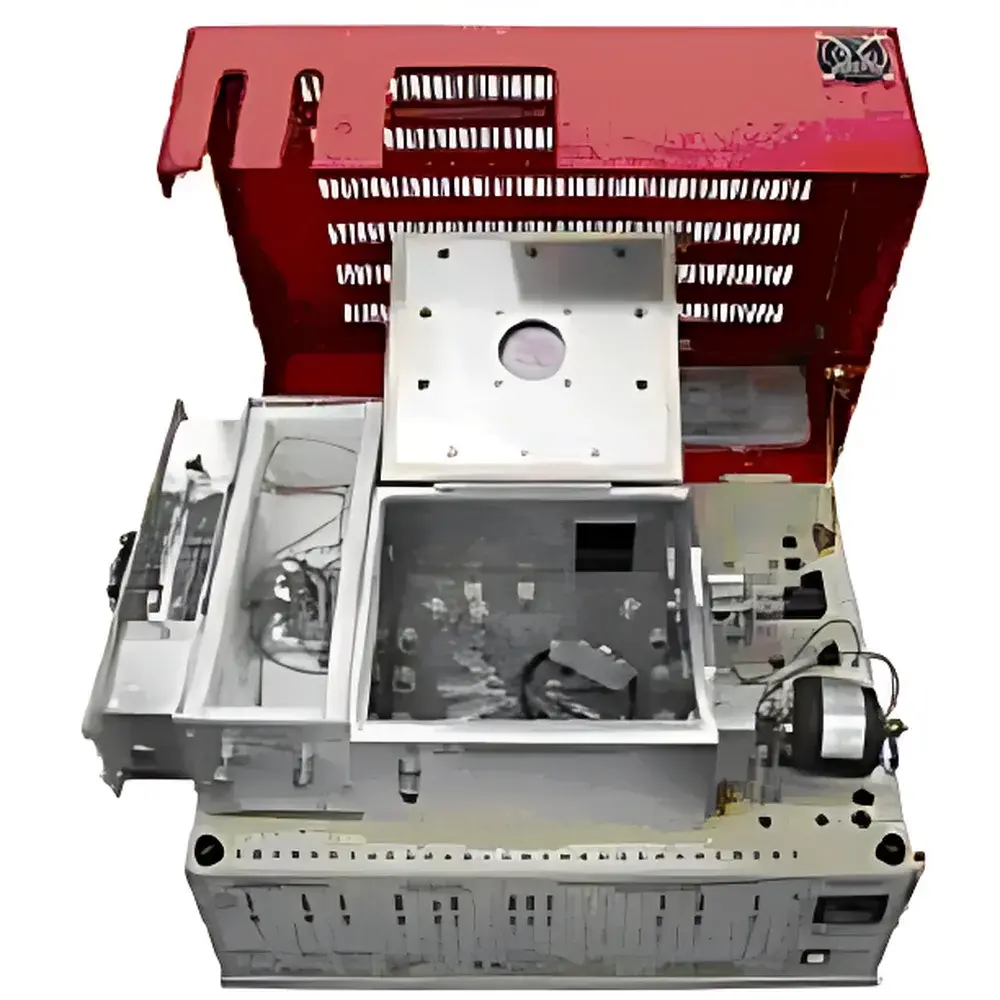
SRI TO-14 Special GC for VOC Analysis
| Brand | SRI |
|---|---|
| Origin | USA |
| Manufacturer Type | Authorized Distributor |
| Origin Category | Imported |
| Model | TO-14 Special GC |
| Pricing | Available Upon Request |
Overview
The SRI TO-14 Special GC is a purpose-built, field-deployable gas chromatograph engineered specifically for the quantitative analysis of volatile organic compounds (VOCs) in ambient and indoor air according to U.S. EPA Method TO-14A and related regulatory protocols. Unlike conventional laboratory-based GC systems requiring cryogenic sampling canisters and off-site analysis, this instrument integrates dual-stage cryogenic air concentrators, a robust 60-meter Restek metal capillary column with fused-silica bonded inner surface, and three complementary detectors—Photoionization Detector (PID), Flame Ionization Detector (FID), and Halogen-Specific Detection via Electron Capture Detector (DELCD)—into a single compact chassis. Its operational principle relies on quantitative adsorption–cryofocusing–thermal desorption chromatography: ambient air is drawn through the dual cold traps at controlled flow rates, where VOCs are selectively retained; subsequent rapid heating releases analytes as sharp, focused bands onto the column for high-resolution separation. The system’s architecture enables direct on-site analysis, eliminating sample degradation, transport artifacts, and associated logistical overhead from SUMMA canister handling.
Key Features
- Dual-stage TO-14 compliant air concentrators with independent temperature control for optimized trapping and desorption of light-end VOCs (e.g., vinyl chloride, chloromethane) and heavier compounds (C2–C12)
- 60-meter Restek metal capillary column with chemically bonded fused-silica inner coating—mechanically robust, non-fragile, and thermally stable up to 350 °C
- Triple-detector configuration: PID (non-destructive, air-carrier compatible, sub-ppb sensitivity for aromatics and alkenes); FID (universal hydrocarbon response, linear dynamic range >107); DELCD (selective, high-sensitivity detection of chlorinated/brominated species post-combustion)
- Integrated ultra-quiet diaphragm air compressor—eliminates external compressed air cylinders and ensures continuous, oil-free combustion air supply to FID
- PeakSimple v5.0 chromatography data system with hardware interface for precise vacuum pump timing control during air sampling and trap conditioning
- Four-channel analog input support for simultaneous acquisition from all detectors, including real-time monitoring of trap temperatures, oven ramp profiles, and flow parameters
- Portable form factor (< 28 kg) with ruggedized enclosure, battery-compatible DC operation option, and integrated power management for extended field deployment
Sample Compatibility & Compliance
The SRI TO-14 Special GC is validated for use with ambient, workplace, and residential indoor air matrices. It complies with the instrumental requirements of EPA TO-14A, TO-15, and ASTM D5466–22 for VOC analysis. Dual cold traps meet the minimum adsorption efficiency criteria (>95% recovery for C2H4, CH2Cl2, C6H6) and thermal desorption linearity across 0.1–100 ppbv concentration ranges. Column selectivity has been verified against NIST SRM 1849 (TO-14 Target Compound Mixture). System suitability testing includes retention time stability (<0.02 min RSD), peak area repeatability (<3.5% RSD), and detector response linearity (r2 ≥ 0.999). Full audit trail capability, electronic signature support, and user-access-level controls align with GLP and FDA 21 CFR Part 11 data integrity expectations when operated with validated PeakSimple configurations.
Software & Data Management
PeakSimple v5.0 serves as the unified control and processing platform, supporting method-driven automation of the entire analytical sequence: vacuum pump actuation, trap cooling/heating cycles, GC oven programming, detector signal acquisition, and report generation. Raw chromatograms and metadata—including timestamps, environmental sensor readings (optional external T/RH probe), and calibration history—are stored in vendor-neutral .csv and .txt formats. Batch processing, integration parameter templates, and customizable reporting modules facilitate compliance with internal QA/QC protocols and third-party accreditation (e.g., ISO/IEC 17025). Software updates are distributed via secure HTTPS portal with version-controlled release notes and validation documentation packages available upon request.
Applications
- Regulatory compliance monitoring for EPA-regulated VOCs in indoor air (schools, offices, residences)
- Rapid source identification during industrial hygiene investigations and fugitive emission surveys
- Real-time verification of remediation effectiveness at brownfield sites and vapor intrusion zones
- Method development and validation studies for emerging contaminants (e.g., fluorinated VOCs, oxygenated compounds)
- Mobile laboratory deployments supporting emergency response (HAZWOPER Level II/III) and environmental justice initiatives
FAQ
Does this system require external gas cylinders for operation?
No—integrated air compressor supplies combustion air to FID; optional hydrogen generator eliminates need for H2 cylinders; PID operates on ambient air.
Can the instrument be used without laboratory infrastructure?
Yes—it is designed for battery-powered or vehicle-inverter operation, with self-contained cooling, power regulation, and data storage.
How is detector selectivity managed between PID, FID, and DELCD?
PID provides broad-spectrum semi-quantitative screening; FID delivers precise total hydrocarbon quantification; DELCD confirms halogenated compound identity and concentration post-FID combustion.
Is method transfer from SUMMA canister-based labs feasible?
Yes—retention indices, relative response factors, and calibration curves are directly comparable when using identical column chemistry and temperature programs.
What maintenance intervals are recommended for field use?
Trap desorption bake-out every 20 analyses; column reconditioning every 100 runs; PID lamp replacement every 6–12 months depending on usage intensity.







