
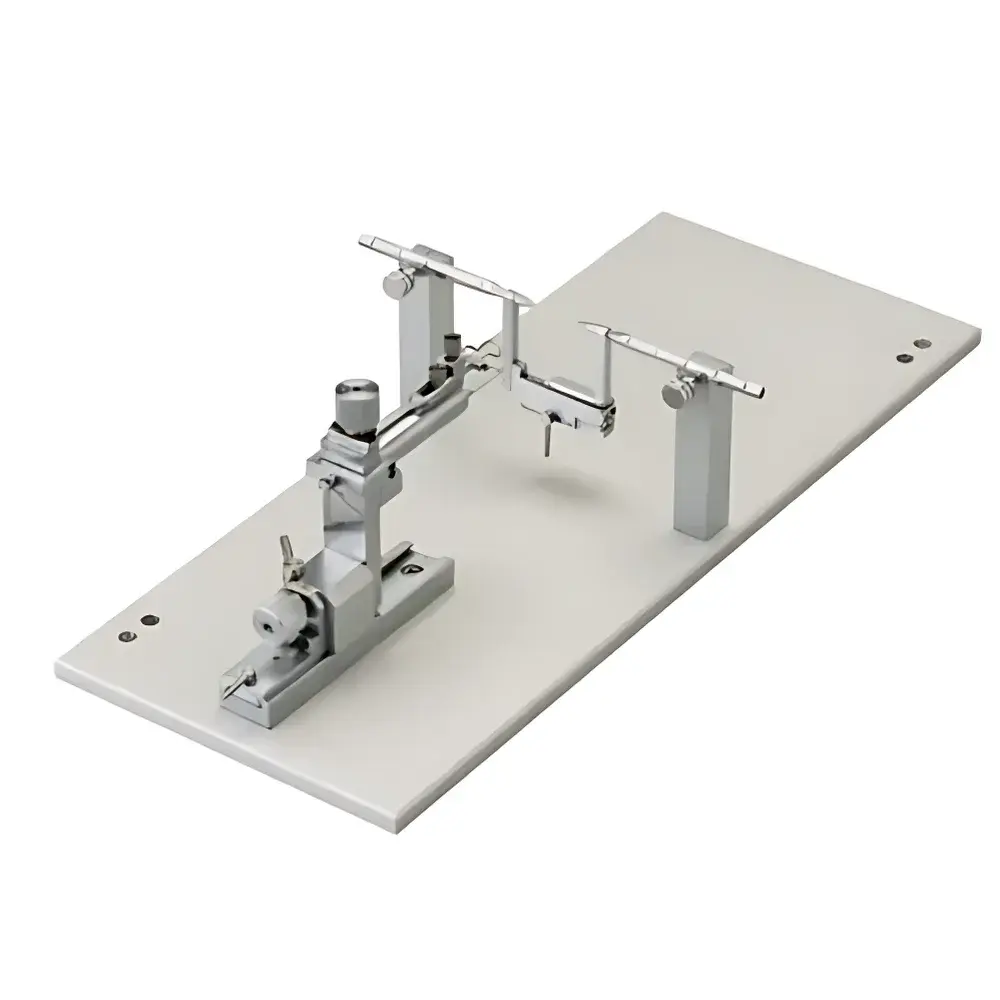
SRS-A Compact Head Holder for SR Series Stereotaxic Instruments
| Brand | NARISHIGE |
|---|---|
| Origin | Japan |
| Model | SRS-A |
| Dimensions (W×D×H) | 300 × 120 × 77 mm |
| Weight | 2.1 kg |
Overview
The SRS-A Compact Head Holder is a precision-engineered accessory designed exclusively for integration with NARISHIGE’s SR-series stereotaxic frames. It serves as a critical interface between the stereotaxic apparatus and the animal subject—primarily rats and mice—during neuroscientific procedures requiring high spatial fidelity, such as intracranial injection, electrophysiological recording, optogenetic implantation, or cranial window surgery. The device operates on a rigid mechanical coupling principle, utilizing standardized mounting interfaces to ensure zero play and repeatable alignment across experimental sessions. Its compact footprint (300 × 120 × 77 mm) enables seamless integration into space-constrained surgical setups without compromising structural integrity or ergonomic access. Unlike generic head holders, the SRS-A incorporates a low-profile, multi-axis adjustment system that allows sub-millimeter repositioning of the skull relative to the stereotaxic coordinate system—critical for targeting small brain regions in juvenile or dwarf rodent models.
Key Features
- Optimized mechanical design for direct compatibility with all SR-series stereotaxic frames (e.g., SR-1R, SR-5R, SR-6R), ensuring full retention of calibrated scale readings and vernier alignment accuracy.
- Modular ear bar assembly with interchangeable tips—standard conical, blunt-tipped, or custom-fitted variants—enabling adaptation to varying pinna morphology across rat strains (e.g., Sprague-Dawley, Wistar) and mouse lines (e.g., C57BL/6J, BALB/c).
- Integrated micrometer-driven fine-adjustment mechanism permitting ±0.5 mm linear displacement along the rostrocaudal axis and ±0.3 mm vertical lift—facilitating real-time verification of skull flatness and bregma/lamda alignment under surgical microscopy.
- Mounting knob secured via M4 stainless steel hex socket screw (included 2.0 mm hex wrench), engineered for torque consistency and long-term thread integrity during repeated sterilization cycles.
- Aluminum alloy construction with anodized black oxide finish—providing electromagnetic neutrality, corrosion resistance, and compatibility with MRI-adjacent workflows and autoclave sterilization (up to 134°C, 2 bar).
Sample Compatibility & Compliance
The SRS-A accommodates rodents weighing 15–500 g, covering neonatal mice through adult rats. Its low-center-of-gravity geometry minimizes head tilt under gravitational load, preserving the Frankfort horizontal plane essential for accurate stereotaxic coordinate mapping. The device conforms to ISO 13485:2016 design control requirements for Class I medical devices used in preclinical research. While not FDA-cleared for human use, it supports GLP-compliant study documentation when paired with NARISHIGE’s traceable calibration tools and maintenance logs. All materials meet USP Class VI biocompatibility standards for short-term tissue contact.
Software & Data Management
As a purely mechanical positioning component, the SRS-A does not incorporate embedded electronics or digital connectivity. However, its dimensional repeatability (±5 µm positional stability over 100 insertion/removal cycles) ensures full compatibility with third-party digital stereotaxic planning software—including Paxinos & Watson atlas-based navigation systems, MATLAB-based coordinate transformation toolboxes, and open-source platforms such as BrainRAT and StereoAtlas. Experimental metadata (e.g., animal ID, coordinates, ear bar offset values) can be logged directly into electronic lab notebooks compliant with 21 CFR Part 11 when using validated LIMS integrations.
Applications
- Precise bilateral cannula implantation for chemogenetic DREADD experiments in transgenic mouse models.
- Chronic microelectrode array (MEA) placement in hippocampal CA1 or prefrontal cortex layers with ≤100 µm targeting error.
- Craniotomy stabilization during two-photon calcium imaging of cortical microcircuits.
- Validation of skull-surface landmark registration algorithms used in automated stereotaxic robotics.
- Training platform for stereotaxic technique certification in academic core facilities and contract research organizations (CROs).
FAQ
Is the SRS-A compatible with non-NARISHIGE stereotaxic frames?
No—the SRS-A relies on proprietary mounting geometry and interface tolerances specific to SR-series frames. Adapters are not available, and third-party frame integration is not supported.
Can the ear bars be autoclaved?
Yes—both main and auxiliary ear bars are constructed from medical-grade stainless steel (AISI 316L) and rated for standard gravity autoclaving cycles (121°C, 15 psi, 20 min) and high-vacuum steam sterilization (134°C, 2 bar).
What is the maximum recommended torque for the mounting knob?
The hex-mounted knob should be tightened to 0.8–1.2 N·m using the supplied 2.0 mm hex wrench; overtightening may deform the aluminum housing and impair micrometer travel linearity.
Does NARISHIGE provide calibration certificates for the SRS-A?
While no factory calibration certificate is issued for this passive mechanical component, NARISHIGE supplies a dimensional inspection report (traceable to JIS B 7512) upon request, confirming nominal tolerance compliance per drawing number SRS-A-REV3.



