
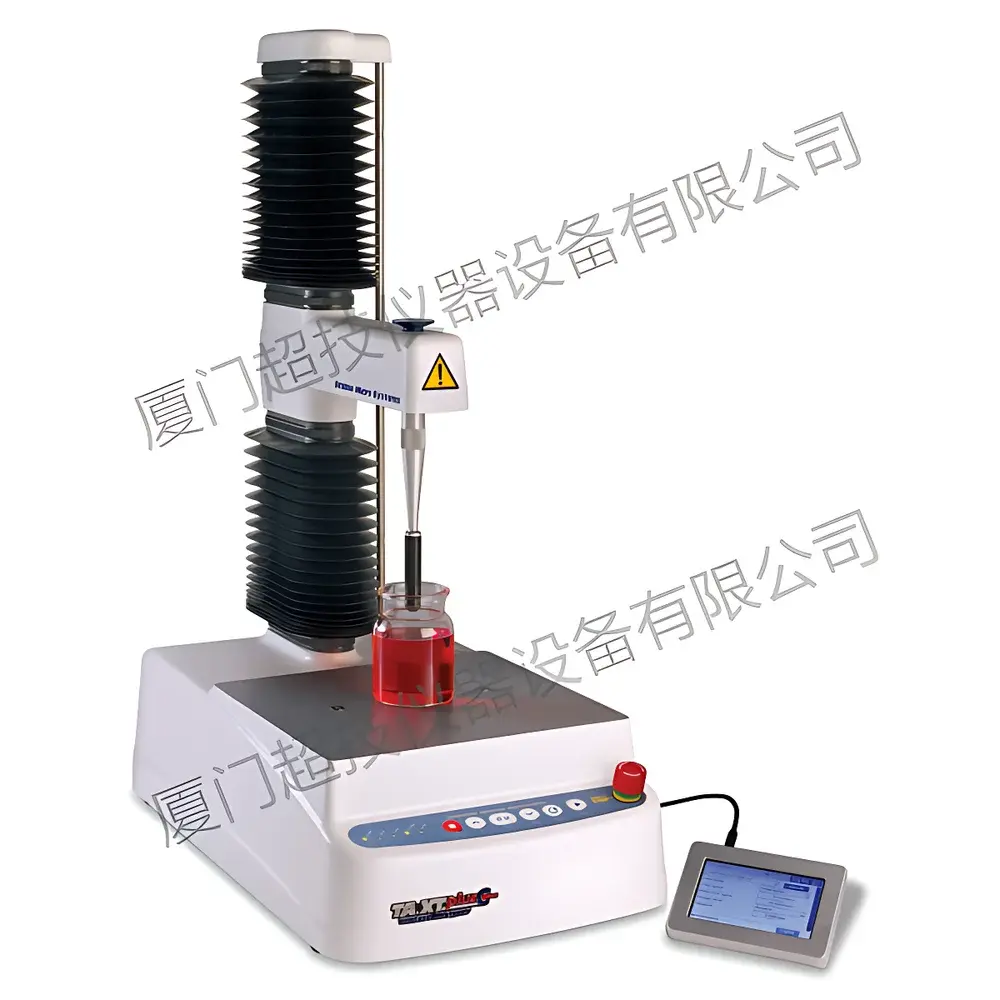
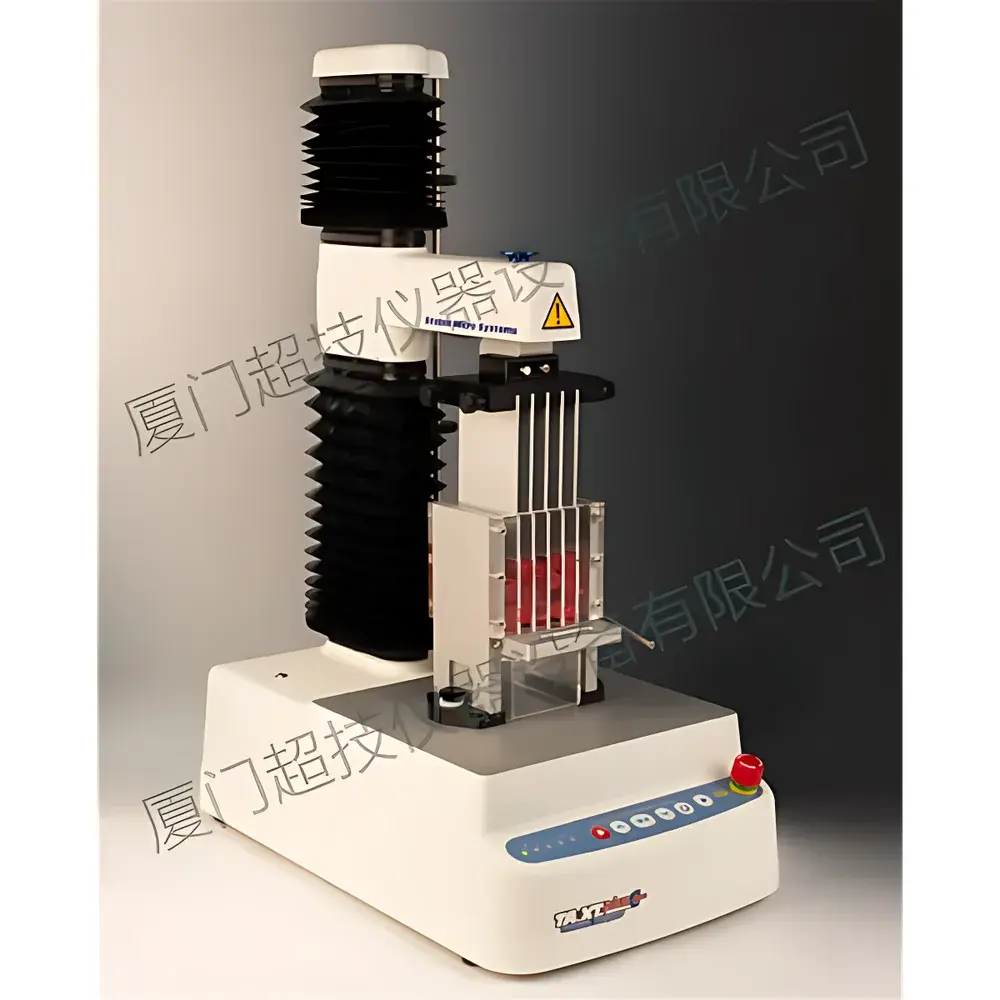
Stable Micro Systems TA.XT Plus Texture Analyser
| Brand | Stable Micro Systems |
|---|---|
| Origin | United Kingdom |
| Model | TA.XT Plus |
| Force Range | 0.5–50 kg |
| Force Resolution | 0.1 g |
| Speed Range | 0.01–40 mm/s |
| Travel Distance | 0.001–370 mm |
| Position Resolution | 0.001 mm |
| Data Acquisition Rate | 0.001 mm |
| Compliance | ASTM, AACC, AOAC, ISO, FINAT, PSTC, AFERA, GMIA |
| Probe Options | >400 dedicated probes |
| Interface | English & Chinese software |
| Connectivity | RS232 or USB |
| Operating Temperature | 0–40 °C |
| Dimensions (H×W×D) | 650 × 280 × 540 mm |
| Weight | 14.9 kg |
| Power Supply | 220 V, 50 Hz |
Overview
The Stable Micro Systems TA.XT Plus Texture Analyser is a high-precision universal testing instrument engineered for objective, quantitative mechanical characterization of solid, semi-solid, and viscous materials. Based on the fundamental principles of uniaxial compression, tension, penetration, extrusion, and shear deformation, the TA.XT Plus applies controlled force and displacement to samples while recording real-time load–displacement–time profiles. Its modular architecture integrates a motor-driven crosshead, precision load cell, optical encoder-based position sensing, and programmable motion control—enabling reproducible measurement of textural attributes such as hardness, adhesiveness, cohesiveness, springiness, chewiness, fracturability, and viscoelastic recovery. Designed and manufactured in the UK, the system complies with international standards for method validation and data integrity, supporting GLP/GMP-aligned workflows in regulated environments.
Key Features
- High-resolution force measurement with ±0.1 g resolution across multiple selectable ranges (±0.5 kg, ±5 kg, ±30 kg, ±50 kg)
- Programmable speed control from 0.01 to 40 mm/s, enabling precise simulation of consumer handling, processing, or physiological interactions
- Sub-micron positional accuracy (0.001 mm) ensured by optical linear encoder feedback and closed-loop motion control
- Automated force calibration using NIST-traceable external weights, verified and logged via embedded software self-check routines
- Modular probe library exceeding 400 application-specific fixtures—including spherical, cylindrical, conical, wire-cut, Kramer shear, and back-extrusion geometries—for standardized and custom test protocols
- Dual-language (English/Chinese) Touch Screen Interface with intuitive test setup wizard, real-time graphing, and on-device data review
- RS232 and USB connectivity for seamless integration with laboratory PCs, LIMS, and automated reporting systems
- Robust aluminum frame construction with vibration-damped base, optimized for long-term stability in shared lab environments
Sample Compatibility & Compliance
The TA.XT Plus accommodates diverse sample formats—from milligram-scale cosmetic gels and pharmaceutical tablets to kilogram-scale food loaves and industrial adhesives—without requiring sample reconfiguration between tests. Its open-platform design supports environmental chambers (temperature/humidity control), liquid baths, and custom jigs for non-standard geometries. Method development aligns with globally recognized standardization bodies: AACC (American Association of Cereal Chemists), AOAC International, ASTM International, ISO (e.g., ISO 11357 for thermal-mechanical analysis), FINAT (adhesive tape testing), PSTC (Pressure-Sensitive Tape Council), AFERA (European Adhesive Tape Association), and GMIA (Global Medical Instrumentation Alliance). All standard methods are pre-loaded and validated per manufacturer specifications; user-defined protocols retain full audit trail compliance under FDA 21 CFR Part 11 when operated with optional electronic signature and data archiving modules.
Software & Data Management
Exponent software—supplied with every TA.XT Plus—provides comprehensive test definition, execution, analysis, and reporting capabilities. It supports multi-cycle testing, conditional logic (e.g., trigger on force threshold), time-stamped metadata capture (operator ID, sample ID, ambient conditions), and automatic calculation of derived parameters (e.g., work of shear, relaxation modulus, rupture energy). Raw data exports in CSV, Excel, and XML formats ensure interoperability with statistical packages (JMP, Minitab) and enterprise QA systems. The software maintains full ALCOA+ compliant audit trails—including user login history, parameter change logs, and electronic signatures—and supports role-based access control for multi-user laboratories operating under ISO/IEC 17025 or GxP frameworks.
Applications
- Cosmetics & Personal Care: Quantification of lip balm hardness (ASTM D1092), mascara film flexibility, foundation spreadability (ISO 16128), toothpaste extrudability (ISO 11357-3), and hydrogel elasticity for wound dressings
- Pharmaceuticals: Tablet friability, capsule shell rupture force, ointment extrusion consistency, and transdermal patch peel adhesion (PSTC-101)
- Food Science: Meat tenderness (Warner-Bratzler shear), cheese meltability, fruit firmness (AACC 74-10A), baked good resilience, and jam spreadability
- Materials & Adhesives: Peel strength of pressure-sensitive tapes (FINAT FTM 1), cohesive failure analysis of hot melts, and viscoelastic recovery of elastomeric polymers
- Academic Research: Rheomechanical modeling of biomaterials, structure–function relationships in plant tissues, and texture perception correlation studies
FAQ
What industries commonly use the TA.XT Plus Texture Analyser?
It is widely deployed in food science, cosmetics R&D, pharmaceutical quality control, polymer engineering, and academic biomechanics laboratories.
Does the TA.XT Plus comply with regulatory requirements for data integrity?
Yes—when configured with Exponent software’s optional 21 CFR Part 11 module, it meets FDA, EMA, and MHRA expectations for electronic records and signatures.
Can the instrument perform dynamic or oscillatory testing?
No—the TA.XT Plus is a static/uniaxial mechanical tester; for oscillatory rheology, Stable Micro Systems recommends coupling with complementary rotational rheometers.
How is probe selection supported for new applications?
SMS provides application notes, peer-reviewed methodology references, and technical consultation to assist users in selecting or designing optimal probe configurations.
Is remote support and method validation assistance available?
Yes—Stable Micro Systems offers global application engineering support, on-site training, IQ/OQ/PQ documentation packages, and method transfer services for multi-site deployments.



