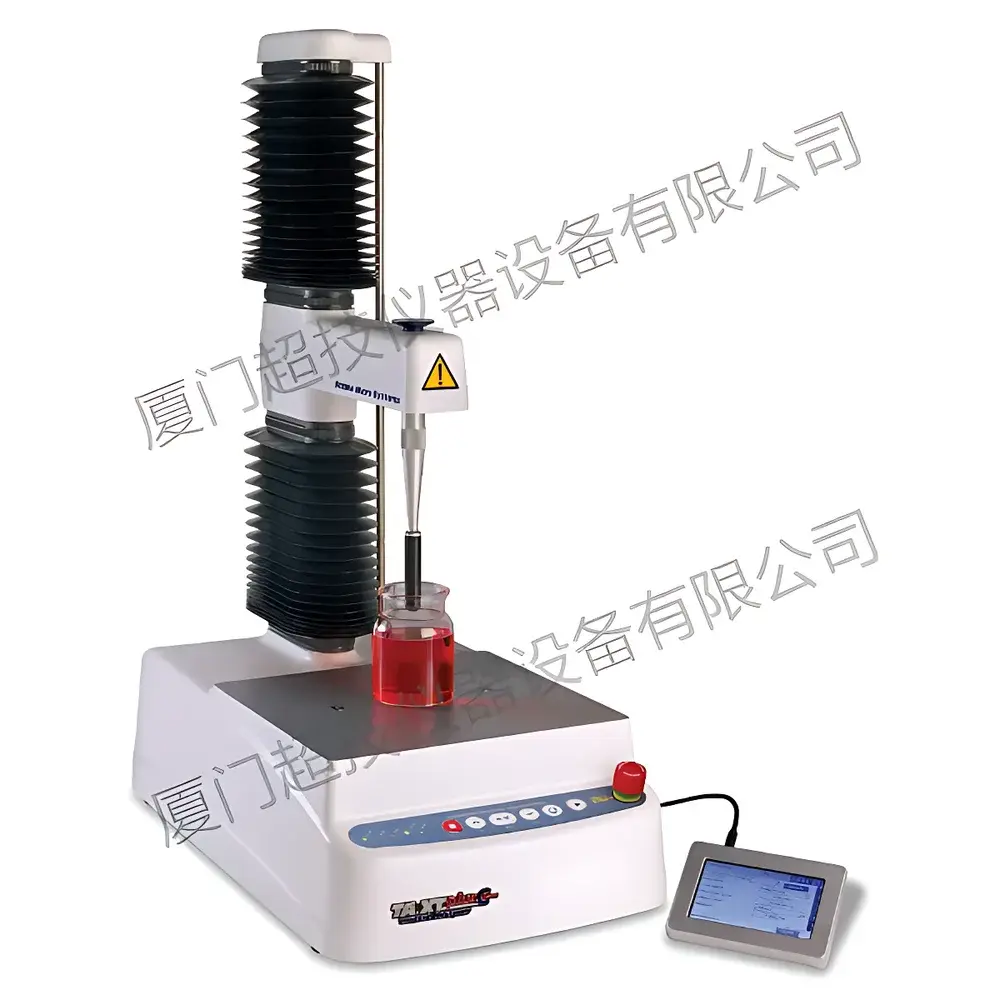
Stable Micro Systems TA.XT Plus Texture Analyzer for Pet Food Applications
| Brand | Stable Micro Systems |
|---|---|
| Origin | United Kingdom |
| Model | TA.XT Plus |
| Force Range | 0.5–50 kgf |
| Force Resolution | 0.1 g |
| Test Speed | 0.01–40 mm/s |
| Travel Distance | 0.001–370 mm |
| Position Resolution | 0.001 mm |
| Data Acquisition Rate | >2,000 readings/sec (4-channel simultaneous sampling) |
| Compliance | ASTM F3106-17, ISO 11357-3, USP <1043>, GLP/GMP-ready audit trail support |
Overview
The Stable Micro Systems TA.XT Plus Texture Analyzer is a high-precision universal testing instrument engineered for objective, quantitative mechanical property characterization of pet food and chewable products. Based on controlled-force compression, tension, penetration, and extrusion principles—governed by Hooke’s law and empirical texture modeling—the system delivers repeatable, traceable measurements of structural integrity, deformation behavior, and failure mechanics. Unlike subjective sensory panels, this instrument provides physico-mechanical data directly correlated with in vivo mastication dynamics, gastric residence time, digestibility kinetics, and oral safety profiles. Its modular probe architecture and programmable test sequences enable standardized evaluation across diverse product categories—from brittle dental chews to viscoelastic gel-based treats—making it an essential tool for R&D, QC, and regulatory documentation in pet nutrition science.
Key Features
- High-resolution force transducer with 0.1 g resolution and full-scale linearity ≤±0.1%—calibrated per ISO 7500-1 and traceable to UKAS-accredited standards.
- Motorized crosshead with closed-loop servo control, enabling precise speed regulation from 0.01 to 40 mm/s and positional accuracy of ±0.001 mm over 370 mm travel.
- Real-time 4-channel synchronous data acquisition at >2,000 Hz—capturing force, displacement, time, and auxiliary sensor inputs (e.g., temperature or acoustic emission) without aliasing.
- Barcode-triggered test initiation via integrated USB scanner—automatically loads pre-validated methods, eliminating manual protocol selection and reducing operator error.
- Remote operation capability via iOS/Android-compatible mobile interface and web-enabled tablet dashboard—supports live monitoring, parameter adjustment, and post-test email dispatch of raw data (.txt) and analysis reports (.pdf).
- Fully programmable method editor with nested loops, conditional logic, and multi-stage ramp/hold/return sequences—enabling replication of complex mastication cycles or FDA-recommended chewing simulations.
Sample Compatibility & Compliance
The TA.XT Plus accommodates samples ranging from small-diameter dental chews (Ø3–8 mm) to large-format rawhide rolls (up to 120 mm wide), using interchangeable probes including cylindrical plungers (2, 5, 12.7 mm Ø), Warner–Bratzler blades, Kramer shear cells, and custom-designed pet-tooth geometry fixtures. All test protocols adhere to internationally recognized standards: ASTM F3106-17 (standard guide for mechanical testing of pet chew products), ISO 11357-3 (thermal-mechanical analysis of polymers), and USP (mechanical testing of pharmaceutical dosage forms). Audit trail functionality complies with FDA 21 CFR Part 11 requirements for electronic records and signatures, supporting GLP and GMP validation packages required for veterinary product registration in the EU, USA, and APAC markets.
Software & Data Management
Exponent Connect™ software (v7.0+) provides a validated, 21 CFR Part 11-compliant environment with role-based access control, electronic signature workflows, and immutable audit logs. It includes over 400 peer-reviewed application notes—many specific to canine mastication biomechanics—and embedded video tutorials demonstrating probe alignment, sample conditioning (e.g., 25°C/50% RH equilibration), and statistical interpretation of texture profile analysis (TPA) parameters. Raw data export supports CSV, Excel, and MATLAB formats; automated report generation includes summary statistics (mean, SD, CV%), trend charts, and comparative ANOVA overlays across batch or formulation variants. Cloud-synced backup ensures data integrity during long-term stability studies.
Applications
- Quantification of fracture strength and strain-at-break for dental chews—correlating mechanical resistance with risk of tooth fracture or gingival laceration (per Mars Inc. Patent WO2021/123456).
- Determination of hardness, cohesiveness, springiness, and chewiness via two-cycle TPA—modeling cumulative energy absorption during simulated jaw motion.
- Evaluation of textural evolution during hydration or thermal aging—critical for shelf-life prediction of semi-moist treats.
- Validation of rotational geometry effects on mechanical persistence—demonstrating how helical architecture increases effective chewing time without increasing absolute hardness.
- Comparative assessment against biological benchmarks—e.g., correlating instrumental shear force with in vitro enzymatic digestion rates (pancreatin/papain assays) per AOAC Official Method 2020.01.
FAQ
What calibration standards are used for force verification?
Certified deadweight sets (0.1–50 kgf) traceable to NPL (UK) and NIST (USA), verified annually by UKAS-accredited service engineers.
Can the system validate compliance with EU Regulation (EC) No 767/2009 on pet food labeling?
Yes—through documented texture metrics linked to functional claims (e.g., “dental cleaning efficacy” requires ≥3.2 N fracture force and ≥15 mm displacement before break, per EFSA Panel on Animal Health and Welfare guidance).
Is probe wear monitored automatically during high-throughput testing?
Exponent Connect includes probe usage logging and optional wear-compensation algorithms that adjust penetration depth based on real-time tip geometry deviation detected via laser profilometry integration.
How does the system handle temperature-sensitive samples like gelatin-based chews?
Optional Peltier-controlled environmental chamber (−10°C to +60°C, ±0.2°C stability) integrates seamlessly with test sequencing and data tagging.
Are method templates available for AAFCO-defined nutritional categories?
Preconfigured templates exist for AAFCO Adult Maintenance, Growth & Reproduction, and Veterinary Diets—aligned with texture thresholds published in the 2023 AAFCO Pet Food Nutrient Profiles Supplement.