
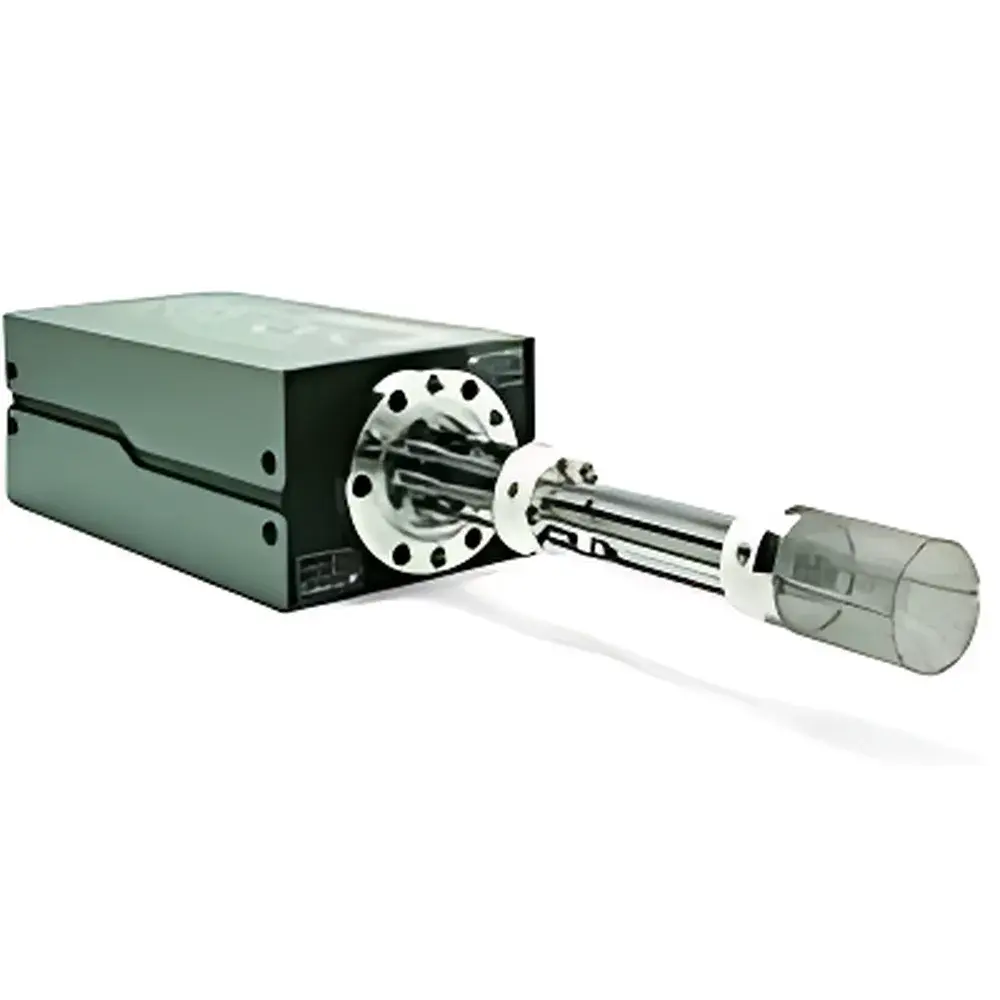
Stanford Research Systems RGA100 Residual Gas Analyzer
| Brand | SRS/Stanford Research Systems |
|---|---|
| Origin | USA |
| Model | RGA100 |
| Mass Range | 1–100 amu |
| Resolution | <1 amu |
| Dynamic Range | 6 decades |
| Detection Limit | 5×10⁻¹⁴ Torr |
| Interface | RS-232 |
| Software | RGA Windows & LabVIEW |
| Replaceable Components | Field-replaceable electron multiplier and filament |
| Compliance | Designed for UHV and HV vacuum environments per ASTM E1981 and ISO 14523-2 |
Overview
The Stanford Research Systems RGA100 Residual Gas Analyzer is a compact, high-sensitivity quadrupole mass spectrometer engineered for real-time, in situ analysis of residual gas composition in vacuum systems. Operating on the principle of quadrupole mass filtering, the RGA100 ionizes neutral gas molecules via electron impact (70 eV standard), separates resulting ions based on their mass-to-charge ratio (m/z) using a dynamically tuned RF/DC quadrupole field, and detects ion current at a secondary electron multiplier. This enables quantitative identification and relative concentration profiling of gases present in ultra-high vacuum (UHV), high vacuum (HV), and medium vacuum environments—critical for leak detection, process monitoring, outgassing characterization, and vacuum integrity validation in research and industrial settings.
Key Features
- Mass range configurable up to 100 amu with factory-calibrated tuning for optimal sensitivity across the operational range
- Mass resolution better than 1 amu (full width at half maximum, FWHM), enabling reliable separation of adjacent isotopes (e.g., N₂⁺ at 28 amu and CO⁺ at 28 amu)
- Dynamic range spanning six decades (10⁶), supporting simultaneous detection of major background species (e.g., H₂O, N₂, O₂) and trace contaminants (e.g., hydrocarbons, He, Ar)
- Detection limit of 5×10⁻¹⁴ Torr partial pressure under typical operating conditions, achieved through low-noise electronics and optimized ion optics
- Modular, field-serviceable design: both the hot-cathode filament and the electron multiplier detector are user-replaceable without breaking vacuum or returning the unit to the factory
- Integrated RS-232 serial interface compliant with EIA/TIA-232 standards, enabling direct communication with host PCs for remote control and data acquisition
Sample Compatibility & Compliance
The RGA100 is compatible with vacuum chambers operating from 1×10⁻² Torr down to <1×10⁻¹⁰ Torr base pressure (with appropriate pumping configuration). It interfaces via standard 2.75" or 3.5" ConFlat (CF) flanges and supports bakeout temperatures up to 150 °C. The analyzer conforms to electromagnetic compatibility (EMC) requirements per FCC Part 15 Subpart B and CE Directive 2014/30/EU. Its measurement methodology aligns with ASTM E1981–22 (“Standard Guide for Mass Spectrometry in Vacuum Systems”) and supports traceability frameworks required under ISO/IEC 17025 for accredited calibration laboratories. While not inherently 21 CFR Part 11 compliant, audit-trail-capable data logging is achievable when integrated with validated LabVIEW-based acquisition software under controlled SOPs.
Software & Data Management
The RGA100 ships with two native software platforms: RGA Windows (a standalone GUI for instrument setup, spectral acquisition, peak identification, and trend logging) and LabVIEW drivers (NI-VISA compatible) for custom automation in manufacturing or test-bench environments. Both support real-time analog output (0–10 V), time-stamped spectral scans, and export of ASCII or CSV files for post-processing in MATLAB, Python (Pandas/NumPy), or Excel. Peak integration algorithms apply Gaussian fitting and background subtraction; library matching uses NIST Chemistry WebBook reference spectra (masses 1–100 amu). All software binaries are digitally signed and distributed via SRS’s secure download portal—no cloud dependency or subscription licensing.
Applications
- Leak detection and localization using helium or hydrogen tracer gases in semiconductor fabrication tools and UHV surface science chambers
- Process gas monitoring during physical vapor deposition (PVD), chemical vapor deposition (CVD), and atomic layer deposition (ALD)
- Outgassing rate quantification of materials (e.g., ceramics, polymers, adhesives) per ASTM E595 protocols
- Vacuum system commissioning and troubleshooting—including water vapor ingress, oil backstreaming, and cryopump regeneration verification
- Residual atmosphere characterization in particle accelerators, fusion diagnostics, and space simulation facilities
FAQ
What vacuum level is required for stable RGA100 operation?
The RGA100 achieves optimal signal-to-noise ratio below 1×10⁻⁵ Torr. Operation above 1×10⁻³ Torr risks filament oxidation and reduced mass filter transmission; optional differential pumping may extend usable range.
Can the RGA100 distinguish between isobaric species such as CO and N₂?
Yes—its <1 amu resolution permits baseline separation of CO⁺ (28.006 amu) and N₂⁺ (28.013 amu) under optimized tuning, though quantitative differentiation requires calibrated response factors and spectral deconvolution.
Is the RGA100 suitable for reactive or corrosive gas environments?
Standard configurations use stainless-steel ion sources and nickel filaments rated for inert and mildly oxidizing atmospheres. For halogenated or sulfur-containing species, optional gold-coated filaments and ceramic insulators are available upon request.
How often does the filament require replacement?
Under continuous operation at 10⁻⁷ Torr and 100 µA emission current, typical filament lifetime exceeds 3,000 hours; replacement takes <15 minutes using standard Torx tools and does not require venting the chamber.
Does the RGA100 support automated calibration routines?
No built-in auto-calibration exists; however, mass axis calibration is performed manually using known peaks (e.g., H₂⁺ at 2 amu, H₂O⁺ at 18 amu, CO₂⁺ at 44 amu), and sensitivity calibration is traceable to certified gas mixtures per ISO 6142.




