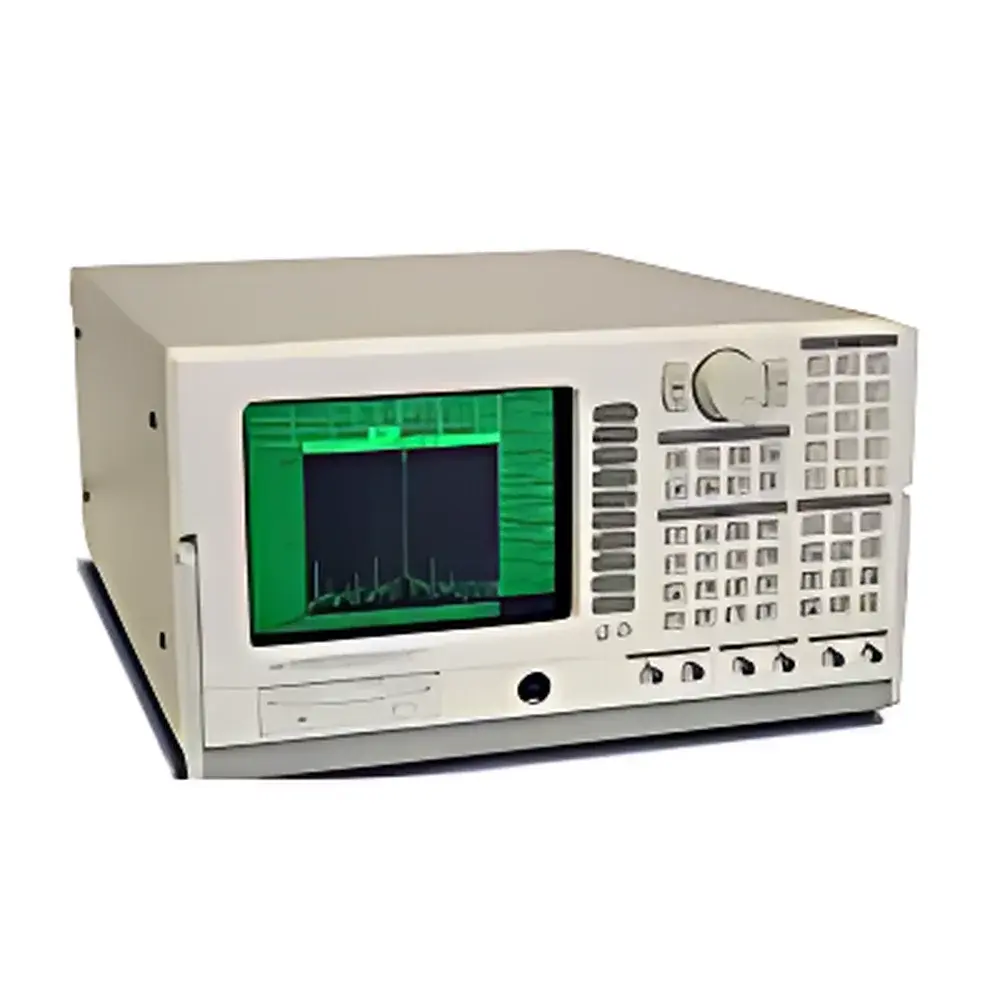
Stanford Research Systems SR785 Dual-Channel FFT Dynamic Signal Analyzer with Tracking Generator
| Brand | SRS/Stanford Research Systems |
|---|---|
| Origin | USA |
| Model | SR785 |
| Frequency Range | DC to 102.4 kHz |
| Dynamic Range | 90 dB (typical), 145 dB (sine sweep) |
| Real-Time Bandwidth | 100 kHz |
| Storage Memory | 32 MB |
| Analysis Modes | Cross-spectrum, frequency response, coherence, harmonic, band, and sideband analysis |
| Tracking Generator | Yes |
| Interfaces | GPIB (IEEE-488.2), RS-232 |
| Filter Types | 1/1-octave, 1/3-octave, 1/12-octave real-time FFT |
| Curve Fitting | 20-pole/20-zero |
| Input Channels | 2 independent analog inputs with configurable range/resolution |
Overview
The Stanford Research Systems SR785 Dual-Channel FFT Dynamic Signal Analyzer with Tracking Generator is a precision-engineered instrument designed for high-fidelity spectral characterization of time-varying electrical signals in research laboratories, R&D engineering environments, and production test facilities. Based on high-speed analog-to-digital conversion and real-time digital signal processing (DSP), the SR785 implements fast Fourier transform (FFT) algorithms to deliver accurate amplitude, phase, and coherence information across its full DC–102.4 kHz bandwidth. Unlike swept-tuned analyzers, the SR785 acquires both channels simultaneously at up to 256 kS/s, enabling true real-time 100 kHz analysis bandwidth—critical for capturing transient dynamics, nonlinear distortion, and modulation sidebands without aliasing or gap-induced artifacts. Its integrated low-distortion tracking generator supports closed-loop system identification, including Bode plot generation, mechanical resonance mapping, and electroacoustic transducer characterization.
Key Features
- Dual-channel synchronous acquisition with independent gain, coupling, and anti-alias filtering per channel
- Real-time FFT engine supporting 1/1-, 1/3-, and 1/12-octave spectrum analysis at update rates up to 100 Hz
- Integrated tracking generator with amplitude and frequency synchronization to analyzer sweep parameters
- High dynamic range: 90 dB typical (1 Hz RBW), extendable to 145 dB under sine-sweep excitation using averaging and narrow resolution bandwidths
- Advanced post-processing capabilities including 20-pole/20-zero digital filter synthesis and transfer function modeling
- GPIB (IEEE-488.2) and RS-232 interfaces compliant with SCPI command syntax for automated test system integration
- Front-panel CRT display with graphical overlay of spectra, Lissajous plots, and time-domain waveforms
- Onboard 32 MB RAM for storage of time records, spectra, and calibration data—expandable via external storage over GPIB
Sample Compatibility & Compliance
The SR785 is optimized for voltage-mode signals from sensors, amplifiers, filters, power supplies, and embedded control systems. Input impedance is 1 MΩ || 25 pF (AC/DC coupled), with programmable gain ranging from 10 mV/V to 10 V/V and selectable input ranges (±10 mV to ±10 V). It complies with IEC 61000-4-30 Class A requirements for harmonic and interharmonic measurement accuracy when used with appropriate current shunts or voltage probes. While not certified for medical or aerospace safety standards, its architecture meets fundamental metrological traceability principles outlined in ISO/IEC 17025 for laboratory-developed test methods. All firmware operations maintain audit-ready logging when connected to host systems supporting IEEE 1149.1 boundary-scan or GLP/GMP-compliant data acquisition frameworks.
Software & Data Management
The SR785 operates autonomously but integrates seamlessly into PC-based test environments via standard SCPI commands. Its native command set supports full configuration of FFT parameters (window type, overlap, averaging mode), trigger conditions (level, edge, external), and data export formats (ASCII, binary, CSV). When interfaced with LabVIEW, MATLAB, or Python (via PyVISA), users can implement custom spectral averaging strategies, statistical outlier detection, and pass/fail limit checking against user-defined templates. Internal memory retains timestamped datasets with metadata (date/time, instrument ID, calibration status), satisfying basic FDA 21 CFR Part 11 requirements for electronic records when paired with validated host software and access controls. No proprietary drivers are required—GPIB communication uses standard NI-VISA or Linux gpib-utils libraries.
Applications
- Vibration and modal analysis of rotating machinery using coherence-gated frequency response functions
- Power electronics characterization—including THD+N, harmonic group analysis, and switching noise profiling
- Audio component validation (amplifiers, DACs, loudspeakers) per AES17 and IEC 60268-3
- Control loop stability assessment via open/closed-loop Bode measurements with phase margin estimation
- EMI precompliance testing for conducted emissions in the sub-100 kHz range
- Material damping coefficient extraction from resonant decay envelopes in ultrasonic transducers
- Educational use in advanced signals & systems laboratories for hands-on FFT, windowing, and leakage mitigation studies
FAQ
What is the maximum real-time analysis bandwidth of the SR785?
The SR785 delivers true 100 kHz real-time bandwidth for FFT-based spectral analysis, supported by dual-channel simultaneous sampling at 256 kS/s and hardware-accelerated computation.
Does the tracking generator support phase-locked operation?
Yes—the internal generator synchronizes frequency and amplitude to the analyzer’s sweep parameters, enabling precise phase-coherent stimulus-response measurements.
Can the SR785 perform order-tracking analysis on rotating equipment?
While it lacks dedicated order-tracking firmware, its time-synchronous acquisition and post-processing flexibility allow implementation of custom order analysis via MATLAB or LabVIEW scripts using tachometer-triggered data capture.
Is calibration documentation provided with the instrument?
Each unit ships with NIST-traceable factory calibration data, including amplitude flatness, phase linearity, and generator distortion metrics—valid for 12 months under standard operating conditions.
How is data integrity ensured during long-duration acquisitions?
The SR785 implements cyclic redundancy checksums (CRC-32) on all stored datasets and supports hardware-level GPIB handshaking to prevent packet loss during bulk transfers.