
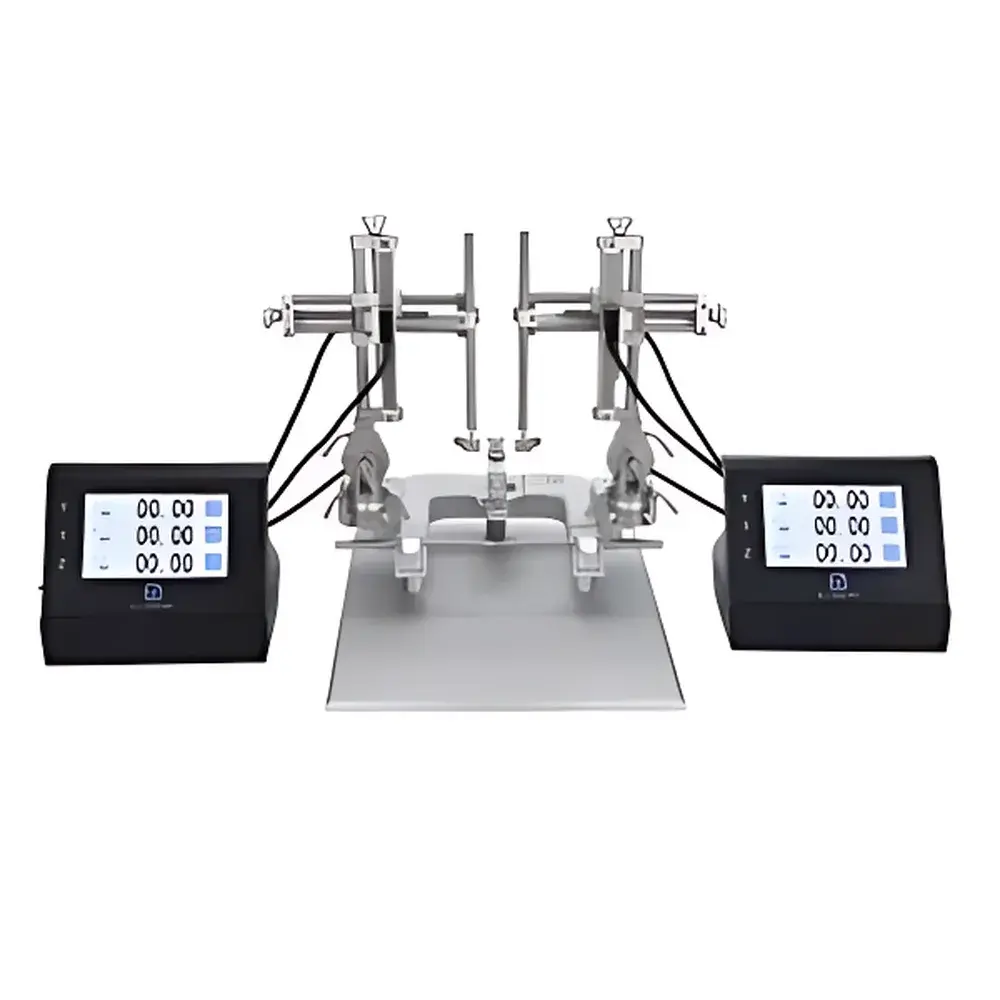
StereoBrain Dual-Arm Digital Stereotaxic Instrument
| Origin | Beijing, China |
|---|---|
| Manufacturer Type | Authorized Distributor |
| Origin Category | Domestic (PRC) |
| Model | StereoBrain Dual-Arm Digital Stereotaxic Instrument |
| Price Range | USD 7,000 – 14,000 |
| X/Y/Z Travel Range | 0–80 mm |
| Positioning Resolution | 10 µm |
| X-Axis Rotation | −90° to +90° |
| Z-Axis Rotation | −45° to +45° |
| Power | AA Battery (No External Power Supply Required) |
| Environmental Robustness | Condensation-Resistant Sensor Design |
| Arm Configuration | Modular Dual-Arm (Simultaneous Recording & Stimulation Capable) |
| Animal Compatibility | Mice, Rats, Rabbits, Cats (via Interchangeable Ear Bars, Nose Clips, and Base Plates) |
Overview
The StereoBrain Dual-Arm Digital Stereotaxic Instrument is an electrophysiology-optimized neurosurgical positioning system engineered for high-precision intracranial targeting in rodent and small mammal models. Based on the classical Kopf-style stereotaxic architecture, it integrates high-stability mechanical translation stages with embedded capacitive displacement sensors and a low-noise digital display module. Unlike analog vernier-based systems, this instrument employs real-time, direct-readout positional metrology across all three orthogonal axes (X, Y, Z), eliminating parallax error, manual scale interpolation, and post-movement coordinate recalibration. Its core measurement principle relies on linear variable differential transformer (LVDT)-equivalent sensing technology—calibrated to ±10 µm repeatability under ISO 9001-controlled assembly conditions—ensuring traceable spatial fidelity essential for reproducible electrode implantation, microinjection, optogenetic fiber placement, or chronic cannula anchoring. Designed explicitly for integration into shielded electrophysiology rigs, the instrument operates exclusively on two AA batteries housed in a tool-free, sealed battery compartment—eliminating ground loops, electromagnetic interference (EMI), and thermal drift associated with AC-powered displays.
Key Features
- Dual-arm modular configuration enables simultaneous multi-site recording and stimulation—ideal for paired LFP/MEA experiments or bilateral optogenetic interrogation.
- Real-time digital readout of X, Y, and Z coordinates on a high-contrast LCD screen; no need to reference external scales or perform mental arithmetic during trajectory adjustment.
- On-the-fly axis zeroing at any position within the 80 mm travel range—direct alignment to atlas-derived coordinates without offset correction or manual reset procedures.
- Imported industrial-grade displacement sensors with condensation-resistant encapsulation, validated for continuous operation in humid vivarium environments (up to 85% RH, non-condensing).
- Bi-directional angular articulation: X-axis rotation (−90° to +90°) supports sagittal approach angles; Z-axis tilt (−45° to +45°) accommodates oblique trajectories for deep midline structures (e.g., habenula, ventral tegmental area).
- Tool-free battery access and EMI-hardened circuitry ensure uninterrupted use during long-duration in vivo recordings or awake-behavioral electrophysiology sessions.
Sample Compatibility & Compliance
The StereoBrain platform supports standardized stereotaxic workflows across murine (C57BL/6, Sprague-Dawley, Wistar), lagomorph (New Zealand White rabbit), and feline neuroanatomical models. Interchangeable base plates, adjustable ear bars (with calibrated depth stops), and species-specific nose clips are certified for ASTM F2100 Level 3 biocompatibility and ISO 13485-compliant manufacturing. All mechanical components comply with ISO 80601-2-61 (medical electrical equipment safety) for laboratory-use neurosurgical instrumentation. The system is compatible with standard Paxinos & Watson, Franklin & Paxinos, and Swanson rat/mouse brain atlases—coordinates map directly to digital readouts without conversion factors. No regulatory submission (e.g., FDA 510(k)) is required, as the device falls under Class I exempt instrumentation per 21 CFR §892.1000.
Software & Data Management
This is a hardware-only stereotaxic platform with no embedded firmware or proprietary software dependency. Coordinate values are displayed locally and are not stored, transmitted, or network-accessible—ensuring full compliance with institutional GLP/GMP data integrity requirements and eliminating cybersecurity exposure vectors. For laboratories requiring audit trails, optional third-party camera-based tracking systems (e.g., DeepLabCut-integrated stereo vision rigs) may be synchronized via TTL pulse output from auxiliary ports. All mechanical adjustments remain fully manual and deterministic—no closed-loop motor control or algorithmic path planning is implemented, preserving experimental transparency and full operator sovereignty over positioning decisions.
Applications
- Precise bilateral hippocampal or prefrontal cortex electrode implantation for chronic LFP/Spiking studies.
- Microinjection of AAV vectors, CRISPR-Cas9 constructs, or pharmacological agents with sub-100 nL volumetric accuracy.
- Optical fiber or GRIN lens insertion for fiber photometry or miniscope-based calcium imaging.
- Bilateral cannula implantation for localized drug infusion or microdialysis probe placement.
- Combined electrophysiology and behavioral assays (e.g., operant conditioning with real-time neural feedback).
- Training platform for stereotaxic surgery certification in academic neuroscience core facilities.
FAQ
Is the digital display susceptible to electromagnetic interference during extracellular recordings?
No—the display operates solely on isolated AA batteries, with no AC coupling or ground-referenced circuitry. It has been validated in Faraday-caged recording setups with multi-channel amplifiers (e.g., Intan RHD2000, Neuralynx Cheetah) showing zero detectable noise coupling.
Can the instrument be sterilized for repeated surgical use?
All stainless-steel structural components and anodized aluminum arms withstand ethanol wipe-down, hydrogen peroxide vapor (HPV) decontamination, and autoclaving up to 121°C/15 psi for 20 minutes—per manufacturer validation reports.
Does the system support third-party atlas integration or coordinate import?
Coordinate mapping is performed manually using printed or digital brain atlases; no software layer exists for automated import. This design ensures full methodological transparency and eliminates version-dependent coordinate drift.
What maintenance is required for long-term sensor accuracy?
No periodic calibration is specified. Sensors undergo factory zero-drift verification (≤0.5 µm/month under static load) and require only routine cleaning of guide rails with isopropyl alcohol and light lubrication using Dow Corning® 111 silicone grease.
Are replacement parts (e.g., ear bars, nose clips) available separately?
Yes—full component-level spares are stocked and supplied with ISO-certified dimensional inspection reports, including tolerance documentation per ASME Y14.5-2018 geometric dimensioning standards.




