
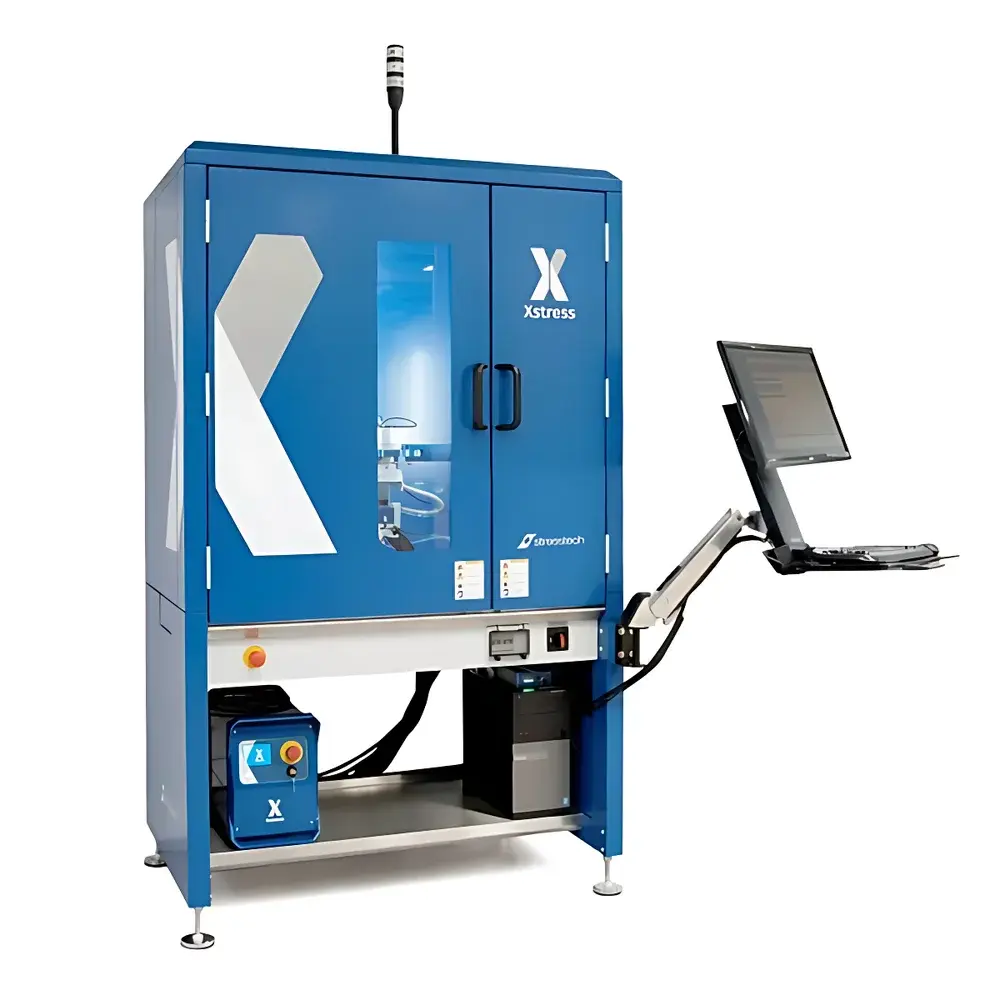
Stresstech XStress3000 Portable X-Ray Residual Stress Analyzer
| Brand | Stresstech Oy |
|---|---|
| Origin | Finland |
| Model | XStress3000 |
| Detector Type | Solid-state linear imaging detector (512-channel, dual-side) |
| Measurement Geometry | Modified ψ-scan (symmetrical side-inclination) |
| Standard ψ-angle Range | –45° to +45° |
| Optional Extended ψ-range | –45° to +60° |
| Φ-rotation | Optional |
| Motion Control | Computer-controlled high-precision DC servo motors |
| X-ray Source | Integrated water-cooled high-voltage generator with self-contained recirculating chiller and heat exchanger |
| Radiation Safety | Fully compliant with IEC 61010-1, IEC 62471, and EN 61331-1 for industrial X-ray equipment |
| Portability | Single-unit compact design with integrated safety interlocks and radiation shielding |
Overview
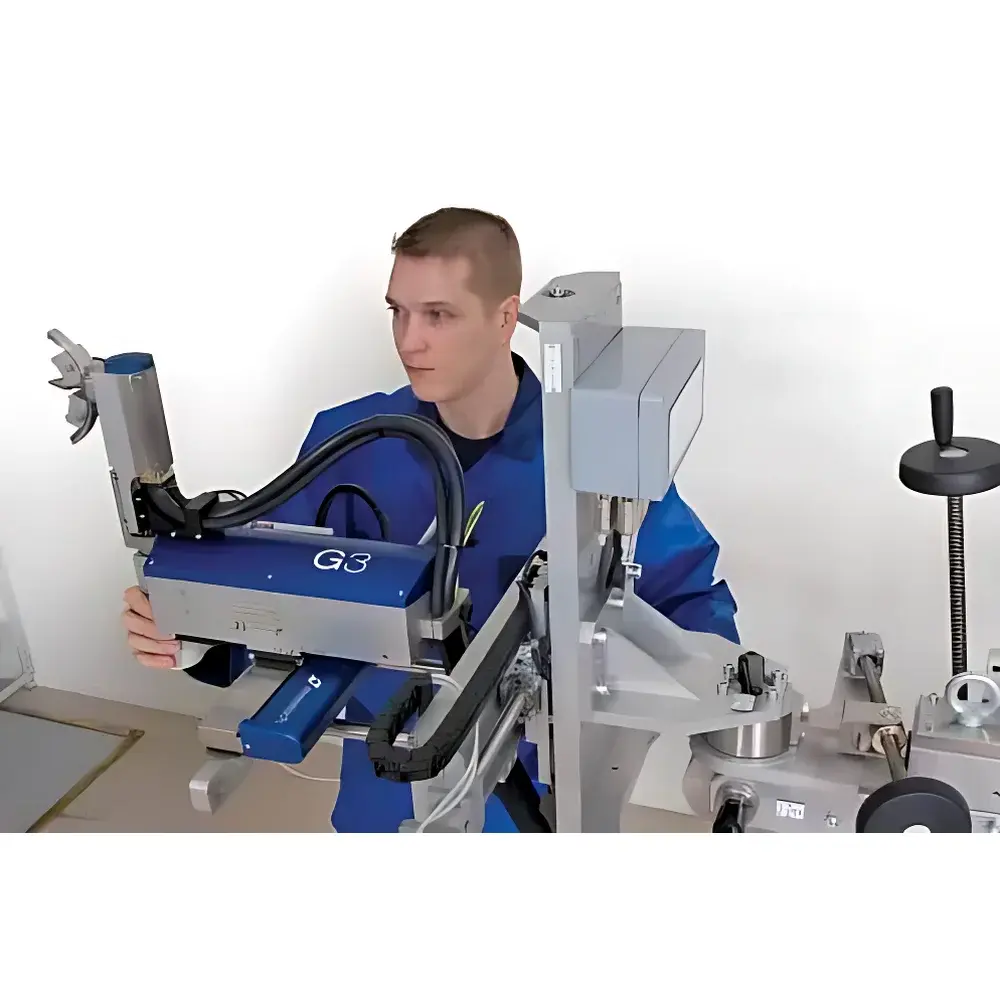
The Stresstech XStress3000 Portable X-Ray Residual Stress Analyzer is an engineered solution for non-destructive, quantitative measurement of near-surface residual stresses in polycrystalline metallic components. Based on the sin²ψ X-ray diffraction (XRD) method—specifically utilizing a modified symmetrical side-inclination (ψ-scan) geometry—the system determines lattice strain by measuring angular shifts in Bragg diffraction peaks as the sample orientation is varied. This principle enables calculation of residual stress components (σ₁₁, σ₂₂, τ₁₂) in the surface plane with high spatial resolution and reproducibility. Designed and manufactured in Finland by Stresstech Oy—a globally recognized leader in residual stress and grinding burn metrology—the XStress3000 integrates a compact goniometer (G2), dual-sided 512-channel solid-state linear detectors, and a fully self-contained X-ray generation and cooling subsystem. Its portable, single-unit architecture meets stringent international radiation safety standards—including IEC 61010-1 (safety of electrical equipment), EN 61331-1 (protective devices for diagnostic X-ray equipment), and IEC 62471 (photobiological safety)—making it suitable for both laboratory and field deployment without external infrastructure.
Key Features
- Compact G2 goniometer with computer-controlled DC servo motors ensuring sub-arcminute angular repeatability and long-term mechanical stability
- Dual-side 512-channel solid-state linear detector array enabling direct X-ray photon-to-digital signal conversion with high quantum efficiency and low electronic noise
- Standard ψ-angle range of –45° to +45°; optional extended ψ-scan (–45° to +60°) and Φ-rotation for full stress tensor determination in anisotropic or textured materials
- Integrated water-cooled high-voltage X-ray generator (typically operating at 20–50 kV, 0.1–1.0 mA) with closed-loop recirculating chiller and thermal management system
- Embedded safety architecture including multiple hardware interlocks, beam shutter control, real-time dose monitoring, and fail-safe radiation containment
- Modular probe design supporting interchangeable collimators (e.g., 1 mm, 2 mm, 4 mm) and anode targets (Cr, Co, Fe, Cu) to optimize Kα line selection per material system
Sample Compatibility & Compliance
The XStress3000 is validated for use on ferrous and non-ferrous alloys including steels, titanium, aluminum, nickel-based superalloys, and cast irons. It accommodates curved, irregular, and large-format components—such as gears, bearing races, turbine blades, weld seams, and additively manufactured parts—without requiring sectioning or surface polishing beyond standard metallographic preparation (e.g., electropolishing or fine grinding). Measurement depth is typically 5–30 µm depending on material absorption and X-ray energy. The system complies with ISO 21943:2020 (Non-destructive testing — X-ray diffraction methods for residual stress analysis), ASTM E915-22 (Standard Test Method for Verifying the Alignment of X-Ray Diffraction Instrumentation for Residual Stress Measurement), and supports audit-ready documentation aligned with GLP and GMP frameworks. All firmware and calibration routines are traceable to NIST-maintained reference standards.
Software & Data Management
Operation is managed via Stresstech’s proprietary XStress Studio software, a Windows-based application offering real-time diffraction pattern acquisition, automatic peak fitting (using pseudo-Voigt or Pearson VII profiles), sin²ψ regression, and stress tensor visualization. The software enforces procedural controls—including user-level access rights, electronic signatures, and full audit trail logging per FDA 21 CFR Part 11 requirements. Raw data (2θ vs. intensity) and processed results (stress maps, error ellipses, confidence intervals) are exportable in ASCII, CSV, and HDF5 formats. Integration with third-party statistical process control (SPC) platforms and LIMS systems is supported via OPC UA and RESTful API interfaces. Calibration certificates, instrument performance verification (IPV) reports, and annual stability checks are automatically archived with time-stamped metadata.
Applications
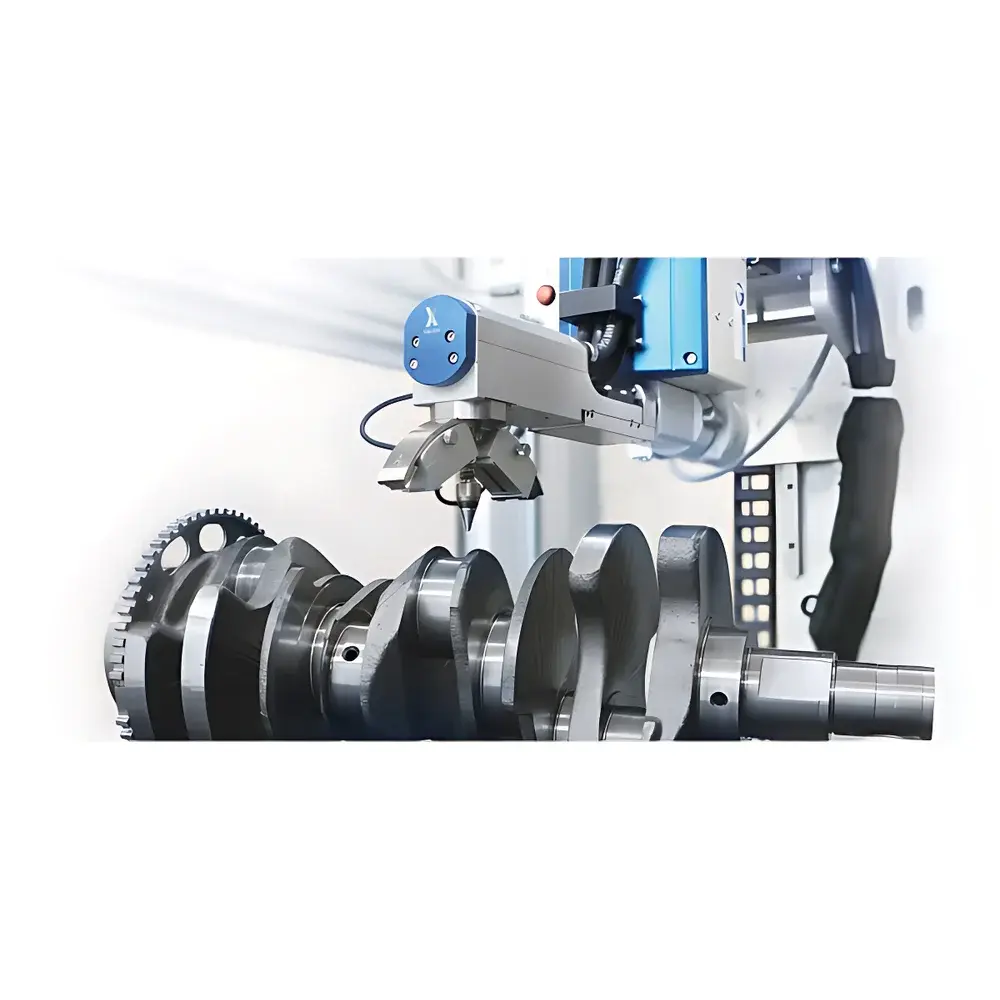
The XStress3000 serves critical quality assurance functions across high-reliability sectors. In aerospace and power generation, it verifies stress states in turbine disks and compressor blades post-machining and shot peening. In automotive manufacturing, it monitors residual stress evolution during gear hardening and crankshaft grinding—directly correlating with fatigue life per SAE J2599. For additive manufacturing, it quantifies build-direction stress gradients in Ti-6Al-4V and Inconel 718 components prior to HIP treatment. In nuclear and pressure vessel applications, it supports ASME Section XI Appendix VIII compliance for weld integrity assessment. Universities and national labs employ the system for fundamental studies on stress relaxation kinetics, phase transformation-induced stresses, and multi-axial loading effects.
FAQ
What X-ray tube anodes are supported?
Standard configurations include Cr, Co, Fe, and Cu anodes; custom anode selection is available based on crystalline structure and absorption edge considerations.
Is the system certified for use in classified or regulated facilities?
Yes—the XStress3000 carries CE marking, UKCA certification, and conforms to EU Directive 2014/30/EU (EMC) and 2014/35/EU (LVD); radiation safety documentation satisfies DOE Order 420.1C and NRC regulatory guidance.
Can measurements be performed on coated or plated components?
Yes, provided the coating thickness is ≤5 µm and does not significantly attenuate the characteristic Kα radiation; thin-film stress analysis requires optimized incidence angle and collimation.
What maintenance is required for long-term operational reliability?
Annual preventive maintenance includes detector gain calibration, goniometer backlash verification, X-ray output stability check, and coolant system integrity test—all documented in accordance with ISO/IEC 17025 requirements.
Does the system support automated scanning for large-area stress mapping?
Yes—optional motorized XYZ stages with programmable trajectories enable grid-based stress mapping (e.g., 10 × 10 mm² at 1 mm step intervals), with synchronized data stitching and interpolation in XStress Studio.



