
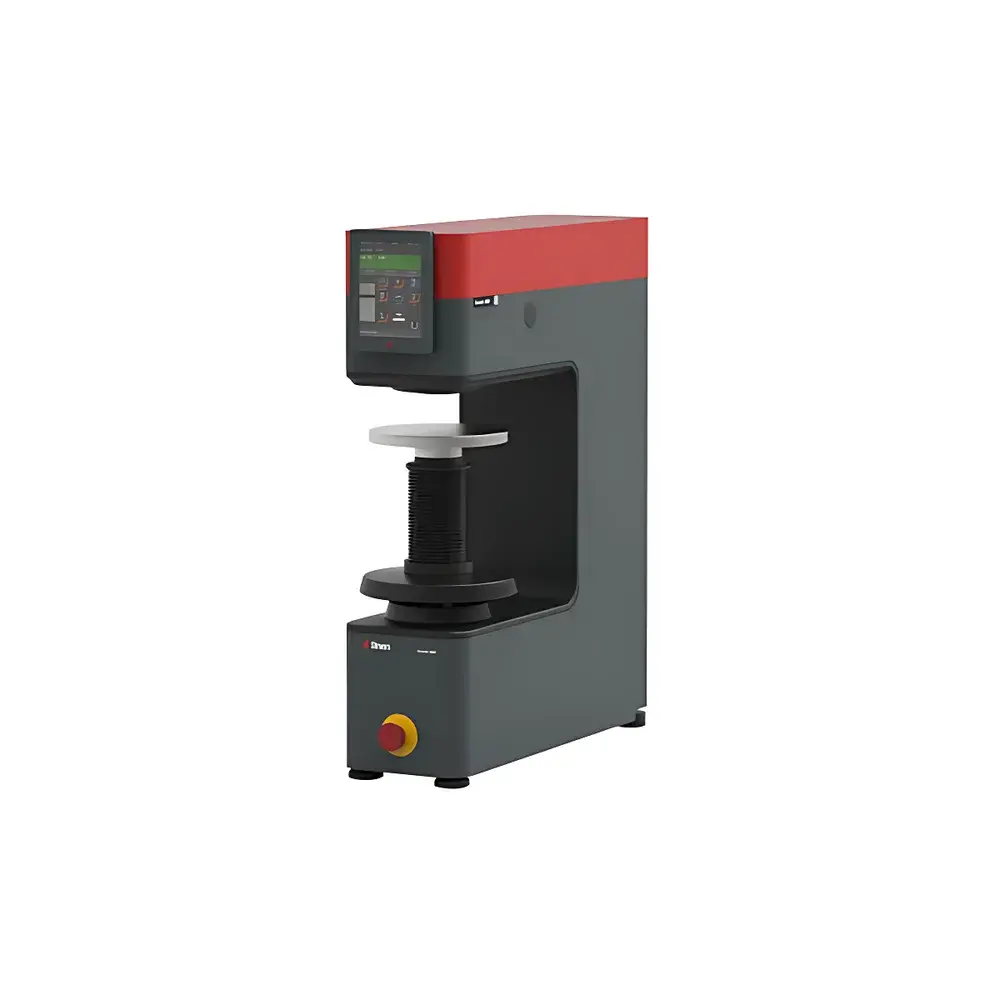
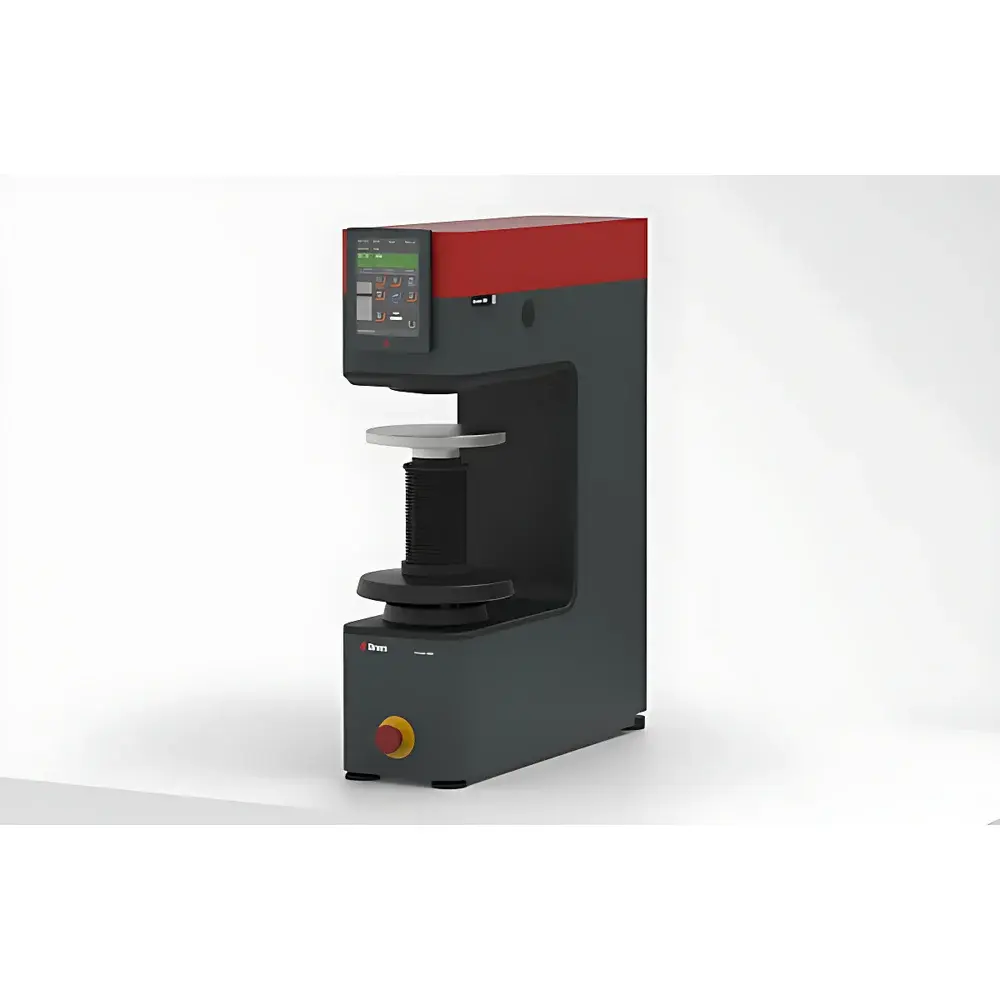
Struers Duramin-3000 Single-Task Brinell Hardness Tester
| Brand | Struers |
|---|---|
| Origin | Denmark |
| Model | Duramin-3000 |
| Hardness Test Method | Brinell |
| Load Range | 62.5–3000 kgf (612.9–29400 N) |
| Maximum Specimen Height | 190 mm |
| Maximum Specimen Depth | 220 mm |
| Indentation Evaluation | Handheld Zoom Camera with Auto-Measurement |
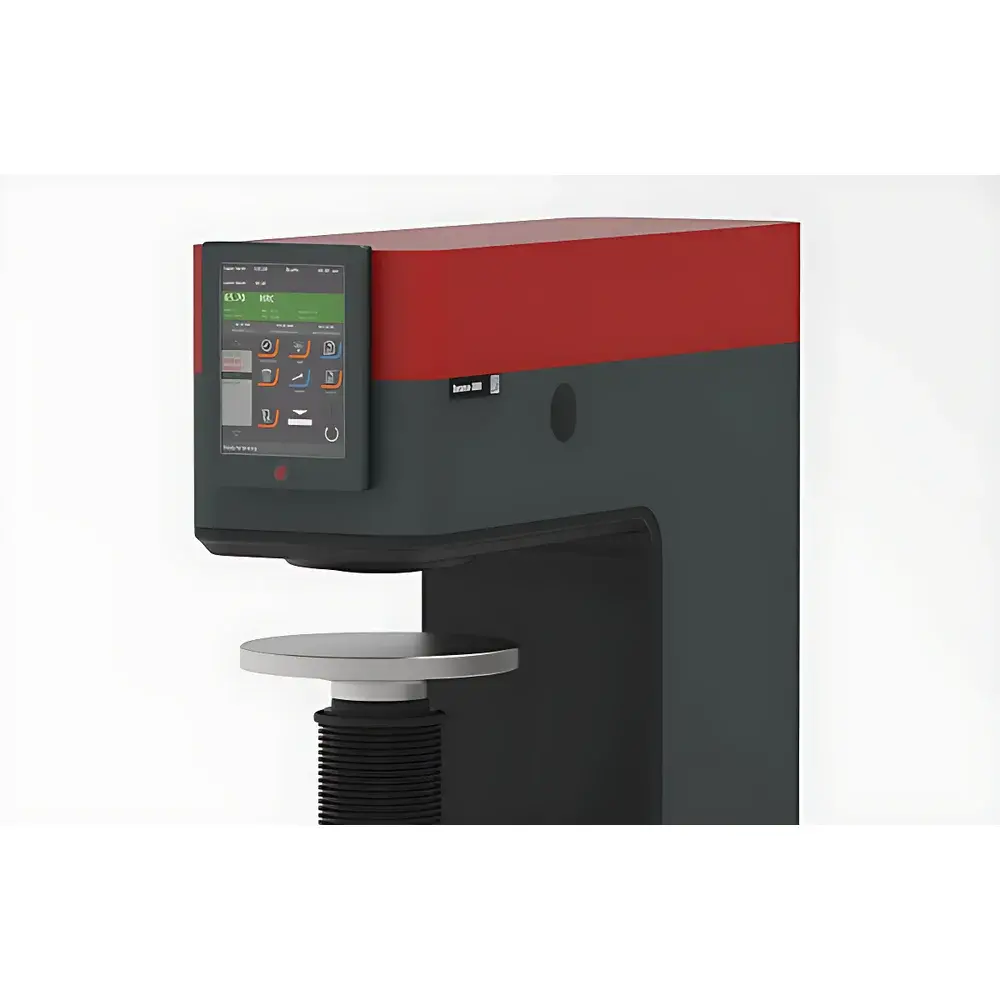
| Control System | Embedded PC with Touchscreen & Mouse Interface |
| Compliance | ASTM E10, ISO 6506-1, EN ISO 6506-1 |
Overview
The Struers Duramin-3000 is a dedicated single-task Brinell hardness tester engineered for robust, repeatable hardness assessment in industrial production and quality control laboratories. It operates on the classical Brinell principle—applying a precisely controlled spherical indenter (typically tungsten carbide, 10 mm diameter) under standardized load to produce a permanent spherical impression on the test surface. The resulting indentation diameter is measured optically, and hardness is calculated using the standardized Brinell formula: HBW = 0.102 × F / A, where F is applied force in newtons and A is the spherical surface area of the indentation. Designed for operational simplicity and mechanical stability, the Duramin-3000 eliminates multi-method complexity while maintaining full compliance with international standards including ASTM E10, ISO 6506-1, and EN ISO 6506-1. Its rigid cast-iron frame, vibration-damped base, and precision-machined loading column ensure minimal deflection under maximum load (up to 29400 N), supporting high reproducibility across shifts and operators.
Key Features
- Single-task architecture optimized exclusively for Brinell testing—reduces procedural ambiguity and minimizes operator-induced variability.
- Wide load range from 62.5 kgf to 3000 kgf (612.9–29400 N), enabling evaluation of soft non-ferrous metals, hardened steels, cast irons, and sintered materials per standard load–diameter combinations (e.g., 3000 kgf/10 mm, 1500 kgf/10 mm, 500 kgf/5 mm).
- High-stability load application via calibrated load cell—ensuring traceable force delivery without hydraulic drift or mechanical lever inaccuracies.
- Integrated embedded PC with Windows-based interface, supporting both touchscreen and external mouse input for intuitive navigation and data handling.
- Handheld zoom-capable digital camera system with motorized focus and real-time image capture—enabling rapid, operator-position-independent indentation measurement without stage repositioning.
- Automated indentation analysis software with sub-pixel edge detection, providing consistent diameter measurement even on low-contrast or oxidized surfaces.
- Compact footprint and reinforced structural design suitable for shop-floor deployment—resistant to ambient vibration, temperature fluctuation, and incidental impact.
Sample Compatibility & Compliance
The Duramin-3000 accommodates specimens up to 190 mm in height and 220 mm in depth, accommodating irregular geometries—including forged components, machined billets, and large castings—without requiring secondary fixturing. Its open-front design allows direct access for oversized or oddly shaped parts. All hardness calculations and reporting adhere strictly to ASTM E10 (Standard Test Method for Brinell Hardness of Metallic Materials) and ISO 6506-1 (Metallic materials — Brinell hardness test — Part 1: Test method). The system supports GLP-compliant documentation through timestamped measurement logs, user authentication, and audit-trail-enabled report generation. While not natively 21 CFR Part 11 compliant out-of-the-box, its embedded OS permits integration with validated third-party LIMS or QA platforms meeting pharmaceutical or aerospace QA requirements.
Software & Data Management
The integrated software suite provides preconfigured measurement templates aligned with common Brinell test protocols (e.g., HBW 10/3000, HBW 5/750). Each test record stores raw image files, measured indentation diameters (d₁, d₂), calculated hardness values (HBW), test load, dwell time, indenter type, and operator ID. Statistical functions include batch averaging, standard deviation, min/max tracking, histogram generation, and Cp/Cpk capability analysis. Reports are exportable in PDF, CSV, and XML formats—with customizable headers, company logos, and QA sign-off fields. Data integrity is maintained via write-protected internal storage and optional network backup to secure file servers.
Applications
The Duramin-3000 serves as a primary hardness verification tool in foundries, forging plants, heat treatment facilities, and metal component suppliers. Typical use cases include incoming material inspection of aluminum alloys (e.g., ASTM B209), post-heat-treatment validation of medium-carbon steels (e.g., AISI 1045 quenched & tempered), hardness profiling of gray iron engine blocks, and quality gate checks for powder metallurgy parts. Its reliability under continuous operation makes it suitable for SPC-driven environments where >50 daily tests are routine. The absence of optical path alignment dependencies—unlike traditional microscope-based Brinell systems—reduces calibration frequency and increases uptime.
FAQ
What indenter materials and sizes are supported?
The Duramin-3000 is configured for tungsten carbide ball indenters (HBW designation) in standard diameters: 10 mm, 5 mm, 2.5 mm, and 1 mm—each selected via software-defined test templates per ISO 6506-1.
Is calibration certification included with shipment?
Yes—each unit ships with a factory-issued calibration certificate traceable to national metrology institutes (e.g., DANAK, UKAS), covering load accuracy (±0.5% of reading) and indentation measurement uncertainty (±0.5 µm at 10× magnification).
Can the system be integrated into an automated production line?
While designed as a standalone benchtop unit, the Duramin-3000 supports RS-232 and Ethernet communication protocols for external trigger input and result data streaming to MES or SCADA systems.
Does the handheld camera require periodic recalibration?
No—its optical scaling is software-validated against on-screen reference targets during startup; physical recalibration is only required after sensor replacement or major mechanical service.
What maintenance intervals are recommended?
Annual preventive maintenance is advised, including load cell verification, camera focus validation, and mechanical wear inspection of the loading column and specimen support stage.



