
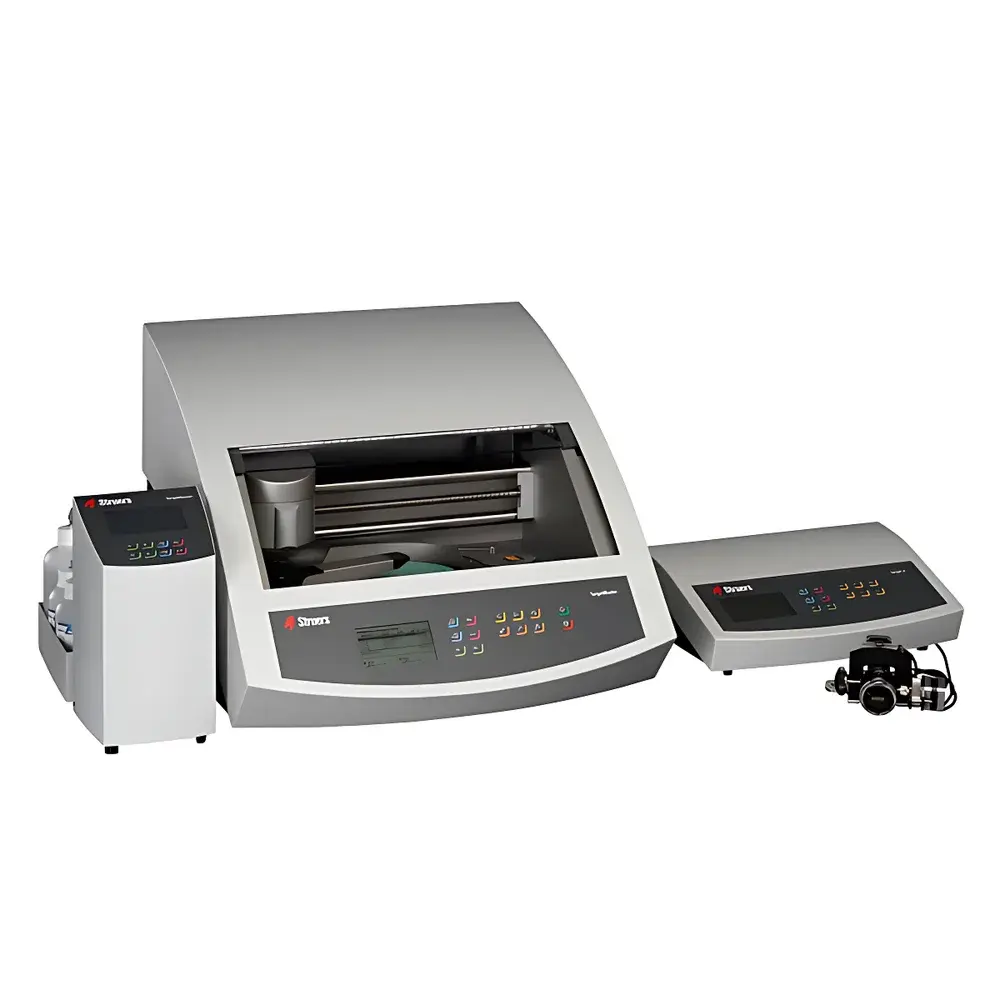
Struers TargetSystem Automated Target Preparation System
| Brand | Struers |
|---|---|
| Origin | Imported |
| Manufacturer Type | Authorized Distributor |
| Model | TargetSystem |
| Dimensions (L×W×D) | 595 × 820 × 860 mm |
| Number of Grinding/Polishing Plates | 1 |
| Plate Diameter | 200 mm (8") |
| Rotational Speed Range | 10–300 rpm |
Overview
The Struers TargetSystem is an engineered solution for high-precision, automated cross-sectional preparation of microelectronic components and planarized targets—specifically designed for failure analysis (FA) laboratories serving semiconductor, packaging, and advanced interconnect R&D environments. Unlike conventional manual or semi-automated grinding/polishing systems, the TargetSystem employs a closed-loop, vision-guided alignment architecture that integrates real-time optical metrology with adaptive motion control. It utilizes reflected-light imaging and sub-pixel edge detection to locate both visible surface features (e.g., bond pads, trace terminations) and buried structures—including micro-vias, through-silicon vias (TSVs), and ball grid array (BGA) solder joints—without requiring destructive pre-marking or fiducial placement. The system achieves positional accuracy of ±5 µm relative to target coordinates, enabling deterministic sectioning at user-defined depths and orientations. Its core functionality centers on iterative, feedback-driven material removal: after each grinding pass, the integrated camera captures a high-resolution surface image; proprietary algorithms recompute optimal grinding vector offsets and dwell time before initiating the next cycle. This eliminates reliance on operator experience and ensures process convergence independent of sample heterogeneity.
Key Features
- Vision-guided real-time target alignment for both surface-exposed and subsurface features (e.g., micro-vias, BGA balls, Cu pillars)
- Integrated optical metrology subsystem with 5 µm absolute positioning repeatability
- Intelligent Preparation System (IPS) software that dynamically adjusts grinding duration, pressure profile, and rotational speed based on in-situ surface condition analysis
- Single-plate 200 mm (8″) grinding/polishing station with programmable speed range (10–300 rpm) and precise torque-controlled feed
- Modular consumable compatibility: accepts standard SiC papers, diamond suspensions, and colloidal silica slurries—no proprietary or premium-cost films required
- Compact footprint (595 × 820 × 860 mm) optimized for cleanroom integration and FA lab space constraints
Sample Compatibility & Compliance
The TargetSystem accommodates rigid, flat, or moderately warped substrates up to 150 mm × 150 mm and 25 mm thick—including silicon wafers, organic substrates (ABF, FR4), ceramic packages, and molded IC assemblies. It supports preparation of both die-level and package-level cross-sections for root-cause analysis per JEDEC JESD22-A108 (temperature cycling), IPC-TM-650 2.2.17 (microsectioning), and ASTM F2751 (failure analysis of flip-chip interconnects). All motion control firmware and image acquisition modules comply with IEC 61508 functional safety requirements for laboratory automation. Audit trails, user access logs, and parameter change history are retained in accordance with GLP and ISO/IEC 17025 documentation standards.
Software & Data Management
The TargetSystem runs on Struers’ proprietary FA-PrepOS v3.x platform, built on a real-time Linux kernel with deterministic I/O scheduling. Software modules include: (1) Target Registration Wizard for multi-point coordinate mapping; (2) Cross-Section Path Planner supporting angled (non-perpendicular) cuts; (3) Surface Condition Analyzer that classifies scratch density, relief height, and phase contrast in real time; and (4) Integrated Report Generator producing PDF/CSV outputs compliant with FDA 21 CFR Part 11 for electronic signatures and audit trail integrity. All raw images, motor encoder logs, and process parameters are timestamped and stored locally with optional network-attached storage (NAS) synchronization.
Applications
- Failure analysis of advanced packaging technologies: fan-out wafer-level packaging (FOWLP), 2.5D/3D IC stacking, and chiplet-based architectures
- Verification of copper pillar height uniformity and solder joint voiding in fine-pitch BGAs
- Delamination assessment at die-attach or mold compound interfaces
- Quantitative evaluation of electroplated via fill quality and sidewall roughness
- Root-cause investigation of electromigration-induced voids in redistribution layers (RDL)
- Preparation of TEM lamellae precursors via precision site-specific thinning
FAQ
What types of samples can be prepared using the TargetSystem?
The system is validated for rigid planar samples including silicon dies, organic substrates, ceramic packages, and molded plastic ICs—up to 150 mm × 150 mm in area and 25 mm in thickness.
Does the TargetSystem require proprietary consumables?
No. It operates with industry-standard SiC abrasive papers, diamond suspensions, and colloidal silica polishing slurries—eliminating dependency on vendor-locked films or expensive disposable kits.
How does the system ensure reproducibility across different operators?
By replacing manual judgment with algorithmic decision-making: all grinding parameters are adjusted autonomously based on real-time surface feedback, removing human variability from the workflow.
Is the TargetSystem compatible with cleanroom environments?
Yes. Its sealed drive train, low particulate emission design, and ESD-safe housing meet Class 1000 (ISO 6) cleanroom specifications.
Can it prepare non-perpendicular cross-sections?
Yes. The path planner supports user-defined tilt angles (±15°) for oblique sectioning to expose specific interface planes or avoid topographical interference.



