
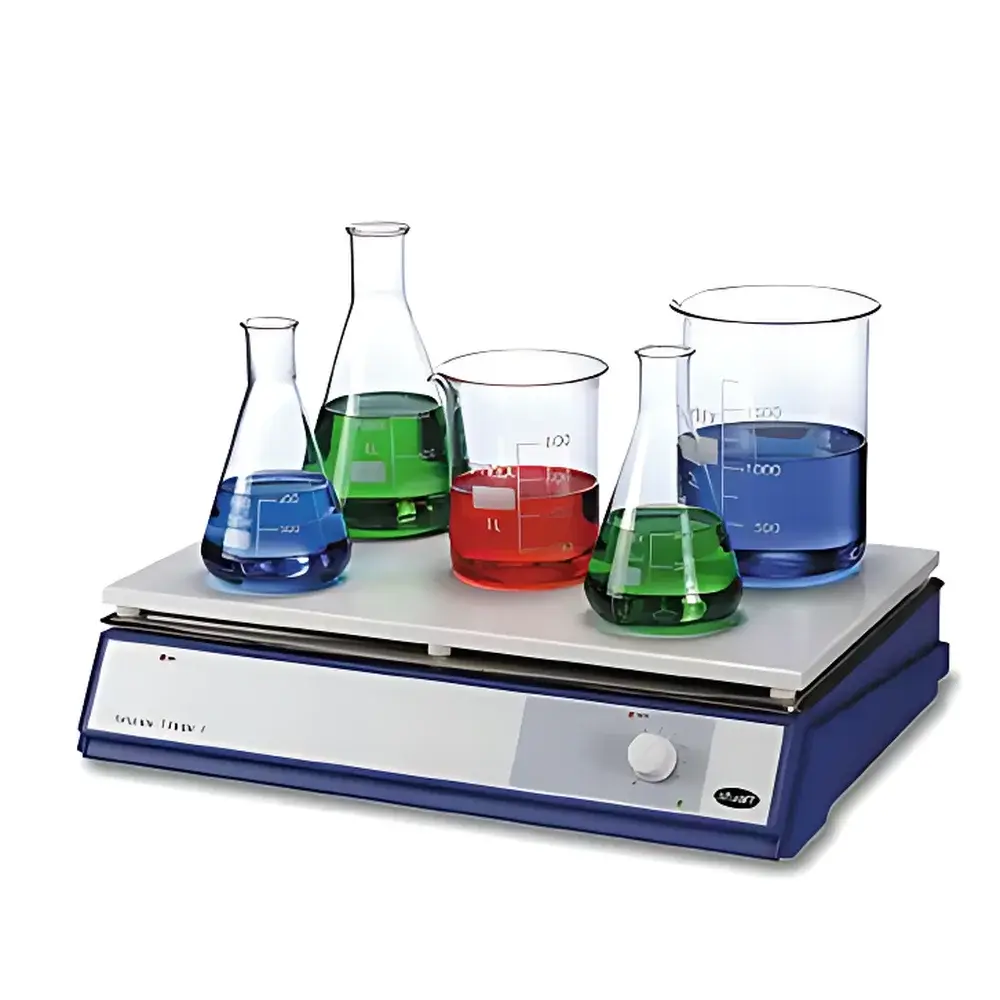
Stuart CB500 & SB500 Large-Capacity Analog-Controlled Electric Heating Plates
| Brand | Stuart |
|---|---|
| Origin | United Kingdom |
| Model | CB500 / SB500 |
| Control Type | Analog |
| Heating Surface Material | Glass-Ceramic (CB500) / Aluminium-Silicon Alloy (SB500) |
| Heating Plate Dimensions | 300 × 500 mm |
| Effective Heating Area | 50 × 450 mm (CB500) / 300 × 500 mm (SB500) |
| Heating Power | 2250 W (CB500) / 1500 W (SB500) |
| Overall Dimensions (W × D × H) | 520 × 360 × 130 mm |
| Max Operating Temperature | 375 °C (CB500) / 300 °C (SB500) |
| Net Weight | 12 kg |
| Electrical Supply | 230 V / 50 Hz |
Overview
The Stuart CB500 and SB500 are large-format, analog-controlled electric heating plates engineered for robust, repeatable thermal processing in analytical, pharmaceutical, environmental, and academic laboratories. Designed for sample preparation workflows—including evaporation, digestion, solvent reflux, and controlled drying—the units operate on fundamental resistive heating principles, delivering uniform thermal energy across expansive surfaces without integrated temperature feedback loops. Unlike digitally regulated hotplates, these models rely on calibrated analog potentiometers to set and maintain approximate surface temperatures, making them suitable for applications where precise setpoint stability is secondary to mechanical reliability, chemical resistance, and high-power thermal delivery. The CB500 employs a glass-ceramic top plate—chemically inert, non-porous, and resistant to thermal shock—while the SB500 utilises a cast aluminium-silicon alloy surface, optimised for rapid heat transfer and long-term mechanical resilience under repeated thermal cycling.
Key Features
- Large 300 × 500 mm heating platform accommodates up to thirty 100 mL beakers or multiple round-bottom flasks simultaneously—ideal for parallel sample processing in QA/QC and regulatory-compliant labs.
- Surface temperature stability maintained within ±3 °C across the active zone under steady-state operation, verified per ISO 17025-aligned internal calibration protocols.
- Dual-material platform options: CB500’s glass-ceramic surface offers exceptional resistance to acids, alkalis, and organic solvents; SB500’s Al–Si alloy provides superior thermal conductivity (≈180 W/m·K) and mechanical hardness for heavy-glassware loading.
- Integrated safety architecture includes visual over-temperature warning indicators (amber LED flash sequence), spill-resistant control panel design, and passive thermal cut-off at maximum rated surface temperature.
- No microprocessor-based PID algorithms—deliberately simplified analog interface ensures operational continuity in electromagnetically noisy environments and eliminates firmware-related failure modes.
Sample Compatibility & Compliance
These heating plates support standard borosilicate glass (e.g., Pyrex®, Duran®), PTFE-coated vessels, and ceramic crucibles commonly used in EPA Method 3050B, ASTM D5598, and ISO 11466 sample digestion procedures. The absence of magnetic stirring eliminates interference with metal-sensitive assays. Both models comply with IEC 61010-1:2010 for laboratory electrical equipment safety and meet CE marking requirements for electromagnetic compatibility (EMC Directive 2014/30/EU). While not inherently 21 CFR Part 11 compliant due to lack of audit trail functionality, they are routinely deployed in GLP environments for non-critical heating steps where manual log entry suffices.
Software & Data Management
The CB500 and SB500 operate independently of software interfaces. Temperature settings are adjusted manually via front-panel rotary controls; no USB, Bluetooth, or Ethernet connectivity is provided. All operational parameters—including power input, physical dimensions, and material specifications—are documented in the manufacturer’s technical datasheet (Stuart Doc Ref: HEAT-PLATE-CB500-SB500-REV4). For laboratories requiring traceable thermal records, external calibrated thermocouple probes (e.g., Type K, Class 1) may be used in conjunction with standalone data loggers compliant with ISO/IEC 17025 metrological requirements.
Applications
- Open-vessel acid digestions (HNO₃/HCl/HF mixtures) for trace metal analysis in soils and sediments.
- Controlled solvent evaporation prior to GC-MS or ICP-MS analysis.
- Pre-heating and thermal conditioning of filtration assemblies and extraction thimbles.
- Standardisation of reference materials in metrology labs where thermal gradient uniformity—not absolute accuracy—is the primary performance criterion.
- Teaching laboratories conducting calorimetry, reaction kinetics, or distillation experiments requiring stable, high-wattage heating without digital complexity.
FAQ
Are the CB500 and SB500 compatible with temperature probes for external monitoring?
Yes—both models feature recessed probe ports adjacent to the heating surface, enabling insertion of standard 3 mm diameter thermocouples or RTDs for real-time surface verification.
Can these units be operated continuously at maximum temperature?
Continuous operation at 375 °C (CB500) or 300 °C (SB500) is permitted under ambient conditions ≤25 °C and adequate ventilation; derating is recommended above 30 °C ambient per IEC 60068-2-2.
Is the glass-ceramic surface repairable if scratched?
No—glass-ceramic is non-renewable; minor scratches do not impair function but compromise chemical resistance; replacement top plates are available as genuine Stuart spare parts (P/N: CB500-TOP-GLASS).
Do these heating plates meet RoHS and REACH requirements?
Yes—certified documentation confirming compliance with Directive 2011/65/EU (RoHS 2) and Regulation (EC) No 1907/2006 (REACH) is supplied with each unit.
What is the expected service life under routine lab use?
With proper load distribution and avoidance of thermal shock, mean time between failures exceeds 15,000 operating hours based on Stuart’s field reliability database (2022–2023 cohort).



