
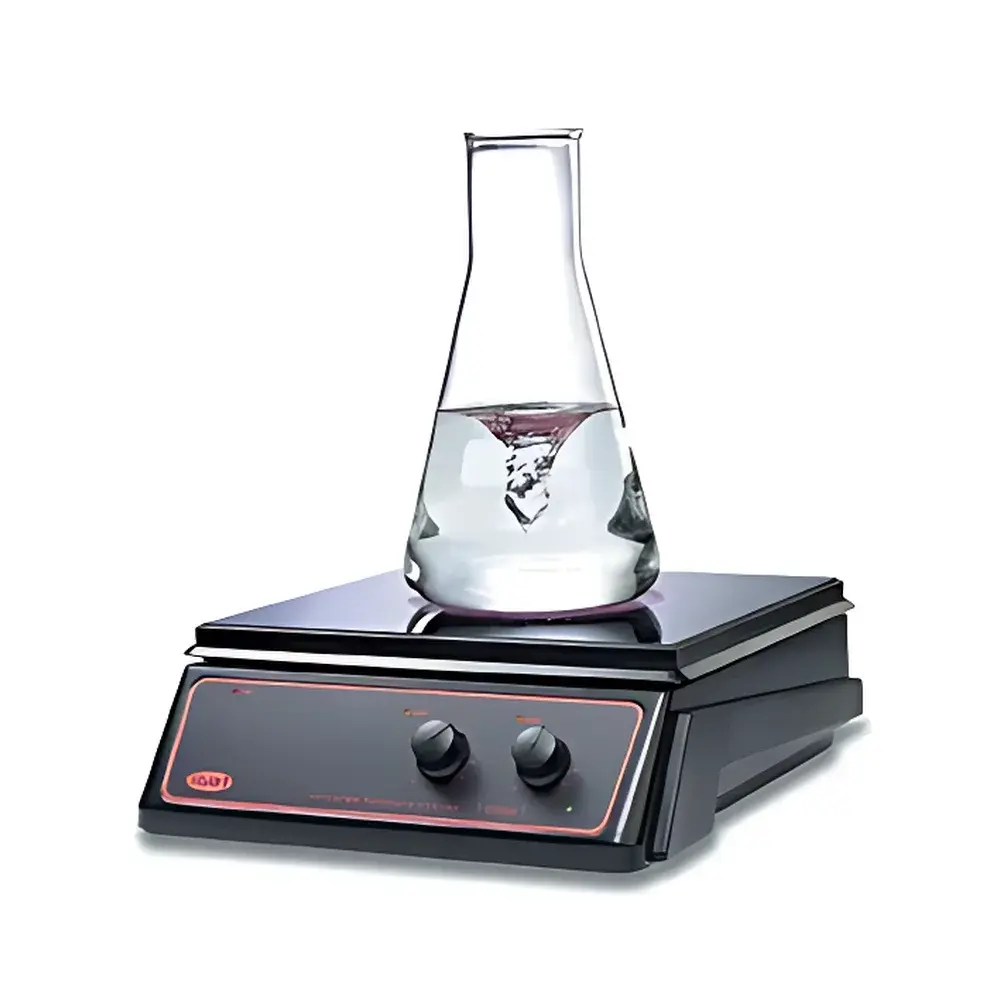
Stuart CR302 Infrared Heating Magnetic Stirrer
| Brand | Stuart |
|---|---|
| Origin | United Kingdom |
| Model | CR302 |
| Heating Power | 900 W |
| Stirring Speed Range | 100–1500 rpm |
| Plate Dimensions (W×D×H) | 300 × 365 × 105 mm |
| Heating Surface Diameter | Ø140 mm |
| Max Load Capacity | 4 kg |
| Input Voltage/Frequency | 230 V / 50 Hz |
| Ceramic Plate Material | Chemically Resistant Alumina-Based Ceramic |
| Safety Features | Overheat Warning LED, Spill Detection Circuit |
| Standard Accessories | Dual 25 mm PTFE-Coated Stir Bars, Adjustable Support Stand |
Overview
The Stuart CR302 Infrared Heating Magnetic Stirrer is an engineered solution for laboratories requiring precise, energy-efficient heating and robust magnetic agitation in a single compact platform. Unlike conventional resistive heating plates that transfer thermal energy via conduction through the base material, the CR302 employs near-infrared (NIR) radiation—emitted directly from a high-emissivity ceramic element—to heat vessels and their contents volumetrically. This principle enables faster thermal response: under identical experimental conditions (e.g., heating 1 L of deionized water), the 900 W NIR system achieves target temperature approximately 30% quicker than a standard 1200 W resistive hotplate. The device operates on fundamental principles of electromagnetic radiation absorption and magnetic torque coupling, making it especially suitable for applications where thermal uniformity, rapid ramp rates, and minimal ambient heat dissipation are critical—such as buffer preparation, dissolution testing, enzymatic reaction initiation, and solvent-based synthesis.
Key Features
- Near-infrared heating technology delivering improved thermal efficiency and reduced warm-up time without compromising temperature stability
- High-torque magnetic drive system supporting continuous stirring across the full 100–1500 rpm range with consistent rotational reproducibility
- Chemically inert, alumina-based ceramic plate surface resistant to acids, bases, and organic solvents; non-porous and easily decontaminated
- Integrated safety architecture including real-time overtemperature monitoring with visual LED alert and automatic shutdown upon liquid spill detection
- Compact footprint (300 × 365 × 105 mm) optimized for benchtop use in QC labs, academic teaching facilities, and R&D environments
- Rated for continuous operation at up to 4 kg load capacity, accommodating standard Erlenmeyer flasks, beakers, and jacketed reactors
Sample Compatibility & Compliance
The CR302 is compatible with all standard PTFE-, glass-, or polypropylene-coated magnetic stir bars—including the supplied pair of 25 mm rods—and supports vessel diameters up to 140 mm. Its ceramic plate tolerates exposure to common laboratory reagents (e.g., 6 M HCl, 5 M NaOH, acetone, ethanol, chloroform) without degradation. While not certified to specific ISO/IEC 17025 calibration standards out-of-the-box, the unit meets essential electrical safety requirements per IEC 61010-1:2010 for laboratory equipment. Its design facilitates compliance with GLP documentation workflows when paired with external temperature validation probes and loggers. No regulatory certification (e.g., FDA 21 CFR Part 11) applies to standalone operation, though data export via optional PC interface modules may support audit-trail configurations in validated environments.
Software & Data Management
The CR302 operates as a stand-alone analog-controlled instrument with no embedded microprocessor or digital display. Temperature regulation is achieved via manual potentiometer adjustment of infrared emitter intensity; stirring speed is independently controlled via rotary dial. As such, it does not feature onboard data logging, USB connectivity, or software integration. However, its stable analog output signals allow seamless integration with third-party temperature monitoring systems (e.g., thermocouple readers linked to LabVIEW or MATLAB) when used in conjunction with external Pt100 or Type-K sensors. For laboratories implementing electronic lab notebooks (ELNs), manual entry of setpoints and observed outcomes remains the standard practice—consistent with widely adopted SOPs for non-automated benchtop instrumentation.
Applications
- Preparation of aqueous and organic-phase solutions requiring simultaneous heating and homogenization
- Dissolution testing in pharmaceutical development per USP , particularly for low-solubility compounds sensitive to localized overheating
- Cell culture media conditioning where gentle, uniform warming minimizes protein denaturation risk
- Extraction protocols involving Soxhlet-compatible solvents or acid digestion matrices
- Teaching laboratories emphasizing foundational concepts in heat transfer, fluid dynamics, and reaction kinetics
- QC release testing for raw materials where reproducible heating/stirring profiles support method transfer between sites
FAQ
Does the CR302 include temperature feedback control?
No—the unit provides open-loop infrared power adjustment only. Precise temperature regulation requires an external probe and controller.
Can the CR302 be used with metal containers?
No. Ferromagnetic or conductive vessels (e.g., stainless steel beakers) will absorb IR radiation inefficiently and disrupt magnetic coupling; glass, ceramic, or polymer containers are required.
Is the ceramic plate replaceable?
Yes—Stuart offers the plate as a service part (P/N: CR302-PLATE), enabling field replacement without full unit refurbishment.
What is the expected lifetime of the infrared emitter under continuous use?
Rated for ≥10,000 hours of operation at nominal power, assuming proper ventilation and absence of condensate accumulation.
Are there CE or UKCA markings on the device?
Yes—each CR302 unit bears both CE and UKCA conformity markings, indicating compliance with the Electromagnetic Compatibility (EMC) Directive 2014/30/EU and Low Voltage Directive 2014/35/EU.



