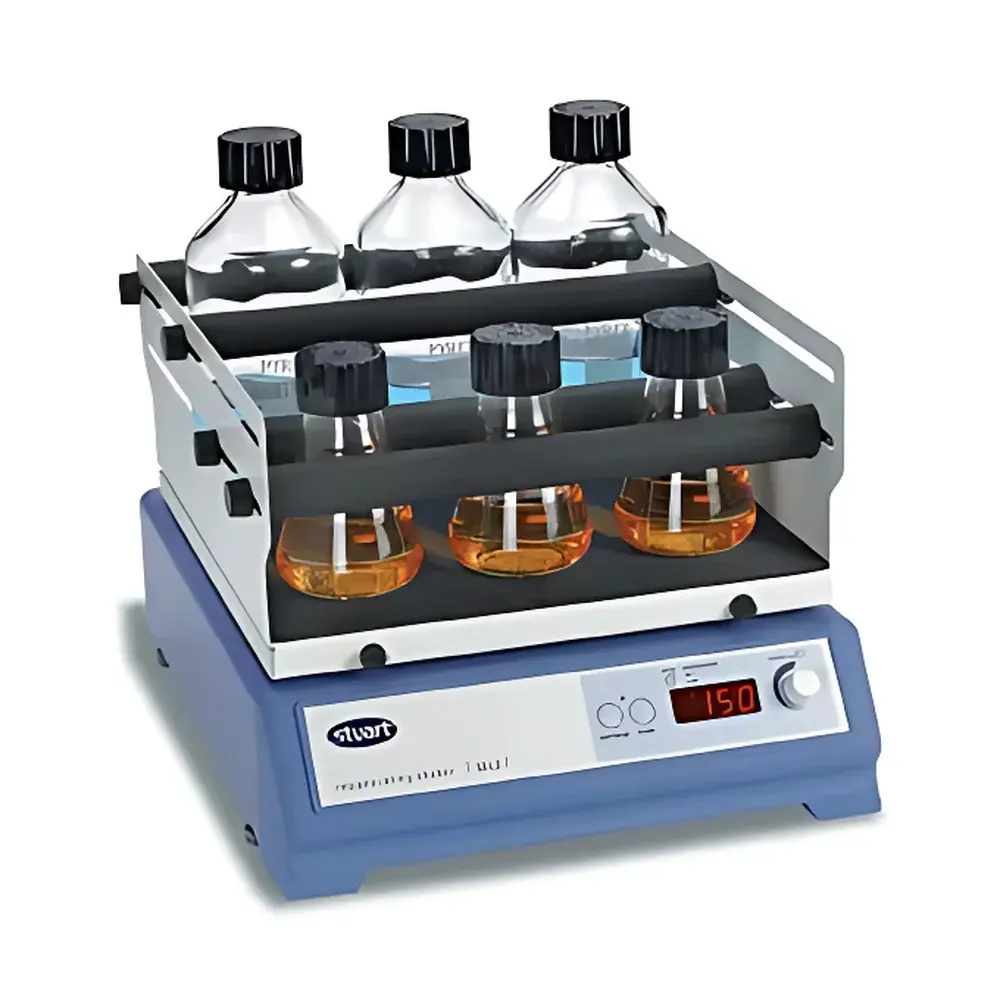
Stuart SSL2 Reciprocating Orbital Shaker
| Brand | Stuart |
|---|---|
| Origin | United Kingdom |
| Model | SSL2 |
| Motion Type | Reciprocating |
| Platform Dimensions (W×L) | 335 × 335 mm |
| Speed Range | 25–250 rpm |
| Stroke Length | 20 mm |
| Max Load Capacity | 10 kg |
| Operating Temperature Range | RT + 4 °C to 40 °C |
| Operating Humidity | ≤80% RH |
| External Dimensions (W×D×H) | 360 × 420 × 270 mm |
| Net Weight | 11 kg |
| Power Supply | 230 V / 50 Hz |
| Timer Function | Yes (built-in) |
| Drive Mechanism | Brushless DC motor with low-vibration cam system |
| Control Interface | Digital LED display with rotary speed dial and push-button timer activation |
Overview
The Stuart SSL2 Reciprocating Orbital Shaker is an engineered laboratory platform designed for high-efficiency liquid-phase extraction, cell suspension, and sample homogenization where linear agitation delivers superior mixing intensity compared to orbital or rotary motion. Unlike conventional orbital shakers that generate circular motion, the SSL2 employs a precisely calibrated reciprocating mechanism—driven by a brushless DC motor and optimized cam linkage—to produce a consistent 20 mm stroke along a straight horizontal axis. This motion profile generates strong shear forces and rapid bulk fluid displacement, making it especially effective for solid–liquid extractions (e.g., soil contaminant leaching, plant metabolite recovery), immunoassay plate washing pre-incubation, and viscous buffer equilibration. Its robust mechanical architecture ensures long-term operational stability under continuous duty cycles, while thermal management enables reliable performance across ambient laboratory environments (RT + 4 °C to 40 °C). The unit complies with IEC 61010-1:2010 safety standards for electrical equipment used in laboratory settings.
Key Features
- Reciprocating motion with fixed 20 mm stroke length—optimized for high-shear mixing and efficient mass transfer in extraction workflows
- Digital speed control (25–250 rpm) via intuitive rotary dial; resolution ±1 rpm with soft-start functionality to prevent splashing and ensure reproducible acceleration profiles
- Integrated digital timer (0–999 min) with auto-shutdown or continuous operation mode selection—supports unattended overnight protocols
- Stainless-steel-reinforced platform (335 × 335 mm) rated for up to 10 kg uniform load; compatible with standard Erlenmeyer flasks (up to 2 L), deep-well microplates, and custom clamping fixtures
- Low-noise, maintenance-free drive system utilizing a precision-machined cam and polymer bushings—meets ISO 4871:2018 acoustic emission limits for laboratory equipment (≤58 dB(A) at 1 m)
- Front-panel LED display with real-time rpm readout and timer countdown; status indicators for power-on, run, and timer-complete states
Sample Compatibility & Compliance
The SSL2 accommodates a wide range of vessel types—including conical flasks (50 mL–2 L), glass jars, multi-well plates (96- and 384-well), and custom-mounted reaction tubes—via its universal platform with adjustable non-slip rubber matting and optional accessory clamps (sold separately). It supports applications requiring adherence to GLP and GMP-aligned workflows: the stable speed regulation (±2% deviation over full load range) and repeatable motion profile enable method transfer between labs. While not inherently 21 CFR Part 11 compliant, its analog/digital hybrid interface allows integration into validated systems when paired with external electronic lab notebook (ELN) or LIMS platforms that enforce audit trail requirements. The device conforms to CE marking directives (EMC Directive 2014/30/EU and Low Voltage Directive 2014/35/EU) and carries UKCA certification for post-Brexit market access.
Software & Data Management
The SSL2 operates as a standalone instrument without proprietary software dependencies. All operational parameters are set and monitored locally via the front-panel interface; no drivers, USB connections, or cloud services are required. For laboratories implementing digital workflow traceability, Stuart provides a documented calibration protocol (available upon request) outlining verification procedures for speed accuracy, stroke consistency, and timer fidelity—supporting internal QA documentation per ISO/IEC 17025:2017 clause 7.7. Optional RS-232 output (via add-on module) enables basic serial logging of runtime and setpoint data to third-party SCADA or LabVIEW environments, though no native data export or remote control capability is embedded.
Applications
- Solid–liquid extraction: Accelerated leaching of heavy metals from environmental samples, alkaloid isolation from botanical matrices, and polymer additive migration studies
- Cell culture maintenance: Gentle yet effective suspension of adherent cell lines during passaging preparation and bioreactor seed train conditioning
- Clinical diagnostics: Pre-analytical mixing of whole-blood samples prior to centrifugation, reagent resuspension in ELISA workflows, and antigen–antibody incubation steps
- Quality control testing: Solubility assessment of pharmaceutical excipients, viscosity screening of topical formulations, and dissolution profile development per USP
- Environmental analysis: Extraction of PAHs and PCBs from sediment cores using EPA Method 3541-compatible protocols
FAQ
What is the difference between reciprocating and orbital motion in shakers?
Reciprocating motion moves the platform back-and-forth along a linear path (20 mm stroke in the SSL2), generating higher peak shear and more aggressive mixing—ideal for extraction. Orbital motion traces a circular path, producing gentler, vortex-like agitation better suited for cell culture.
Can the SSL2 be used inside a temperature-controlled incubator?
No—the SSL2 is rated for ambient operation only (RT + 4 °C to 40 °C) and lacks insulation or condensation protection; it is not designed for enclosed, humidified, or elevated-temperature enclosures.
Is speed calibration traceable to national standards?
Yes—Stuart supplies a factory calibration certificate (NIST-traceable tachometer verification) with each unit; annual recalibration is recommended per ISO/IEC 17025 guidelines.
Does the SSL2 support variable stroke length?
No—stroke is fixed at 20 mm to ensure mechanical reliability and consistent energy input; this design prioritizes repeatability over configurability.
What safety certifications does the SSL2 hold?
CE, UKCA, and IEC 61010-1:2010 compliance are verified; full test reports available under NDA upon request from Stuart Technical Support.