
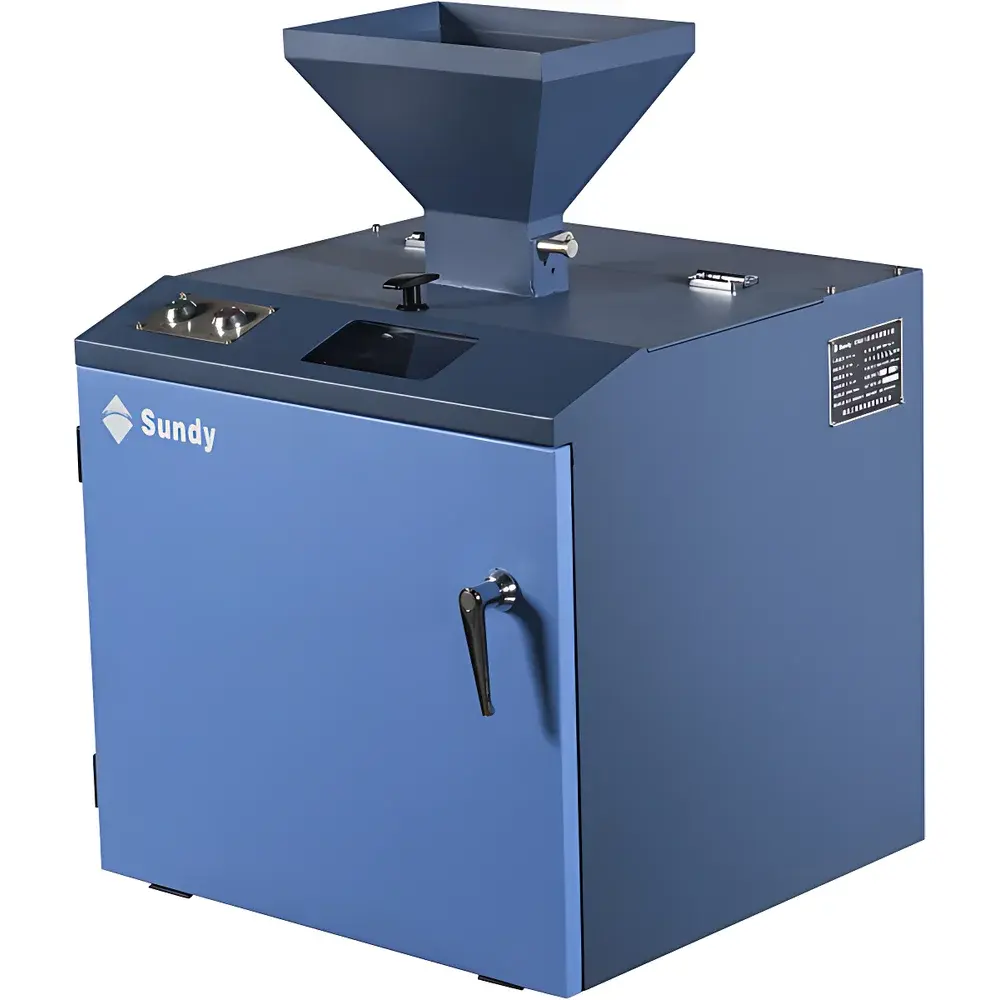
Sundy SDMD16 Automatic Mechanical Sample Divider
| Brand | Sundy |
|---|---|
| Model | SDMD16 |
| Application | Coal & Mineral Sample Reduction |
| Compliance | GB/T 474–2008 |
| Maximum Feed Size | ≤13 mm |
| Moisture Tolerance (Total Moisture) | ≤12% |
| Splitting Ratio | Adjustable from 1:2 to 1:16 |
| Throughput | 300–800 kg/h |
| Dimensions (L×W×H) | 560×525×785 mm |
| Weight | 66 kg |
| Motor Power | 0.18 kW |
| Supply Voltage | AC 380 V ±10%, 50 Hz ±1 Hz |
| Construction | Stainless Steel Body with Sealed Enclosure |
| Dust Extraction Port | Yes |
| Inlet/Outlet Configuration | Full-Cross-Sectional Cutting Chamber |
Overview
The Sundy SDMD16 Automatic Mechanical Sample Divider is an industrial-grade, precision sample reduction system engineered for laboratories in power generation, coal mining, metallurgy, chemical processing, building materials, and geological survey sectors. It operates on the principle of mechanical riffle splitting—utilizing a full-cross-sectional, rotating divider mechanism that ensures statistically representative subsampling of bulk particulate materials such as coal, coke, limestone, and other friable minerals. Designed in strict accordance with GB/T 474–2008 “Methods for the Preparation of Coal Samples”, the SDMD16 guarantees compliance with national standard requirements for mass-based sample division, minimizing bias and preserving sample integrity throughout the preparation workflow. Its robust architecture supports continuous operation in high-throughput laboratory environments while maintaining reproducible mass reduction ratios across variable feed conditions.
Key Features
- Full-cross-sectional cutting chamber: Ensures complete transverse division of the entire material stream at all adjustable splitting ratios (1:2 to 1:16), eliminating preferential flow paths and particle segregation.
- Stainless steel construction: Main structural components—including hopper, splitter chute, and collection bins—are fabricated from corrosion-resistant stainless steel for long-term durability and ease of cleaning.
- Self-locking, uniform-flow discharge hopper: A proprietary flow-regulating design prevents bridging and residual hold-up, delivering consistent material discharge without manual intervention or vibration assistance.
- Open-access configuration: Front door and top cover are hinged for unrestricted access to internal components, facilitating rapid visual inspection, residue removal, and routine maintenance.
- Hermetically sealed enclosure: Minimizes airborne dust emissions during operation, supporting occupational health and safety (OHS) compliance and reducing cross-contamination risks between samples.
- Dust extraction interface: Standardized 100 mm diameter port enables direct connection to centralized or portable dust collection systems, compatible with ISO 13370-compliant exhaust specifications.
Sample Compatibility & Compliance
The SDMD16 accepts dry or moderately moist particulate feed with maximum particle size ≤13 mm and total moisture content ≤12% (w/w). It is validated for use with bituminous coal, anthracite, lignite, pulverized fuel, slag, bauxite, and silicate-based ores. All operational parameters—including split ratio accuracy, mass recovery rate, and repeatability—meet the statistical sampling criteria defined in GB/T 474–2008. While not certified to ASTM D2013 or ISO 13909, its mechanical design principles align with internationally recognized riffle-splitting methodologies. The unit is suitable for GLP-aligned laboratories where documented traceability, operator training records, and equipment logbooks are maintained per internal quality protocols.
Software & Data Management
The SDMD16 is a fully electromechanical, non-digital device with no embedded microprocessor or onboard data logging capability. All operational settings—including splitting ratio selection and start/stop control—are executed via manually actuated rotary switches and push-button interfaces. No software installation, firmware updates, or network connectivity is required. For laboratories implementing electronic recordkeeping under FDA 21 CFR Part 11 or ISO/IEC 17025, users must document split ratio selection, batch ID, operator name, date/time, and post-split mass measurements externally using LIMS or paper-based worksheets. Calibration verification is performed annually using certified reference masses and volumetric checks per internal SOPs.
Applications
- Routine coal sample subdivision prior to proximate analysis (moisture, ash, volatile matter, fixed carbon), ultimate analysis (C/H/N/S/O), and calorific value determination.
- Preparation of homogenized sub-samples for X-ray fluorescence (XRF) spectroscopy, ICP-OES, and acid digestion workflows.
- Reduction of composite geological core samples or bulk ore shipments into analytical aliquots meeting ISO 18222 and ASTM D7508 requirements.
- Quality control preprocessing in cement raw meal blending lines and ferroalloy production facilities.
- Supporting interlaboratory comparison studies where consistent, auditable sample division is essential for result comparability.
FAQ
What standards does the SDMD16 comply with?
It is designed and verified to meet the mechanical and procedural requirements of GB/T 474–2008 for coal sample preparation.
Can the SDMD16 handle wet or sticky coal?
No—it is rated only for materials with total moisture ≤12%. Higher moisture levels may cause adhesion, blockage, or inaccurate splitting due to reduced flowability.
Is the splitting ratio calibrated or certified?
The ratio is mechanically fixed by the number and geometry of splitter chutes; no recalibration is required during normal use. Users should verify mass balance (input vs. output + discard) periodically.
Does the unit require compressed air or external utilities beyond electrical supply?
Only AC 380 V ±10%, 50 Hz ±1 Hz power is needed. Dust extraction requires separate vacuum source.
What maintenance intervals are recommended?
Daily visual inspection of splitter vanes and hopper interior; monthly lubrication of drive shaft bearings; annual verification of motor insulation resistance and mechanical alignment.



